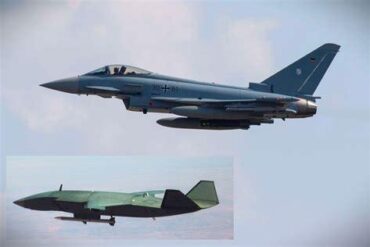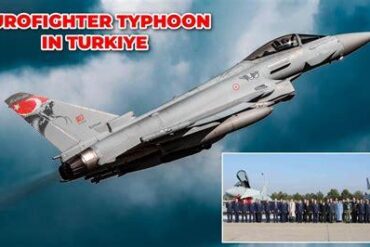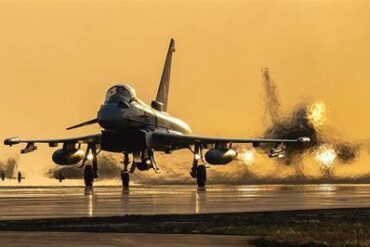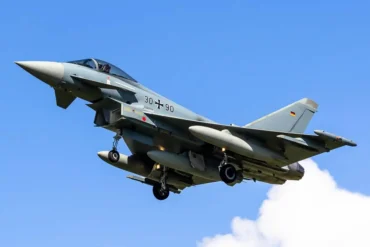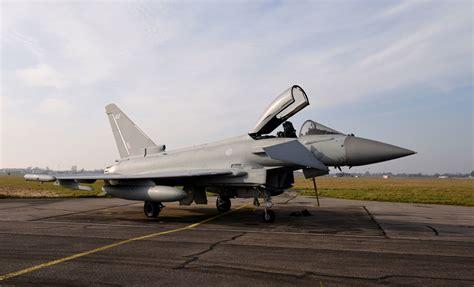
The Royal Air Force (RAF) has long stood at the forefront of military aviation, shaping the evolution of air combat since the early twentieth century. From the legendary Supermarine Spitfire of World War II to the cutting-edge stealth fighters of the modern era, the RAF’s fleet reflects both technological progress and strategic necessity. In today’s increasingly complex aerial battlefield, one aircraft stands clearly at the center of Britain’s airpower: the Eurofighter Typhoon.
Although the stealthy Lockheed Martin F-35 Lightning II represents the latest generation of combat aviation, the Typhoon continues to dominate the RAF inventory in terms of operational presence, pilot preference, and mission versatility. In 2026, between 110 and 140 Typhoon FGR4 airframes remain in active service, making the aircraft the backbone of Britain’s fighter fleet.
Its enduring popularity comes from a powerful combination of factors—speed, maneuverability, payload capacity, advanced avionics, and national industrial pride. While stealth fighters increasingly lead the future of warfare, the Typhoon still delivers the raw performance and operational flexibility that air forces rely on every day.
By understanding the aircraft’s capabilities, mission roles, and technological evolution, it becomes clear why the Eurofighter Typhoon remains the most popular fighter jet in the Royal Air Force.
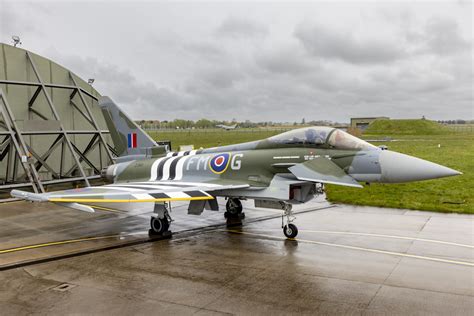
The Eurofighter Typhoon: Backbone of the Modern RAF
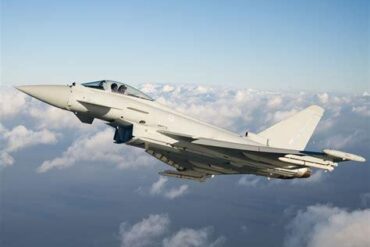
The Eurofighter Typhoon is a fourth-generation multirole fighter developed through a European partnership involving the United Kingdom, Germany, Italy, and Spain. Designed initially during the Cold War as a high-performance air superiority aircraft, it has evolved into one of the world’s most capable swing-role combat jets, able to conduct both air-to-air and air-to-ground missions with remarkable effectiveness.
When the RAF introduced the Typhoon into operational service in the early 2000s, the aircraft was primarily intended to replace the Panavia Tornado F3 interceptor. Its first mission profile focused on Quick Reaction Alert (QRA) duties—scrambling at a moment’s notice to intercept unidentified aircraft approaching British airspace.
Over time, however, upgrades transformed the Typhoon from a pure interceptor into a highly capable multirole strike platform. Modern RAF Typhoons now carry advanced weapons such as:
- Meteor beyond-visual-range air-to-air missiles
- Brimstone precision strike missiles
- Storm Shadow long-range cruise missiles
- SPEAR Cap 3 network-enabled weapons
This flexibility allows the aircraft to perform air superiority, deep strike, close air support, and electronic warfare missions without requiring entirely separate aircraft types. The result is a fighter jet that remains central to the RAF’s tactical doctrine.
The “Thug” of the RAF Fighter Fleet
Within modern air combat strategy, the RAF increasingly operates a high-low mix of aircraft generations. The F-35 Lightning II serves as the stealthy forward scout—penetrating sophisticated enemy air defenses and gathering intelligence. The Typhoon, by contrast, plays a more aggressive and heavily armed role behind it.
This doctrine has earned the Typhoon a colorful nickname among military analysts: “The Thug.”
The name reflects its role as a missile truck, capable of carrying large numbers of powerful weapons into contested airspace. With up to 13 external hardpoints, the aircraft can carry far more missiles and bombs than stealth fighters whose payload must fit inside internal weapon bays.
That heavy payload allows the Typhoon to act as a force multiplier. Once stealth aircraft identify enemy targets, Typhoons can launch long-range missiles from safer distances, dramatically increasing the overall combat power of the formation.
This approach mirrors developments within the United States Air Force, where aircraft like the F-15EX Eagle II serve a similar supporting role alongside stealth fighters.
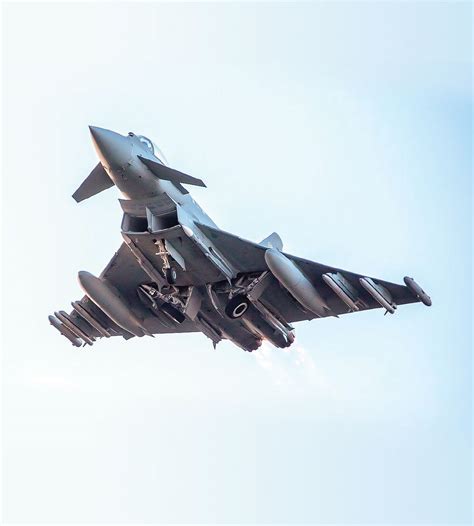
Raw Performance: Speed, Power, and Agility
The popularity of the Typhoon among RAF pilots is not just about mission flexibility—it is also about the thrilling performance of the aircraft itself.
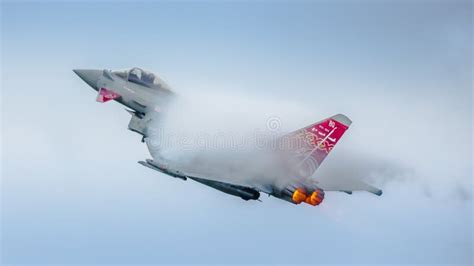
The fighter’s canard-delta wing design produces extraordinary aerodynamic efficiency. Combined with two Eurojet EJ200 turbofan engines, the aircraft achieves a top speed exceeding Mach 2 and possesses the ability to supercruise, meaning it can fly at supersonic speeds without using fuel-hungry afterburners.
This capability provides several major advantages:
- Greater fuel efficiency during high-speed flight
- Longer operational range
- Reduced infrared signature compared with afterburner use
The Typhoon also boasts a remarkable thrust-to-weight ratio, allowing it to accelerate, climb, and maneuver with exceptional responsiveness. In dogfight scenarios, these attributes can determine survival.
RAF pilots often describe flying the aircraft as an unforgettable experience, a phenomenon known informally as the “Typhoon Grin.” When pilots push the aircraft to the edge of its performance envelope—rapid climbs, tight turns, high-G maneuvers—the sheer power of the jet often leaves them smiling inside the cockpit.
The “Flying Supercomputer”: Advanced Avionics and Flight Control
Beneath its sleek aerodynamic shape lies a machine of immense technological complexity. The Typhoon is inherently aerodynamically unstable, meaning it cannot remain stable in flight without continuous computer assistance.
This design choice might sound dangerous, but it actually provides a critical advantage. By allowing the aircraft to remain unstable, engineers made it far more maneuverable and responsive than traditional fighters.
Advanced digital fly-by-wire systems constantly adjust the aircraft’s control surfaces hundreds of times per second, keeping the jet stable while maximizing agility. The same concept exists in aircraft like the Northrop Grumman B-2 Spirit stealth bomber, which also relies heavily on computerized flight control.
The Typhoon’s avionics suite integrates sensors, navigation systems, electronic warfare tools, and weapons management into a highly sophisticated digital architecture. Pilots receive enormous amounts of information through advanced cockpit displays and helmet-mounted targeting systems, allowing them to engage targets rapidly and efficiently.
In effect, the Typhoon operates less like a traditional aircraft and more like a networked combat computer with wings.
High Altitude Advantage in Air Combat
One often overlooked strength of the Typhoon is its ability to operate at extremely high altitudes. The aircraft can reach service ceilings approaching 65,000 feet, significantly higher than many other modern fighters.
Altitude provides a powerful tactical advantage. In air combat physics, the aircraft with the higher energy state—a combination of speed and altitude—typically holds the upper hand. From greater heights, a fighter can convert gravitational potential energy into speed during combat maneuvers.
For missile engagements, altitude also increases the effective range of air-to-air weapons. Missiles launched from higher altitudes travel farther and maintain greater energy when intercepting their targets.
This advantage becomes particularly important when combined with the Meteor missile, one of the most advanced beyond-visual-range weapons in the world.
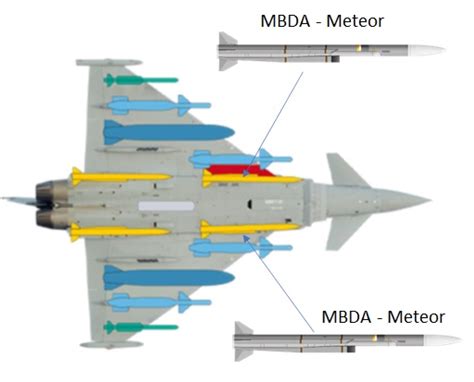
Meteor Missiles and Long-Range Air Dominance
The Meteor missile is a defining component of the Typhoon’s combat capability. Unlike traditional missiles powered by solid rocket motors, Meteor uses a ramjet propulsion system, allowing it to maintain thrust throughout much of its flight.
This design dramatically increases the missile’s no-escape zone—the region where a targeted aircraft cannot evade interception.
When launched from a high-speed Typhoon flying at altitude, the Meteor becomes a formidable weapon. The aircraft’s speed and altitude effectively extend the missile’s engagement range, allowing RAF pilots to threaten adversaries at extreme distances.
Combined with advanced radar tracking and datalink updates, the Typhoon can guide these missiles toward targets well beyond visual range. This capability reinforces the aircraft’s reputation as one of the most capable air superiority fighters in Europe.
ECRS Mk2 Radar: Transforming the Typhoon’s Capabilities
A major technological leap for the RAF’s Typhoon fleet comes from the European Common Radar System Mk2 (ECRS Mk2), a cutting-edge active electronically scanned array (AESA) radar.
Traditional radars rely on mechanically moving antennas to scan the sky. AESA radars operate differently. They consist of thousands of tiny transmit/receive modules that electronically steer radar beams at near-instantaneous speeds.
The ECRS Mk2 contains more than 1,000 modules, allowing it to track numerous airborne and ground targets simultaneously while maintaining exceptional detection range and precision.
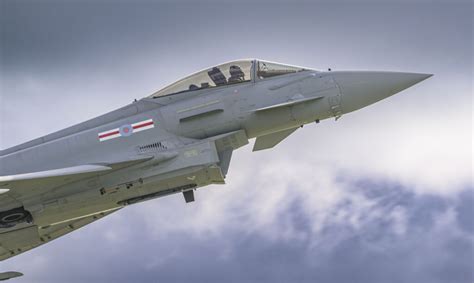
This radar introduces several powerful capabilities:
- Simultaneous target tracking and electronic warfare
- Passive detection of enemy emissions
- High-power electronic attack against radar systems
- Enhanced targeting data for long-range missiles
Unlike earlier radars that only detected targets, the ECRS Mk2 can actively jam enemy sensors, disrupt communications, and support suppression of enemy air defenses.
In practical terms, the Typhoon becomes both a sensor platform and an electronic warfare asset, expanding its influence across the entire electromagnetic spectrum.
Strike Power and Electronic Warfare
Stealth fighters like the F-35 focus on avoiding detection. The Typhoon takes a different approach: dominating the electromagnetic environment through sheer capability.
Using the ECRS Mk2 radar and advanced electronic warfare systems, the aircraft can blind enemy radars and missile batteries while simultaneously delivering precision strikes.
This capability is especially important for SEAD and DEAD missions—suppression and destruction of enemy air defenses. In such operations, Typhoons may carry weapons such as:
- Brimstone precision attack missiles
- Storm Shadow long-range cruise missiles
- SPEAR network-enabled smart weapons
During these missions, the aircraft can flood hostile radar systems with electronic interference while launching precision weapons from safe distances.
The combination of electronic attack and heavy payload capacity transforms the Typhoon into an extraordinarily potent strike platform.
Rapid Interceptor for Homeland Defense
Another reason the Typhoon remains central to RAF operations is its unmatched ability to perform airspace interception missions.
Quick Reaction Alert aircraft must reach potential threats as fast as possible. Speed and climb rate are critical. A stealth fighter optimized for covert penetration does not always excel in this role.
The Typhoon’s powerful engines and exceptional climb performance allow it to scramble quickly and intercept aircraft approaching UK airspace.
These missions occur regularly, particularly when Russian long-range bombers approach NATO airspace during patrol flights. RAF Typhoons routinely launch to identify and escort these aircraft away from British territory.
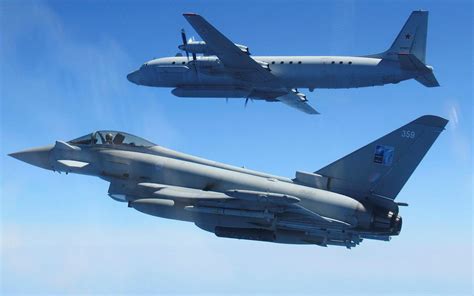
Such missions demonstrate the aircraft’s reliability as a guardian of national airspace, reinforcing its popularity both within the RAF and among the public.
National Pride and Industrial Independence
Technology and performance explain much of the Typhoon’s success, but politics and national pride also play a significant role.
Unlike the American-built F-35, the Eurofighter Typhoon represents a European aerospace achievement. The aircraft is the product of cooperation between several European nations and supports thousands of skilled engineering and manufacturing jobs.
In the United Kingdom, companies such as BAE Systems have played a crucial role in the aircraft’s development and production.
For many observers, the Typhoon symbolizes sovereign defense capability—an aircraft built by European engineers for European air forces.
Concerns occasionally arise about the strategic dependence associated with foreign-built weapons systems. Some analysts speculate about the possibility of software restrictions or external controls embedded within complex modern platforms.
Whether or not such fears are justified, the Typhoon’s European origins contribute to its strong public support.
The Future: From Typhoon to Tempest
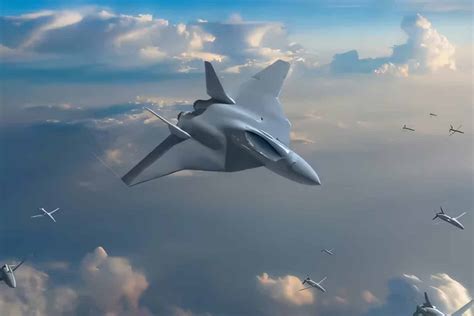
Despite its popularity, the Typhoon will not remain the RAF’s primary fighter forever. The United Kingdom and its partners are already developing a sixth-generation aircraft known as Tempest, part of the Global Combat Air Programme (GCAP).
Tempest aims to introduce revolutionary technologies, including:
- Artificial intelligence assisted combat systems
- Optionally piloted aircraft
- Advanced sensor fusion
- Next-generation stealth and networking
However, the program is still years away from operational deployment. Until then, the Typhoon will continue to carry the bulk of the RAF’s tactical airpower responsibilities.
Even after Tempest enters service, the Typhoon will likely remain active for years as a high-performance complement to newer systems.
Why the Typhoon Remains the RAF’s Most Popular Fighter
Several powerful reasons explain why the Eurofighter Typhoon continues to dominate the Royal Air Force fleet:
- Large operational fleet size compared with other fighters
- Exceptional speed, altitude, and maneuverability
- Heavy payload capacity for missiles and bombs
- Advanced avionics and AESA radar systems
- Proven reliability in air defense and strike missions
- Strong national industrial and political support
Together, these qualities make the Typhoon far more than a transitional aircraft between generations. It remains one of the most formidable fighters ever fielded by a European air force.
Conclusion: The RAF’s Relentless Air Combat Workhorse
Modern warfare increasingly emphasizes stealth, networking, and data dominance. The F-35 Lightning II represents the cutting edge of that technological revolution. Yet technology alone does not define an air force’s operational strength.
The Eurofighter Typhoon provides the RAF with something equally valuable: raw performance, overwhelming firepower, and mission flexibility. It climbs faster, flies higher, and carries more weapons than many contemporary fighters, making it indispensable in a wide variety of combat scenarios.
For RAF pilots, it remains one of the most exhilarating aircraft ever built—a machine capable of breathtaking speed and astonishing agility. For military planners, it offers a dependable platform that integrates seamlessly with modern network-centric warfare.
For the United Kingdom itself, the Typhoon represents a symbol of engineering excellence and strategic independence.
Even as stealth aircraft and future sixth-generation fighters begin to reshape the battlefield, the Eurofighter Typhoon continues to stand proudly as the most popular fighter jet in the Royal Air Force, embodying the enduring power of performance, innovation, and national aviation heritage.