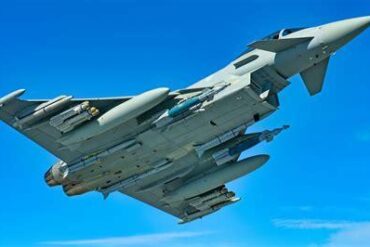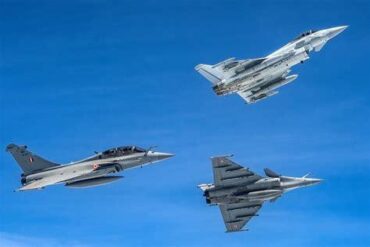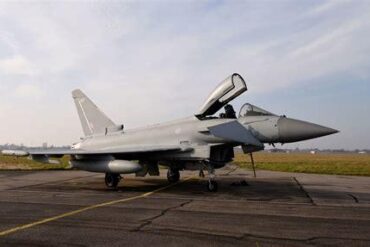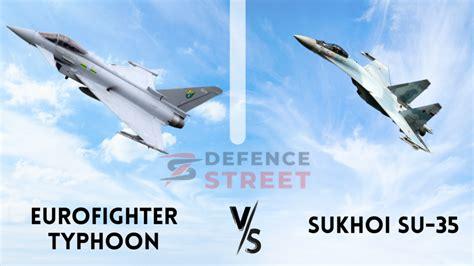
The modern battlefield is entering a new era where stealth fighters, artificial intelligence, advanced sensors, and networked warfare are reshaping the future of aerial combat. Yet even as fifth-generation aircraft such as the F-35 Lightning II and emerging sixth-generation programs dominate headlines, two highly capable fourth-generation-plus fighters continue to represent the peak of conventional fighter technology: the Eurofighter Typhoon and the Sukhoi Su-35S Flanker-E.
Both aircraft were designed around the same fundamental objective: achieving and maintaining air superiority. However, the philosophies behind their development could hardly be more different. The Eurofighter Typhoon represents a European approach centered on agility, sensor integration, coalition warfare, and precision-guided weapons. The Sukhoi Su-35 reflects Russia’s long-standing emphasis on range, raw power, heavy weapons capacity, and extreme maneuverability.
By 2026, the question of whether the Eurofighter Typhoon or Sukhoi Su-35 is the superior fighter jet remains one of the most debated topics among aviation analysts. Neither aircraft can be judged by specifications alone. Modern air combat depends on a complex combination of radar performance, electronic warfare, missile technology, pilot training, tactical doctrine, and the wider military network supporting the aircraft.
Two Elite Fighter Jets Designed For Air Superiority
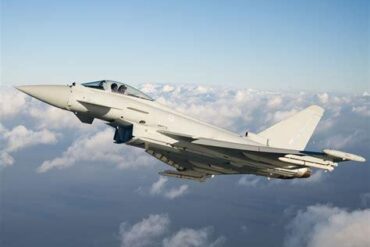
The Eurofighter Typhoon and Sukhoi Su-35S Flanker-E occupy the highest level of non-stealth fighter aircraft currently operating around the world. Both are often classified as 4.5-generation fighters, meaning they combine traditional aerodynamic advantages with many technologies associated with newer aircraft generations.
The Eurofighter Typhoon originated from a multinational European defense program involving the United Kingdom, Germany, Italy, and Spain. The project began during the 1980s with the goal of creating a lightweight, highly agile fighter capable of defending European airspace against advanced Soviet aircraft. After decades of development and upgrades, the Typhoon has become one of NATO’s most important combat aircraft.
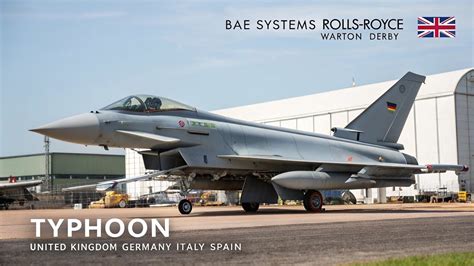
As of 2026, more than 600 Eurofighter Typhoons have been produced. The aircraft serves with multiple European air forces and has also been exported to countries including Saudi Arabia, Qatar, Kuwait, and Austria. Continuous modernization programs have transformed the original air-superiority fighter into a sophisticated multirole platform capable of air defense, ground attack, maritime strike, and electronic warfare missions.
The latest Typhoon variants feature improvements such as the Captor-E AESA radar, enhanced electronic warfare systems, improved mission computers, and compatibility with advanced weapons including the MBDA Meteor beyond-visual-range missile.
The Sukhoi Su-35S, meanwhile, represents the final evolution of Russia’s famous Flanker family. Developed from the Su-27 design lineage, the Su-35 incorporates decades of aerodynamic refinement and technological upgrades. It entered Russian Aerospace Forces service in 2014 as Russia’s most advanced operational non-stealth fighter.
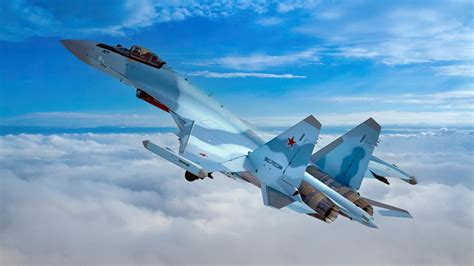
Unlike the smaller and lighter Typhoon, the Su-35 follows the Russian philosophy of creating a powerful long-range fighter capable of carrying heavy weapons while operating across enormous geographic areas. Approximately 100 to 120 Su-35 aircraft have been produced, with Russia remaining the primary operator alongside export customers such as China and Algeria.
The aircraft combines powerful Saturn AL-41F1S engines, thrust-vectoring capability, a large radar system, and a massive weapons payload. These features allow the Su-35 to perform air superiority missions, long-range interception, escort operations, and strike support.
Although both fighters belong to the same broad category, their designs reveal different strategic priorities. The Typhoon emphasizes speed, agility, and integration into a large military network. The Su-35 focuses on independence, endurance, and overwhelming individual aircraft capability.
Performance And Aerodynamic Comparison: Speed, Agility, And Range
At a basic specification level, the Sukhoi Su-35 appears to hold several advantages. It is significantly larger, heavier, and equipped with more powerful engines than the Eurofighter Typhoon. However, aircraft performance is not determined only by size and thrust.
The Su-35 is powered by two Saturn AL-41F1S turbofan engines, each producing approximately 31,900 pounds of thrust with afterburner. Combined, these engines provide enormous acceleration and allow the fighter to reach speeds around Mach 2.25.
The aircraft’s defining aerodynamic feature is its three-dimensional thrust-vectoring system. By directing engine exhaust in different directions, the Su-35 can perform extreme maneuvers that would be impossible for conventional fighters. These include high-angle-of-attack maneuvers and famous demonstrations such as the Pugachev’s Cobra.
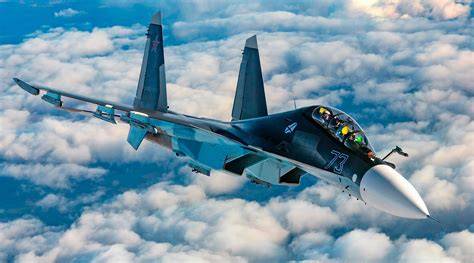
The Eurofighter Typhoon takes a different approach. Instead of relying on thrust-vectoring engines, it achieves exceptional agility through its delta wing and canard configuration, combined with advanced digital flight controls.
The aircraft is powered by two Eurojet EJ200 engines, each generating around 20,000 pounds of afterburner thrust. While this is considerably less than the Su-35’s engine output, the Typhoon’s lighter structure gives it an outstanding thrust-to-weight ratio.
This design allows the Typhoon to accelerate rapidly, climb quickly, and maintain energy during high-speed maneuvering. NATO pilots frequently highlight the aircraft’s ability to sustain performance during demanding aerial engagements.
The basic performance comparison shows the different design priorities:
| Specification | Eurofighter Typhoon | Sukhoi Su-35 |
|---|---|---|
| Length | 52 feet (15.96 meters) | 71.9 feet (21.9 meters) |
| Maximum Speed | Mach 2.0 | Mach 2.25 |
| Combat Radius | Approximately 863 miles | Approximately 932 miles |
| Service Ceiling | 55,000 feet | 59,000 feet |
| Maximum Takeoff Weight | Around 51,800 pounds | Around 76,100 pounds |
| Weapons Payload | Around 16,500 pounds | Around 17,600 pounds |
The Su-35 clearly benefits from greater range and payload capacity. Its larger airframe allows more fuel storage and heavier weapons loads. This gives the Russian fighter advantages during long-range patrol missions and interception scenarios.
However, the Typhoon’s smaller size provides advantages in acceleration and maneuver efficiency. In modern air combat, where engagements increasingly occur beyond visual range, the ability to rapidly change position and maintain energy can be just as important as raw power.
The close-range dogfight advantage is therefore difficult to determine. The Su-35’s thrust-vectoring engines provide extraordinary nose-pointing capability, while the Typhoon’s aerodynamic design offers excellent sustained maneuverability.
In a traditional turning battle, both aircraft would be extremely dangerous opponents. However, modern fighter combat rarely resembles the close-range engagements of previous decades. Today, the aircraft that detects, identifies, and attacks first usually holds the greatest advantage.
Radar Systems And Situational Awareness: Captor-E Versus Irbis-E
Modern air combat is increasingly decided before pilots ever see each other. The ability to detect enemy aircraft, process information, resist electronic attacks, and share targeting data has become just as important as speed or maneuverability.
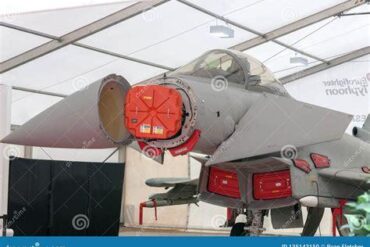
The Eurofighter Typhoon’s greatest technological improvement in recent years has been the introduction of the Captor-E AESA radar.
Unlike older mechanically scanned radar systems, an active electronically scanned array radar uses hundreds of individual transmit and receive modules. This allows the radar beam to move instantly without physically rotating the antenna.
The result is improved target tracking, greater resistance to electronic interference, and the ability to monitor multiple targets simultaneously.
The Captor-E radar is estimated to detect fighter-sized targets at distances exceeding 100 miles under favorable conditions. More importantly, the system works together with the Typhoon’s broader electronic warfare architecture and NATO information-sharing networks.
The aircraft’s PIRATE infrared search and track system provides another major advantage. Because it detects heat emissions rather than radar reflections, it allows pilots to track targets without revealing their own position through radar emissions.
The Typhoon’s connection to NATO Link 16 data networks significantly expands its battlefield awareness. A pilot does not rely only on the aircraft’s own sensors but can receive information from AWACS aircraft, ground radar stations, naval systems, and allied fighters.
The Su-35 uses a different philosophy centered around the powerful N035 Irbis-E PESA radar.
The Irbis-E is one of the most powerful fighter radars ever developed. Its large antenna and high power output allow it to detect large targets at very long distances, with Russian sources claiming detection ranges approaching 350–400 kilometers against large aircraft.
For long-range interception missions, this capability gives the Su-35 a significant theoretical advantage. The fighter can carry long-range missiles and search large areas of airspace.
However, the radar technology differs from modern AESA systems. While the Irbis-E offers impressive raw power, AESA radars generally provide advantages in electronic warfare resistance, reliability, and simultaneous tracking capability.
The Su-35 also carries the OLS-35 infrared search and track system, allowing passive target detection. Its electronic warfare capability comes from the Khibiny-M system, designed to disrupt enemy radar and missile guidance.
Ultimately, the radar contest between the Typhoon and Su-35 is not simply about which radar detects farther. It is about how effectively each aircraft converts information into battlefield advantage.