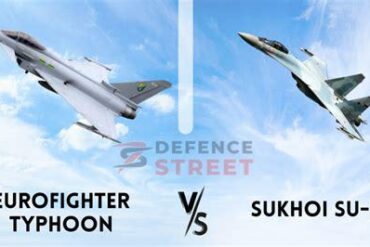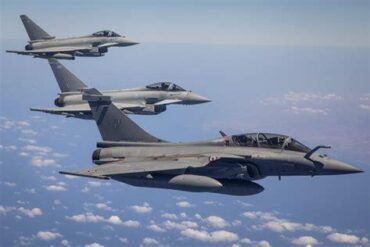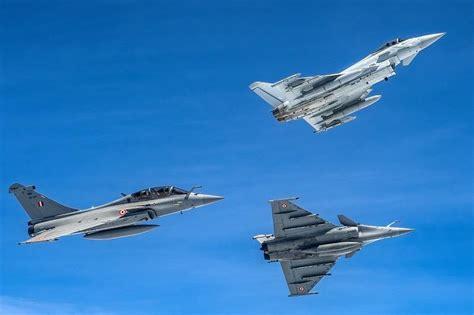
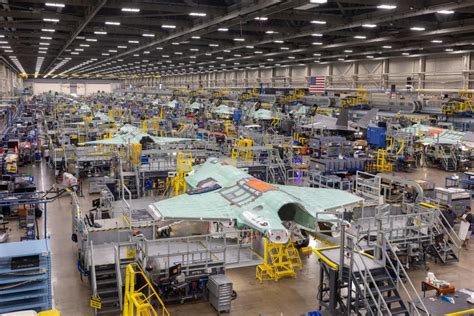
In 2025, Lockheed Martin achieved a production milestone that has reshaped the landscape of global military aviation. By delivering 191 F-35 Lightning II stealth fighters in a single calendar year, Lockheed not only smashed its own record of 142 units but also eclipsed the combined outputs of all major rival platforms — the Rafale, Eurofighter Typhoon, Sukhoi Su-35, and Gripen.
F-35 Production Outpaces Global Competitors by a Staggering Margin
Producing one F-35 every two days, Lockheed Martin reached a tempo that underscored both industrial might and strategic coordination. This pace was five times faster than any other allied fighter aircraft program in production, reflecting deep supply chain integration, international collaboration, and relentless demand.
To illustrate the scale:
- Dassault Aviation delivered just 26 Rafales, barely exceeding its modest target.
- Russia’s United Aircraft Corporation (UAC) shipped approximately 14–21 Su-35s, lacking transparency in exact numbers.
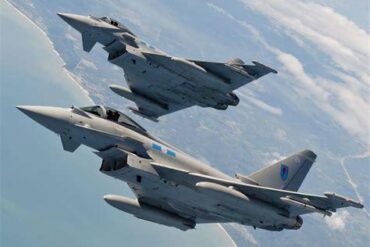
- The Eurofighter Typhoon saw only 12 deliveries, while Sweden’s Gripen managed 17.
Combined, these outputs still fall significantly short of the F-35’s 191. This isn’t simply a production story — it’s an avalanche of airpower dominance.
The Backbone of the Western Air Dominance Strategy
The F-35 Joint Strike Fighter (JSF) program is the product of an unprecedented multi-national development framework involving eight core countries. As a result, nearly 30% to 42% of every F-35 is manufactured overseas before final assembly at Lockheed’s Fort Worth facility.
This globalized production model allows Lockheed Martin to fulfill vast international demand. To date, over 1,300 F-35s have been delivered, with total commitments exceeding 3,000 aircraft across 20 nations.
Beyond production, 2025 was marked by another achievement: the F-35 fleet surpassed one million flight hours, underlining not just quantity but maturity, reliability, and operational readiness.
Combat-Proven in High-Stakes Global Operations
2025 was also the year the F-35 proved its lethality in real-world combat. During the intense 12-day Iran-Israel War, Israeli F-35I Adirs carried out deep-penetration strikes against heavily defended Iranian positions. Despite constant exposure to advanced air defenses, no Israeli F-35 was lost.
The F-35’s value as a force multiplier was evident during Operation Midnight Hammer and Operation Rising Lion, where it played a central role in air defense suppression and pre-strike sanitization for B-2 stealth bombers. These joint-force missions highlighted the aircraft’s capacity to dominate contested airspace with surgical precision.
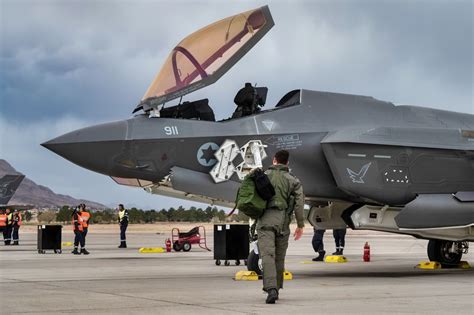
In Europe, F-35s also made headlines by neutralizing Russian drones over Poland, marking a historic first: NATO’s use of F-35s in real-world airspace defense of allied territory.
The Technological Edge: TR-3 & Software Dominance
One of the less publicized yet critically significant aspects of the F-35’s success is its software evolution. In 2025, Lockheed Martin completed the rollout of Technology Refresh 3 (TR-3) — the most advanced software upgrade to date. TR-3 provides enhanced data fusion, electronic warfare capabilities, and AI-driven target identification, reinforcing the F-35’s information dominance in the battlespace.
Safety, Precision & Endurance in the Skies
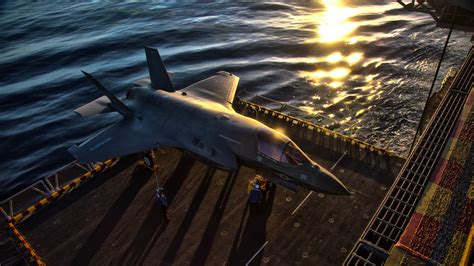
Flight safety metrics in 2025 further cemented the F-35’s credibility. A U.S. Marine Corps F-35B deployment recorded nearly 5,000 mishap-free flight hours, underscoring a mature airframe, robust maintenance regime, and superior training protocols. These results place the F-35 among the safest combat aircraft currently deployed.
Global Demand & Massive Order Backlogs Fuel the Surge
Even with record-setting deliveries, Lockheed Martin entered 2026 with a backlog of 416 aircraft. This backlog, which included 265 jets at the end of Q3 2025 and 151 additional orders in Q4, signals unstoppable global demand.
Countries around the world expanded their procurement plans:
- Italy increased its order by 25 aircraft.
- Denmark added 16 jets to its program.
- Saudi Arabia and Turkey, long eyeing the F-35, gained renewed momentum as President Trump signaled openness to sales.
- India also surfaced in discussions, though official interest has remained cautious.
This demand tsunami ensures that Lockheed Martin’s production lines will remain at full throttle well into the next decade.
The F-35 vs. Fifth-Gen Rivals: A Numbers & Capability Gap
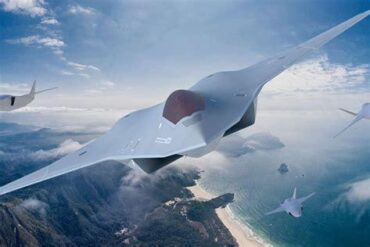
As of late 2025, there are more operational F-35s in service globally than all other fifth-generation fighters combined — including the F-22 Raptor, Su-57 Felon, Chengdu J-20, and Shenyang J-35.
While rivals struggle with technical setbacks, logistics constraints, and limited international sales, the F-35 is becoming the de facto air dominance fighter for NATO and allied nations.
Lockheed Martin’s Expanding Defense Ecosystem: The PAC-3 MSE
The F-35 is just the crown jewel in Lockheed Martin’s growing defense dominance. In January 2026, the company signed a seven-year framework agreement with the U.S. Department of War to triple production of PAC-3 MSE interceptors — the advanced variant of the Patriot missile system.
The goal: Scale up from 600 missiles annually to over 2,000, supporting 17 international partners including Japan, Poland, Saudi Arabia, and Ukraine. In 2025 alone, Lockheed delivered 620 PAC-3 MSEs, building upon 500 delivered in 2024 and 380 in 2023.
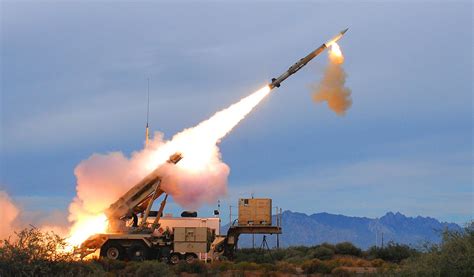
This move aligns with U.S. military priorities to replenish strategic stockpiles and prepare for simultaneous conflicts, especially as geopolitical instability rises across Europe and the Indo-Pacific.
Trump’s Pressure on Defense Contractors: Accelerate or Be Penalized
President Donald Trump, who remains a dominant voice in U.S. defense policy, lambasted defense firms for slow production. On January 8, 2026, Trump issued a fiery statement demanding:
“Defense Companies are not producing our Great Military Equipment rapidly enough… From this moment forward, these Executives must build NEW and MODERN Production Plants. Until they do so, no Executive should be allowed to make in excess of $5 Million Dollars.”
He went on to ban dividends and stock buybacks for defense firms until production inefficiencies are addressed. Raytheon Technologies came under specific fire for being “the least responsive.”
Lockheed Martin, however, stands as the exception — meeting targets, expanding infrastructure, and building trust with military partners globally.
Conclusion: A New Era of Aerial Supremacy
The year 2025 will be remembered as the year the F-35 Lightning II program soared to unparalleled heights. With unmatched production output, combat validation, software superiority, and unrelenting global demand, the F-35 has not just set a new standard — it has rendered its competitors obsolete.
As Lockheed Martin continues to ramp up capacity and integrate next-gen technologies, the F-35 remains the cornerstone of global security, a symbol of strategic deterrence, and the aircraft most likely to dominate 21st-century skies.