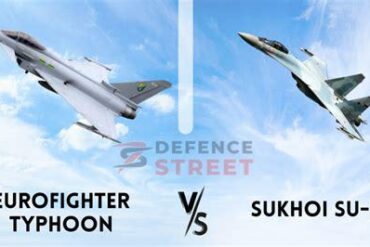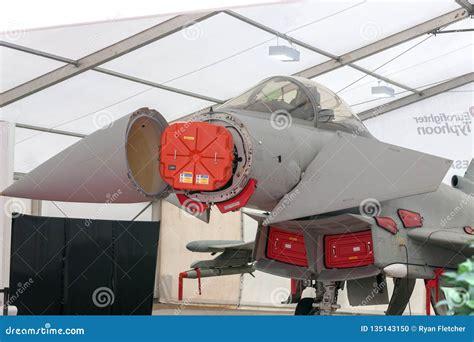
The modern battlefield is no longer defined purely by speed, altitude, or payload. Instead, it is shaped by who controls the electromagnetic spectrum first—who sees, who tracks, and ultimately, who shoots first. Within this invisible war, the Eurofighter Typhoon’s CAPTOR-E AESA radar and the F-35 Lightning II’s AN/APG-81 stand as two of the most sophisticated sensor systems ever deployed on combat aircraft.
Yet comparing them isn’t as simple as stacking specifications. These radars are not just pieces of hardware—they are the embodiment of two fundamentally different philosophies of air warfare. One emphasizes raw power and flexibility, the other stealth and systemic integration. Understanding how they diverge reveals far more than performance metrics; it exposes the future trajectory of aerial combat itself.
Two AESA Radars, Two Opposing Design Philosophies
At a glance, both systems belong to the same technological family: Active Electronically Scanned Array (AESA) radars. This means they use hundreds—or thousands—of transmit/receive modules to steer beams electronically rather than mechanically, enabling rapid scanning, multitasking, and resilience against jamming.
But similarity ends there.
The AN/APG-81, developed by Northrop Grumman, was engineered specifically for the F-35 program as part of a fully integrated sensor fusion ecosystem. From day one, it was designed not to operate independently, but to act as a single node within a larger intelligence network that includes infrared sensors, electronic warfare suites, and data links. Its purpose is not just detection—it is information dominance.
By contrast, the CAPTOR-E, developed by the Euroradar consortium, reflects the Typhoon’s lineage as an air superiority fighter built for performance-first engagements. Without the constraints of a stealth airframe, engineers prioritized maximum antenna size, power output, and scanning flexibility.
This divergence leads to a crucial truth:
The F-35’s radar is part of a system-of-systems, while the Typhoon’s radar is designed to be a standalone powerhouse.
Hardware Architecture and Signal Power: Where Design Shapes Capability
The AN/APG-81 features approximately 1,676 transmit/receive modules, forming a dense and highly capable array. Its design prioritizes low probability of intercept (LPI), meaning it can emit radar signals that are difficult for enemy systems to detect or track. This is essential for maintaining the F-35’s stealth advantage.
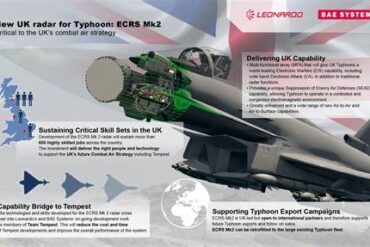
Meanwhile, the CAPTOR-E, particularly in its ECRS Mk2 configuration, incorporates gallium nitride (GaN) technology, a significant leap over older gallium arsenide systems. GaN allows for:
- Higher power output
- Greater thermal efficiency
- Wider bandwidth for signal flexibility
While its module count may appear lower on paper, this is misleading. Radar performance is not dictated solely by module quantity—it is heavily influenced by aperture size, power density, and processing sophistication.
And this is where the Typhoon begins to tilt the scales.
Aperture Size and Detection Range: Physics Still Wins
Radar performance ultimately bows to physics. A larger antenna aperture produces a stronger, more focused beam, which directly translates into greater detection range and resolution.
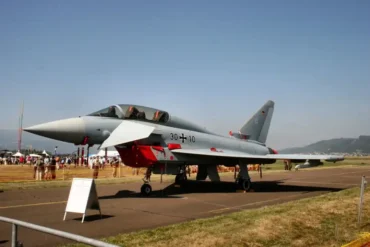
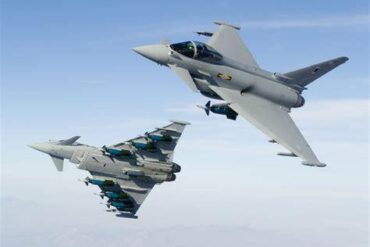
The Eurofighter Typhoon, with its larger nose cone, accommodates a significantly larger radar array than the stealth-constrained F-35. This physical advantage cannot be engineered away—it is fundamental.
Open-source estimates highlight this difference clearly:
- CAPTOR-E / ECRS Mk2: ~120 miles detection range (1m² target)
- AN/APG-81: ~90–100 miles detection range (1m² target)
That extra 20–30 miles is not trivial. In beyond-visual-range (BVR) combat, it can mean the difference between firing first and reacting too late.
However, focusing purely on range misses a critical nuance. Detection is only half the battle—remaining undetected while doing so is where the F-35 changes the equation entirely.
The CAPTOR-E’s Unique Edge: A Mechanically Steerable AESA
Here’s where things get genuinely interesting.
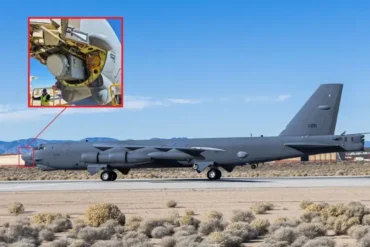
Unlike virtually every modern AESA radar, the CAPTOR-E is mounted on a mechanical repositioner. This allows the entire radar array to pivot, dramatically expanding its field of regard to approximately 200 degrees.
The AN/APG-81, like most AESA systems, uses a fixed array with a field of regard of roughly 120 degrees.
That 80-degree difference has real combat implications.
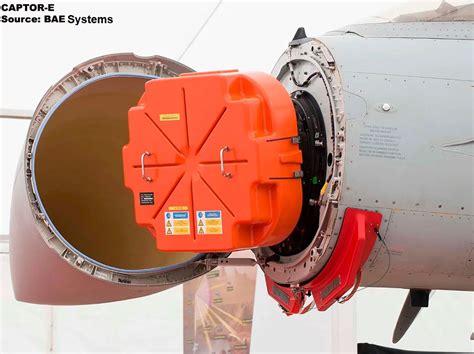
In dynamic engagements—especially dogfights or multi-target scenarios—the Typhoon can:
- Track targets far off-boresight
- Maintain situational awareness without pointing its nose directly
- Engage threats across a wider angular spectrum simultaneously
This gives Typhoon pilots a more flexible and natural sensor picture, particularly in high-speed maneuvering combat.
The trade-off? Mechanical complexity. Moving parts introduce maintenance demands and potential reliability considerations. But the payoff is undeniable: unmatched scan agility.
Electronic Warfare: When Radars Become Weapons
Modern AESA radars are no longer just sensors—they are offensive tools in the electromagnetic spectrum.
The AN/APG-81 has long integrated electronic warfare capabilities, allowing it to:
- Conduct electronic attack (jamming)
- Perform electronic support measures
- Disrupt enemy radar systems while maintaining tracking functions
This multi-role capability has been embedded since early F-35 production, making it a mature and combat-proven feature.
But the Typhoon’s upcoming ECRS Mk2 takes this concept even further.
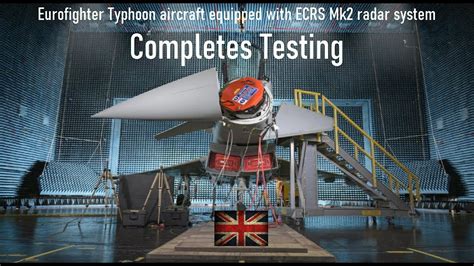
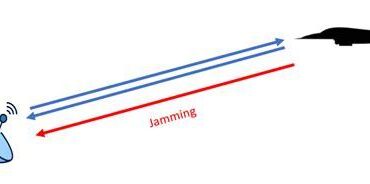
The Mk2 is being designed with dedicated offensive electronic attack functionality built directly into the radar. This transforms the system into a hybrid sensor-jammer, capable of:
- Blinding adversary radar systems
- Conducting stand-in electronic attack without external pods
- Integrating detection and disruption into a single workflow
This convergence eliminates the traditional separation between radar and electronic warfare pods, streamlining combat operations and reducing external drag or signature penalties.
In dense, contested environments, this capability could prove decisive.
Stealth and Sensor Fusion: The F-35’s True Advantage
Evaluating the AN/APG-81 in isolation is a mistake.
Its true strength lies in how it integrates with the F-35’s broader architecture. The aircraft combines radar data with inputs from:
- Distributed Aperture System (DAS) for 360° infrared coverage
- Electro-Optical Targeting System (EOTS) for precision tracking
- Advanced electronic warfare suites
- Data links like MADL and Link 16
The result is a fused battlespace picture that presents the pilot with a coherent, real-time understanding of threats and opportunities.
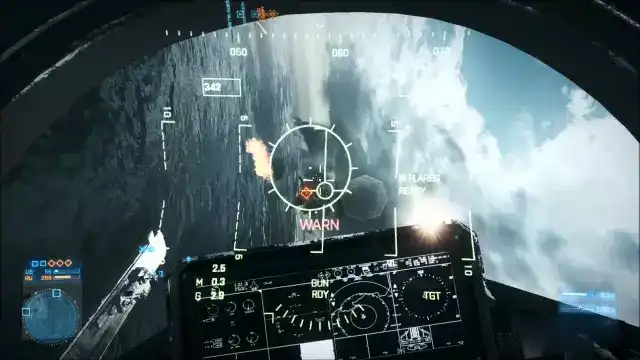
This is not just situational awareness—it is information dominance.
And then there’s stealth.
The F-35’s very low observable (VLO) design means that even if the Typhoon’s radar is more powerful, it is detecting a much smaller radar cross-section. In practical terms:
- The Typhoon might detect the F-35 at a reduced range
- The F-35 may detect the Typhoon much earlier
- The F-35 can engage before being effectively targeted
This creates a powerful asymmetry. A radar’s effectiveness is not just about how far it sees—but how soon it is seen in return.
Ground Mapping and Multi-Role Capability
The AN/APG-81 also excels in synthetic aperture radar (SAR) modes, enabling:
- High-resolution ground mapping
- Precise targeting in all weather conditions
- Identification of stationary and moving targets with exceptional clarity
This capability transforms the F-35 into a precision strike platform, not just an air superiority fighter.
The Typhoon’s radar is evolving in this area, and it does offer advanced ground mapping modes. However, the F-35’s integration of SAR with sensor fusion and stealth gives it a unique advantage in penetrating defended airspace and conducting strikes with minimal exposure.
Future Evolution: AN/APG-85 vs ECRS Mk2
Neither system is standing still.
The F-35 is set to receive the AN/APG-85, a next-generation radar designed to further enhance:
- Processing power
- Electronic warfare capabilities
- Integration within Block 4 upgrades
Meanwhile, the Typhoon’s ECRS Mk2, backed by significant investment, represents a generational leap in radar capability.
This upgrade aims to:
- Match or exceed current detection capabilities
- Deliver full-spectrum electronic attack
- Reinforce the Typhoon’s role in electromagnetic dominance
These upgrades ensure that both aircraft remain highly relevant in an era increasingly defined by networked warfare and contested spectra.
Which Radar Is Superior? The Answer Depends on the War
Framing this as a simple winner-takes-all comparison misses the reality.
The CAPTOR-E / ECRS Mk2 excels in:
- Raw detection range
- Wide-angle scanning
- Electromagnetic attack flexibility
It is a brute-force instrument, optimized for dominance through power and adaptability.
The AN/APG-81, on the other hand, thrives in:
- Stealth-enabled engagements
- Sensor fusion and data integration
- Network-centric warfare
It is not just a radar—it is part of a combat ecosystem that reshapes how engagements unfold.
The real distinction can be distilled into a simple analogy:
- The Typhoon wields a powerful spotlight, illuminating vast areas with intensity
- The F-35 operates like night vision, seeing clearly while remaining unseen
Neither approach is universally superior. In open, high-energy engagements, the Typhoon’s radar advantages become pronounced. In contested, stealth-centric environments, the F-35’s integrated approach is extraordinarily difficult to counter.
Final Analysis: Power vs Perception in the Electromagnetic Age
The comparison between the Eurofighter Typhoon’s AESA radar and the F-35’s AN/APG-81 ultimately reflects a deeper strategic divide.
One prioritizes maximum sensor performance and flexibility, embracing complexity to dominate the electromagnetic spectrum directly. The other leverages stealth, integration, and information fusion to avoid detection and control the battle indirectly.
Both approaches are not only valid—they are complementary in modern coalition warfare.
As air combat continues to evolve, the decisive factor may not be which radar is more powerful, but which philosophy better aligns with the mission, the threat environment, and the broader operational network.
And that’s the uncomfortable truth for anyone looking for a simple winner:
In the skies of the future, victory won’t belong to the aircraft with the best radar—but to the one that best understands how to use it.