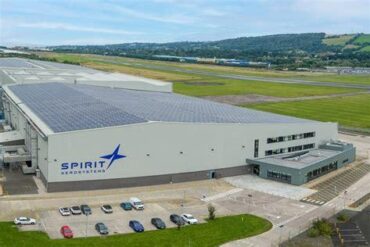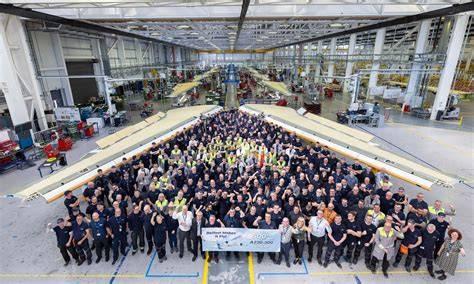
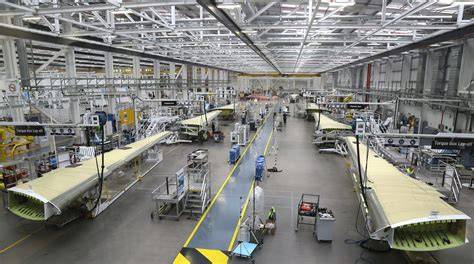
Airbus is moving to expand one of the most strategically important facilities in its global commercial aircraft network, with construction now underway on a major extension to its A220 wing manufacturing plant in Belfast, Northern Ireland. The 6,221-square-meter (67,000-square-foot) expansion is designed to provide the additional capacity Airbus needs as it targets production of 13 A220 aircraft per month by 2028, a major increase for a program that has faced years of industrial and supply-chain challenges.
The Belfast investment is significant because the facility is not simply another production site in the A220 network. It is the aircraft’s exclusive global source of wings, supplying Airbus final assembly operations in Mirabel, Canada, and Mobile, Alabama. As a result, increasing final assembly rates depends directly on Airbus being able to manufacture, cure, inspect and ship enough wings from Northern Ireland.
The new facility is scheduled to be completed during the first half of 2028. Airbus plans to install a third autoclave, specialized wing tooling and additional cranage, while also upgrading electrical infrastructure, IT systems and site facilities. Forty new apprentices are expected to join the Belfast operation in September, reinforcing the workforce needed to support the next stage of A220 production.
Airbus Belfast Expansion Targets 13 A220s Per Month
The scale of the investment reflects the importance of Airbus’ rate-13 production target. The manufacturer delivered 93 A220 aircraft during 2025, equivalent to an average of just 7.75 aircraft per month. Reaching 13 aircraft every month would translate into an annualized production rate of 156 jets, approximately 68% higher than 2025 deliveries.
That increase will not happen simply by accelerating final assembly lines. The entire industrial system must expand in parallel, from raw materials and composite structures to engines, interiors, landing gear, avionics and final assembly. Belfast is particularly critical because the A220’s wings are highly specialized composite structures, and any shortage can quickly affect production schedules elsewhere in the network.
Airbus previously aimed for an even more aggressive production trajectory. In April 2025, the company was targeting 14 A220s per month during 2026, but supply-chain pressures forced a revision to 12 aircraft per month. The current objective of 13 aircraft monthly in 2028 therefore represents a more measured ramp-up, but it remains a substantial increase from the program’s recent output.
The Belfast expansion provides tangible evidence that Airbus is now building the industrial capacity required to achieve that objective rather than relying solely on production improvements at its final assembly sites. For an aircraft program that has repeatedly struggled to reach promised production rates, that distinction matters.
Third Autoclave Becomes Key to A220 Wing Production
One of the most important additions at Belfast will be a third autoclave, a large industrial pressure vessel used to cure advanced composite structures. The A220’s wings rely heavily on carbon-fiber composite technology, making the curing process a fundamental part of the manufacturing cycle.
Belfast pioneered the patented Resin Transfer Infusion (RTI) process used to manufacture the A220’s composite wings. Airbus says the resulting structure is approximately 10% lighter than a comparable conventional aluminum design. Lower structural weight contributes to reduced fuel consumption and supports the A220’s overall operating economics.
Adding another autoclave should increase the facility’s ability to process composite wing structures while reducing the possibility that curing capacity becomes a bottleneck as production rises. Additional tooling and cranage will further support the higher manufacturing rate, while new high-voltage electrical substations will provide the infrastructure required for the expanded operation.
The project also includes a new office block, upgraded IT systems and a larger parking area capable of accommodating 650 vehicles. These elements may appear secondary compared with the autoclave, but they demonstrate that Airbus is expanding the site as an integrated industrial operation rather than simply adding individual pieces of equipment.
Belfast’s A220 Wings Have Been a Major Supply-Chain Constraint
The decision to expand Belfast carries particular significance because the A220 program has experienced serious problems obtaining wings in sufficient quantities. Before Airbus acquired the relevant Spirit AeroSystems operations, the Belfast facility was operated by Spirit, and production difficulties became one of the constraints limiting the wider A220 ramp-up.
At times, Airbus had to take extraordinary measures to keep components moving through the production system. In 2024, reports indicated that Antonov An-124 cargo aircraft were used to transport A220 wing components from Belfast to Canada, illustrating how urgently Airbus was trying to overcome supply-chain disruptions.
Those problems exposed a fundamental weakness in the A220 industrial model. Airbus could increase activity at Mirabel and Mobile, but higher final assembly capacity would have limited value if the required wings could not arrive on schedule. Bringing the Belfast operation into Airbus ownership therefore gave the manufacturer greater control over one of the aircraft’s most important production bottlenecks.
Anthony Rouse, Head of Airbus Belfast Plant and Site, described the expansion as a direct investment in the future of A220 wing production and in the long-term development of the Belfast operation. The message is clear: Airbus wants the plant to become an industrial foundation for the A220’s next growth phase rather than remain a constraint on it.
From Bombardier’s CSeries to Airbus’ Belfast A220 Operation
The Belfast facility has a history that predates the A220 name. The aircraft was originally developed by Bombardier as the CSeries, with the company’s advanced composite wing assigned to the historic Short Brothers operation in Belfast.
A purpose-built 600,000-square-foot wing manufacturing and assembly facility officially opened in 2013, shortly after the CSeries completed its first flight. At the time, the investment represented a major commitment to Northern Ireland’s aerospace industry and reflected the technical importance of the composite wing to the new aircraft.
Airbus took control of the CSeries program in 2018 and subsequently renamed the aircraft the A220-100 and A220-300. However, Airbus did not initially own the Belfast operation. Bombardier later sold its aerostructures business to Spirit AeroSystems, with the transaction completed in October 2020.
That ownership structure changed again after Boeing agreed to reacquire Spirit AeroSystems. As Airbus sought to protect its own supply chain, it agreed to take control of Spirit’s Airbus-related work packages, including the A220 wing and mid-fuselage operations in Belfast.
Airbus completed the acquisition in December 2025. The transaction included substantial compensation for Airbus because of the financial condition of the acquired operations, but the company also gained direct control of a strategically important part of its A220 manufacturing system.
Less than a year later, Airbus is already expanding the operation. That sequence illustrates how dramatically the strategic importance of Belfast has changed. What was once an external supplier is now an in-house Airbus production asset whose capacity is directly linked to the company’s A220 growth plans.
A220 Demand Gives Airbus More Reason to Increase Production
The production investment is also supported by a growing order backlog. By the end of July, Airbus had recorded 1,106 A220 orders and 532 deliveries, leaving 574 aircraft still to be delivered. That backlog provides a substantial base of committed demand as Airbus works to improve production efficiency.
AirAsia’s order for 150 A220-300 aircraft in May was particularly significant. At a production rate of 13 aircraft per month, those 150 aircraft would represent nearly a full year of output. The airline also holds options for another 150 aircraft if Airbus eventually launches the proposed larger A220-500.
That potential aircraft would give Airbus another opportunity to improve the economics of the program, but the immediate priority is establishing a reliable production system for the existing A220 family. Demand means little if manufacturers cannot deliver aircraft consistently and profitably.
Higher A220 Production Is Crucial to Program Economics
Production rate is especially important because the A220 has continued to face profitability challenges. Increasing output can help spread fixed costs across more aircraft, improve supplier efficiency and reduce the unit cost of manufacturing.
For Airbus, reaching 13 A220s per month is therefore about more than satisfying airlines waiting for aircraft. It is also an important step toward making the program economically sustainable. Airbus Canada has indicated that reaching at least this production level is crucial to improving program profitability.
The Belfast expansion addresses one part of that equation by increasing wing capacity. The wider challenge is ensuring that every other part of the supply chain can increase at a similar pace. A third autoclave cannot solve shortages elsewhere, but it removes a significant potential bottleneck from one of the most technically demanding stages of A220 manufacturing.
Belfast Becomes Central to the A220’s Next Chapter
The Airbus investment ultimately represents a vote of confidence in both the A220 program and Belfast’s aerospace workforce. The aircraft has developed a strong reputation for efficiency and advanced design, but its commercial success depends on Airbus turning that technical potential into consistent, profitable production.
With construction underway, Airbus is now putting physical infrastructure behind its 2028 objective. The expanded Belfast facility will provide additional composite manufacturing capacity, new equipment and a larger workforce while giving Airbus greater control over a crucial component of the A220 supply chain.
If the expansion is completed as planned in the first half of 2028, Belfast should be positioned to support an annual production rate of 156 A220 aircraft. That would mark a major transformation from the production levels achieved only a few years earlier.
For Airbus, the lesson from the A220 ramp-up is straightforward: ambitious delivery targets require equally ambitious industrial foundations. By expanding Belfast, the company is addressing one of the program’s most persistent constraints and giving the A220 a stronger platform for its next phase of growth.