Turkish Airlines is looking at London City Airport (LCY) as the next piece of its increasingly ambitious London strategy, but adding the airport to its network would be far more complicated than simply opening another route. The airline already has a formidable presence across the British capital, serving London Heathrow, London Gatwick and London Stansted, yet London City offers something none of those airports can replicate: a location remarkably close to the financial heart of the city.
According to reporting by The Times, Turkish Airlines Chairman Murat Seker identified London City Airport as a potential future destination while discussing the carrier’s longer-term expansion. On paper, the idea makes obvious commercial sense. Turkish Airlines could use Istanbul as a connecting hub between the City of London and destinations across Asia, the Middle East and Africa. In practice, however, LCY’s short runway, steep approach and strict aircraft requirements create a substantial fleet problem.
The central question is therefore not whether Turkish Airlines wants to fly to London City. It is what aircraft the airline could actually use. That question becomes particularly interesting because the airport is preparing to introduce a new approach procedure that could eventually allow larger next-generation aircraft, including the Airbus A320neo, to operate there. Turkish Airlines, however, does not currently operate the A320neo in its mainline fleet.
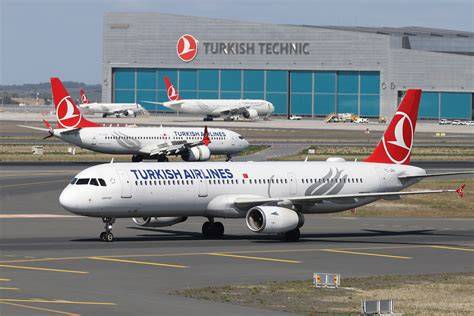
Turkish Airlines Already Has a Huge London Network
Turkish Airlines hardly needs another London airport to establish its presence in the market. The carrier’s August 2026 schedule shows 374 Istanbul-London departures, equivalent to roughly 12 departures per day on average, with frequencies reaching 14 daily on selected dates. The operation is also significantly larger than it was a year earlier, demonstrating just how strongly the airline views the United Kingdom as a strategic market.
Heathrow remains the centerpiece, accounting for 183 departures in August, while Gatwick contributes another 124 and Stansted adds 67. Heathrow is particularly important because Turkish Airlines can deploy large aircraft such as the Boeing 777-300ER and Airbus A350-900, giving the carrier considerable capacity on one of Europe’s most important international markets.
Stansted is the newest addition. Turkish Airlines launched passenger services there in March 2026, initially operating ten flights per week before expanding to approximately twice-daily service during the summer. The airport gives the airline another outlet for its Istanbul hub and demonstrates that Turkish Airlines is willing to add capacity when it sees sufficient demand.
London City would serve a very different purpose. Rather than simply adding more seats, LCY would provide geographical convenience and access to premium business travelers. Its location near Canary Wharf and London’s traditional financial district could make a comparatively small Istanbul operation commercially attractive, particularly for passengers who value time more than airport choice.
That distinction matters. A Turkish Airlines flight from LCY would not necessarily need to compete directly with its own Heathrow or Gatwick services. Instead, it could target travelers who consider a long transfer from London’s outskirts to the center of the city to be a significant inconvenience.
London City Airport’s Steep Approach Creates the First Problem
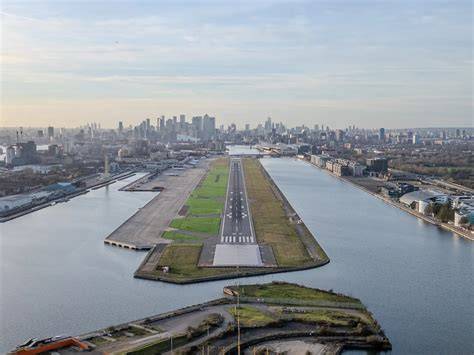
London City is unlike most major European airports because aircraft must currently approach the runway at a 5.5-degree descent angle. Conventional commercial approaches are generally much shallower, often around 3 to 3.5 degrees. The difference may look small on paper, but it has major implications for aircraft certification, flight procedures and pilot training.
The airport’s unusual operating environment became particularly famous through British Airways’ former Airbus A318 service between London City and New York JFK. The A318 was equipped with a special steep-approach capability that allowed it to operate into LCY, making the route one of the most distinctive long-haul services in European aviation.
Turkish Airlines’ existing Airbus A319-100 and A320-200 aircraft do not provide an immediate solution. Neither type is currently approved for the airport’s existing steep approach, meaning the airline cannot simply take an aircraft from Istanbul and schedule it for London City tomorrow.
There is, however, potentially a major change coming. London City Airport is seeking approval for a new 4.49-degree RNP-AR approach, which would reduce the steepness of the procedure by just over one degree. If approved by the UK’s Civil Aviation Authority, the procedure could become available from January 2027 at the earliest.
The Airbus A320neo Could Unlock London City
The proposed 4.49-degree approach is specifically associated with the airport’s plan to welcome new-generation, more efficient aircraft. London City has repeatedly highlighted the Airbus A320neo as an important example of the type that could benefit from the change.
For Turkish Airlines, that creates an intriguing problem. The A320neo is arguably the aircraft that fits the airport’s future requirements best, but Turkish Airlines mainline does not currently operate it.
The airline has A319s, A320ceos and A321neos within its narrowbody fleet, while its newer-generation fleet strategy is increasingly centered on the A321neo. Its major December 2023 Airbus order included 150 A321 aircraft alongside 70 A350-family aircraft, providing the carrier with substantial future growth capacity.
Yet an A321neo should not automatically be assumed to qualify for London City. Approval for one aircraft type does not necessarily extend to another, even when both belong to the same aircraft family. The Boeing 737 MAX 8 presents the same issue. Turkish Airlines has both types in its broader fleet strategy, but neither has been announced as an immediate beneficiary of the proposed LCY procedure.
That means the A320neo is unusually important. It is the aircraft London City is specifically preparing for, and Turkish Airlines has access to the type elsewhere within its wider corporate structure.
AJet May Hold the Most Interesting Answer
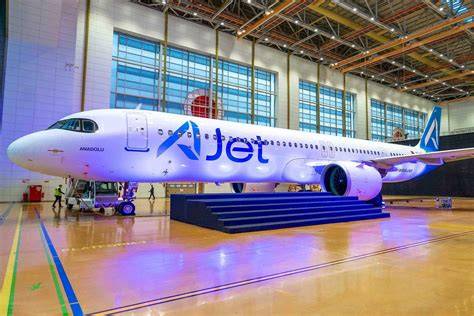
The most obvious clue can be found inside the Turkish Airlines group itself. AJet, Turkish Airlines’ low-cost subsidiary, currently operates A320neos and lists 27 examples among a fleet of 118 aircraft.
That immediately raises an obvious possibility: could Turkish Airlines simply use AJet’s A320neos for London City?
Unfortunately, aviation groups are not quite that simple. AJet operates under its own Air Operator Certificate, meaning its aircraft cannot simply be treated as Turkish Airlines mainline equipment and inserted into the latter’s schedule without addressing regulatory, operational and commercial considerations.
Some AJet aircraft are also subject to lease arrangements that restrict how they can be operated. Consequently, a Turkish Airlines LCY service using an AJet aircraft would require a carefully structured solution rather than a straightforward fleet transfer.
Nevertheless, the existence of A320neos within the group significantly changes the equation. Turkish Airlines would not be starting from zero. The group already has experience operating the aircraft, and the technical knowledge, crew familiarity and maintenance infrastructure surrounding the type could make an A320neo-based solution much more realistic than introducing a completely unfamiliar aircraft.
Leasing A320neos Could Be the Cleanest Solution
If Turkish Airlines decides that London City is strategically important, leasing a small number of A320neos for mainline operations could be the most straightforward answer. The airline would effectively create a limited LCY-capable sub-fleet without waiting for its broader fleet plan to change.
Such an approach would also make more sense economically than purchasing a completely new aircraft type. Buying Airbus A220s or Embraer E195-E2s purely for a handful of London City flights would introduce additional pilot training, maintenance, spare-parts and operational complexity.
The Embraer E195-E2 is especially interesting because Embraer has indicated that planned takeoff-performance improvements could eventually make Istanbul-London City feasible. The aircraft already has strong credentials for challenging airports and shorter routes, but Turkish Airlines would have to establish an entirely new aircraft sub-fleet to use it.
That is difficult to justify for a single destination unless LCY becomes the beginning of a much broader network strategy.
Istanbul Would Be One of London City’s Longest Routes
Aircraft choice is only half of the problem. Istanbul is a long sector from London City, and the airport’s short runway creates additional performance constraints.
An aircraft operating from LCY to Istanbul may not always be able to depart with the same combination of passengers, baggage and fuel that it could carry from a larger runway. Hot weather, runway performance and aircraft weight can all influence the economics of the route.
This is particularly important because Istanbul would become one of the airport’s longest scheduled destinations. A flight can be technically possible without being commercially optimal. Turkish Airlines would need to determine whether an LCY aircraft could carry enough passengers and payload to make the operation financially worthwhile.
The good news is that the route is not inherently unrealistic. The fact that aircraft manufacturers are studying performance improvements for flights such as Istanbul-London City suggests that the distance itself is manageable. The challenge is achieving the right combination of payload, runway performance, fuel and operating economics.
Why London City Could Still Be Worth the Trouble
Despite all these obstacles, LCY offers Turkish Airlines something its other London airports cannot easily reproduce. The airport’s location is the product.
A passenger working around Canary Wharf or the City could potentially save a substantial amount of ground-transfer time by flying through London City rather than Heathrow, Gatwick or Stansted. For premium passengers connecting through Istanbul, that convenience could carry significant value.
Turkish Airlines has also built its Istanbul hub around connecting traffic, making London City particularly interesting as a gateway into its global network. A small number of daily flights could provide access to destinations far beyond Turkey without requiring Turkish Airlines to operate a large long-haul aircraft into LCY.
That could make the route strategically valuable even if the aircraft carries fewer passengers than a Heathrow widebody.
Turkish Airlines London City Flights Are Possible, But Not Simple
The most likely path toward Turkish Airlines London City flights therefore involves several developments happening in sequence. London City first needs approval for its proposed 4.49-degree approach. The relevant aircraft types then need the necessary technical and operational approvals. Turkish Airlines must identify an aircraft that can meet LCY’s runway and range requirements, while also producing acceptable economics.
The A320neo currently looks like the most logical candidate because it is explicitly central to LCY’s expansion plans and already exists within the Turkish Airlines group through AJet. Leasing several A320neos for Turkish Airlines mainline could provide a practical bridge between the airport’s ambitions and the carrier’s existing fleet structure.
There are other possibilities. An A321neo could eventually receive the required approvals, while a 737 MAX 8 could theoretically become another candidate if the relevant certification and operational requirements are satisfied. Turkish could also decide that the economics do not justify the complexity and postpone the project.
For now, however, London City represents an unusually compelling aviation puzzle. Turkish Airlines has the demand, the hub and the commercial rationale. What it lacks is the perfect aircraft. If London City’s new approach is approved, that missing piece could become much easier to find—and the sight of a Turkish Airlines A320neo descending toward the heart of London could become one of the capital’s most interesting new aviation developments.