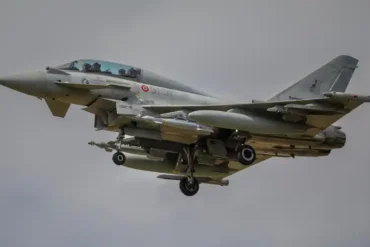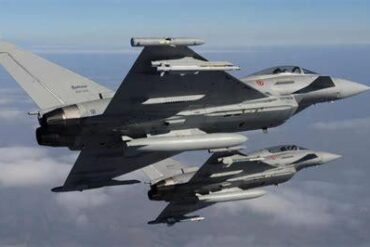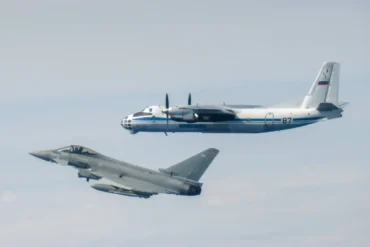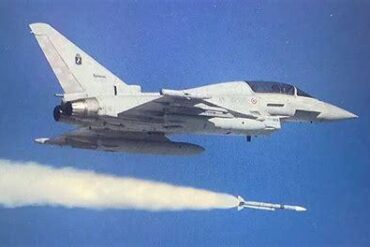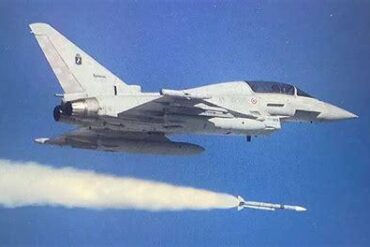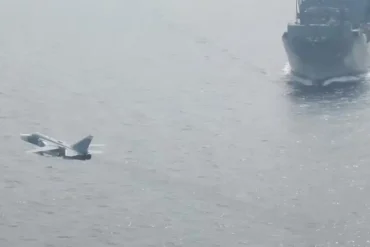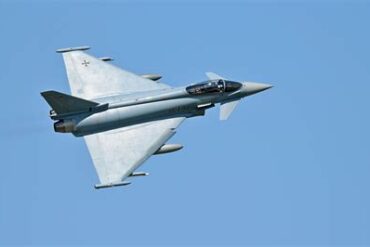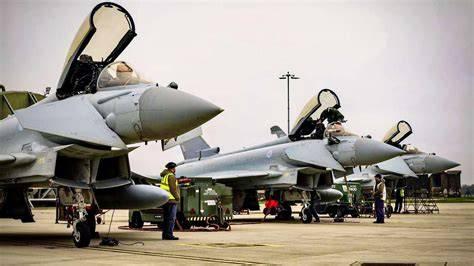
While the skies over the United Kingdom are generally calm, the Royal Air Force (RAF) maintains a very different level of vigilance along NATO’s eastern frontier. RAF Eurofighter Typhoons deployed to Eastern Europe are operating in an environment where Russian military aircraft, drones, electronic warfare, and the continuing war in Ukraine have transformed routine air policing into a demanding round-the-clock mission.
The contrast is striking. RAF Quick Reaction Alert (QRA) fighters protecting British airspace may scramble only occasionally during a normal year. In Eastern Europe, however, deployed Typhoons can be launched repeatedly to identify and intercept aircraft approaching NATO airspace. Their task is not simply to shoot down threats. Much of the mission involves detecting, identifying, escorting, and deterring aircraft before an incident becomes a larger security crisis.
The RAF’s contribution forms part of NATO’s wider integrated air and missile defense network. Fighters from several allied nations operate from bases across the eastern flank, creating a multinational shield stretching from the Baltic region toward the Black Sea. For the United Kingdom, these deployments demonstrate how a relatively small number of frontline fighters can carry responsibilities far beyond Britain’s immediate airspace.
NATO Air Policing on the Eastern Flank
NATO’s Baltic Air Policing mission dates back to 2004, when Estonia, Latvia, and Lithuania joined the alliance without possessing the fighter fleets needed to conduct their own air sovereignty missions. Allied combat aircraft therefore filled the capability gap, creating a standing multinational presence over the Baltic region.
The strategic importance of that arrangement has changed dramatically since Russia’s full-scale invasion of Ukraine. What was once primarily an air-policing requirement has become part of NATO’s broader deterrence posture. Allied fighters now operate much closer to a major active conflict, while Russian aircraft routinely move between mainland Russia and the Kaliningrad exclave.
Those movements can create serious risks even when no deliberate attack is taking place. Russian military aircraft may operate without conventional flight plans, communicate poorly or not at all with regional air traffic control, and fly with their transponders switched off. Such behavior makes them harder for civilian aviation authorities to track and increases the possibility of dangerous encounters in already crowded airspace.
For NATO, therefore, an interception does not automatically mean that an aircraft has attacked or intends to attack. The fighter’s presence is often about establishing exactly what is happening. A Typhoon can approach an unidentified aircraft, visually identify it, monitor its behavior, and escort it away from sensitive airspace when necessary.
Why RAF Typhoons Are Scrambled
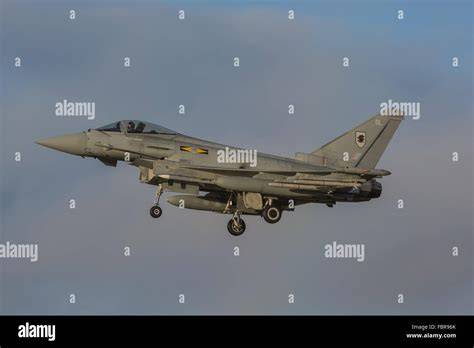
The Eurofighter Typhoon is particularly well suited to the QRA role because it combines high speed, advanced sensors, powerful communications systems, and the ability to remain on immediate standby. When an alert is received, pilots must move rapidly from readiness to airborne interception.
The mission requires much more than simply flying toward an unknown contact. Ground controllers must establish where the aircraft is, determine its track, assess whether it presents a threat, and direct the fighters toward the appropriate intercept point. Pilots then have to identify the aircraft and follow instructions while maintaining tactical awareness of the surrounding airspace.
The operational picture becomes even more complicated when multiple contacts appear at once. During a 2025 RAF deployment to Poland, Typhoons reportedly intercepted 15 Russian aircraft in only six days. On one particularly demanding sortie, a pilot described being repeatedly re-tasked after already intercepting aircraft, ultimately responding to a third contact during the same mission.
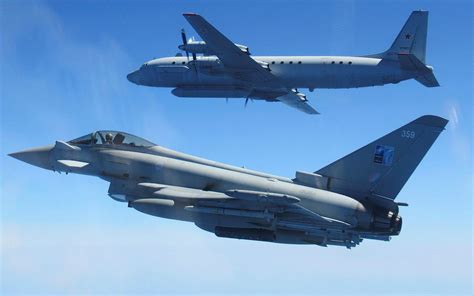
Such missions illustrate why NATO air policing cannot be measured simply by the number of aircraft shot down or threats destroyed. The overwhelming majority of successful interceptions end without weapons being used. The objective is to prevent escalation while preserving NATO airspace and protecting civilian and military aviation.
From Baltic Patrols to Eastern Sentry
The RAF’s experience on the eastern flank has steadily expanded since Russia’s invasion of Ukraine. During Operation Azotize in Estonia in 2023, RAF Typhoons conducted 21 interceptions involving 56 Russian aircraft over a four-month deployment.
That operational tempo could become intense very quickly. On one day in June, Typhoons were launched twice to intercept three Russian aircraft. The British fighters also operated alongside Swedish JAS-39 Gripens, while German Airbus A400M aircraft provided aerial refueling support.
This multinational structure is fundamental to NATO’s eastern defense. No single air force is expected to carry the entire burden. Fighter aircraft, tankers, command-and-control assets, surveillance systems, maintenance teams, weapons specialists, and air traffic controllers all contribute to the mission.
The same principle applies to the broader force deployed across Eastern Europe. RAF Typhoons have operated alongside fighters from Spain, Germany, Denmark, France, Italy, Sweden, and other allied nations. Each deployment adds another layer to NATO’s ability to monitor and respond to activity near its borders.
The mission has also expanded beyond conventional aircraft. Drones have become a persistent challenge, particularly because their origins and intentions can initially be difficult to establish. The large-scale violation of Polish airspace by Russian drones in September 2025 demonstrated how quickly unmanned systems can turn an air-policing mission into a serious defensive operation.
Operation Biloxi and the Romanian Detachment
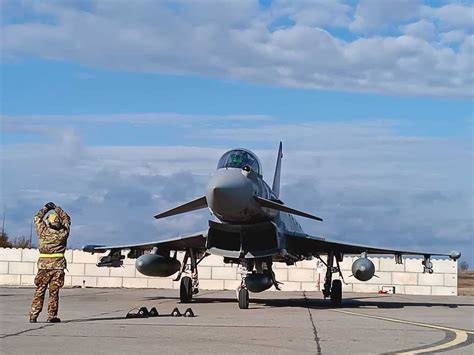
One of the RAF’s most visible commitments has been its deployment to Romania under Operation Biloxi. The latest RAF Typhoon detachment arrived at Borcea Air Base on March 31 and remained until August 1, when the Spanish Air and Space Force assumed responsibility.
The deployment represented the sixth RAF Typhoon rotation to Romania since 2014. These scheduled rotations have traditionally focused on protecting NATO airspace around the Black Sea, monitoring Russian military activity, and responding to potential incursions. Since the war in Ukraine began, however, the strategic significance of the mission has increased substantially.
Romania is particularly important because of its geographic position. The country sits on NATO’s southeastern flank, close to the Black Sea and within reach of the wider security environment created by the war in Ukraine. Fighter aircraft stationed there can therefore contribute to a much broader surveillance and response architecture.
The aircraft may be the most visible part of the deployment, but the operation depends on hundreds of personnel working behind the scenes. Engineers, technicians, intelligence specialists, logisticians, weapons personnel, communications teams, and support staff must keep the fighters ready to launch at short notice.
The Growing Drone Threat
The emergence of drones has added another dimension to NATO’s air-policing mission. Unlike conventional fighter aircraft, drones can be smaller, slower, and more difficult to classify. Their operators may also exploit electronic warfare, navigation interference, and other techniques that complicate identification.
The reference incidents on NATO’s eastern flank demonstrate why this matters. Russian drones crossed into Polish airspace in significant numbers in September 2025, while other unmanned aircraft incidents have continued to challenge regional defenses.
A June incident involving a French Dassault Rafale highlighted another problem. A fighter intercepted and destroyed a drone approximately 20 miles from the border after NATO authorities assessed that Russian electronic warfare had spoofed its navigation. The aircraft appeared to have Ukrainian origins, demonstrating how electronic interference can blur the distinction between deliberate intrusion, misnavigation, and hostile activity.
For QRA pilots, this creates an extraordinarily demanding decision environment. A radar contact does not automatically reveal its purpose. Crews must combine sensor information, intelligence, command instructions, visual identification, and the behavior of the contact before deciding how to respond.
The RAF’s Typhoon Fleet Is Under Pressure
The eastern mission comes at a difficult time for the RAF. The service is expected to maintain 24/7 home air defense while simultaneously supplying aircraft for NATO commitments, overseas operations, training, and other strategic tasks.
The retirement of 30 Tranche 1 Typhoons in 2025 attracted scrutiny from a parliamentary defense committee because many of those aircraft still had usable airframe life remaining. Their withdrawal reduced the active-service Typhoon fleet to approximately 107 aircraft, increasing the pressure on the remaining force.
The problem is not simply the number of aircraft. A fighter fleet can contain many airframes while still lacking sufficient availability to generate sustained operational sorties. Maintenance requirements, spare parts, engineering capacity, weapons availability, pilot numbers, and training all determine how many aircraft can actually be deployed.
RAF Typhoons have already accumulated an extensive operational workload. Alongside NATO air policing, the fleet has supported operations over Iraq and Syria, Falkland Islands responsibilities, domestic QRA, and increasingly demanding eastern-flank deployments. Each commitment consumes aircraft hours and places additional demands on personnel.
The Fast-Jet Pilot Shortage
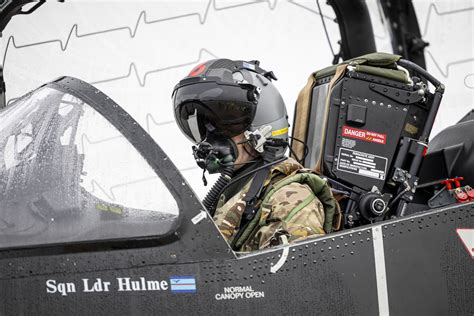
Perhaps the most difficult challenge is the shortage of experienced fast-jet pilots. Fighter aircraft cannot sustain a 24/7 mission without qualified crews, and the RAF’s training pipeline has struggled for years to produce pilots at the required rate.
A process intended to take roughly two or three years can extend dramatically, in some cases reaching seven or eight years. This creates a bottleneck that cannot be solved simply by ordering additional aircraft.
The shortage also affects instructors. Experienced Typhoon pilots who would normally progress into training roles may instead remain on frontline squadrons because operational commitments require their expertise. That reduces the number of instructors available to train the next generation, creating a cycle in which today’s operational demands can directly affect tomorrow’s combat-air capability.
The problem has been serious enough for the UK to use international partnerships to support flying instruction. Such arrangements demonstrate that the RAF’s challenge extends beyond individual recruitment campaigns. It involves the entire pathway from initial training to advanced fast-jet instruction, operational conversion, retention, and eventual instructor development.
Keeping NATO’s Eastern Border Secure
Despite these pressures, the RAF continues to sustain its eastern-flank commitments. Its Typhoons provide a highly visible demonstration that NATO airspace is defended collectively rather than by individual nations acting alone.
That principle matters because the purpose of air policing is ultimately deterrence. A potential adversary must understand that unidentified military aircraft, drones, or other airborne threats may be detected and challenged quickly. The presence of armed fighters on standby reduces the time available for an incident to develop unchecked.
The RAF’s eastern mission also demonstrates the importance of allied interoperability. British Typhoons can operate with Spanish, German, Swedish, French, Italian, Danish, and other NATO aircraft while receiving support from multinational tanker and command assets. The result is an integrated defensive network rather than a collection of isolated national deployments.
The Long-Term Challenge for the RAF
The immediate requirement is straightforward: keep aircraft and crews available around the clock. The longer-term challenge is considerably harder. Britain must sustain its current commitments while rebuilding the depth of its combat-air force.
The £205 million contract extension for Typhoon technical and engineering support is one part of that effort, intended to help keep the fleet mission-ready. Increased defense spending and wider modernization plans are also intended to address aircraft availability, recruitment, retention, and industrial support.
Yet the RAF must bridge the gap between today’s Typhoon force and the next generation of combat aircraft. The UK’s Global Combat Air Programme and its future Tempest aircraft are not expected to enter service until the mid-2030s. That means the Typhoon will remain a central pillar of Britain’s air-defense strategy for years.
The 24/7 mission on NATO’s eastern border therefore represents more than another overseas deployment. It is a test of endurance for the RAF’s aircraft, pilots, engineers, support personnel, and defense infrastructure. Every scramble, patrol, interception, and handover depends on a force capable of generating combat power repeatedly without exhausting its people or aircraft.
For NATO, the message is equally clear. Eastern European airspace cannot be treated as a quiet rear area while the war in Ukraine continues. The RAF Typhoons operating from Romania, Poland, Estonia, and elsewhere form part of a continuous defensive system designed to detect danger early, respond quickly, and prevent isolated air incidents from becoming wider security crises.
The fighters may spend much of their time waiting on the ground. But the mission never really stops. That is the essence of NATO air policing: maintaining the ability to act within minutes, every hour of every day, along one of Europe’s most strategically important borders.