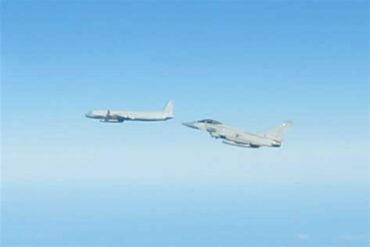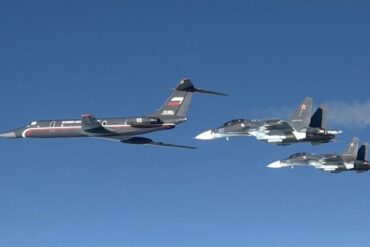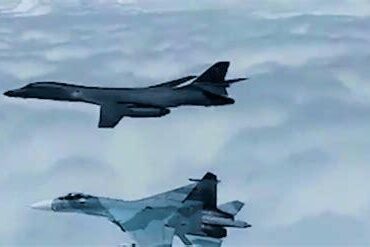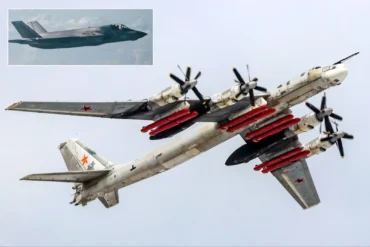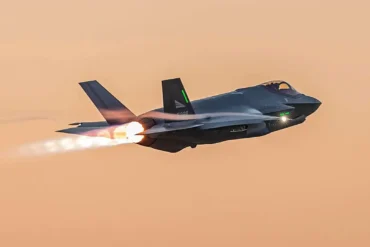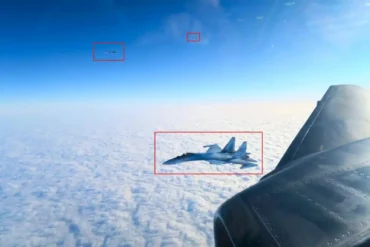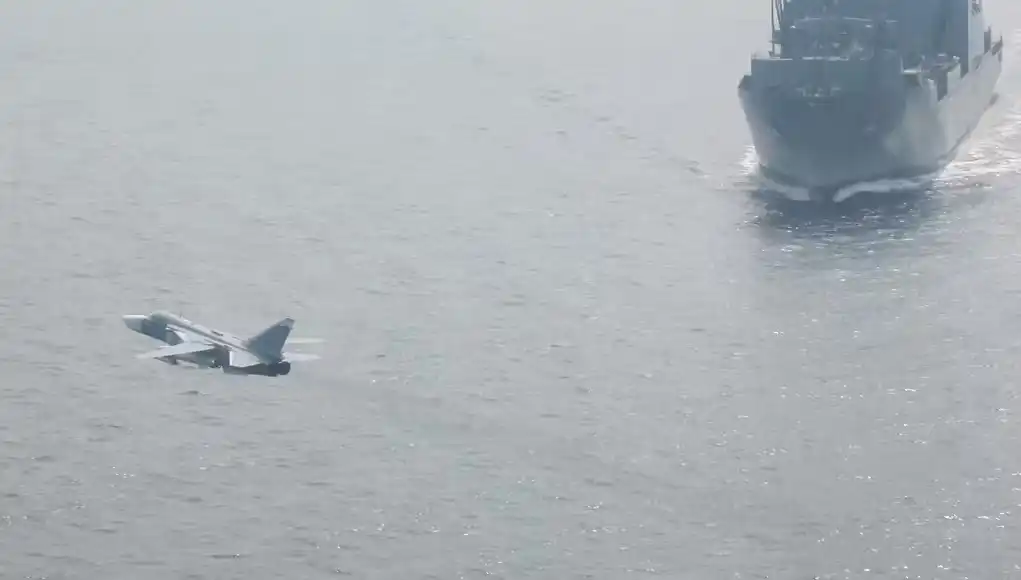
On 8 June, in a high-stakes display of aerial brinkmanship over the Baltic Sea, British Royal Air Force (RAF) Typhoons were scrambled under NATO command to intercept two Russian Su-24M tactical bombers making dangerously close passes near a U.S. Navy support ship operating in international waters. The incident, viewed by NATO as a deliberate provocation, adds to the escalating pattern of Russian military assertiveness near NATO’s eastern flank.
A High-Speed Intercept Over Tense Waters
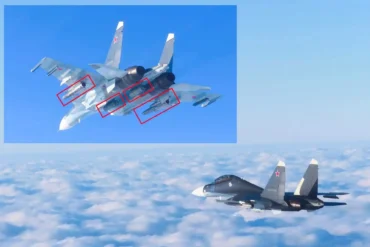
The RAF Typhoon FGR4s, stationed at Malbork Air Base in eastern Poland as part of NATO’s enhanced Air Policing mission, were scrambled after unidentified aircraft were detected departing Kaliningrad, the Russian exclave wedged between Poland and Lithuania. Upon visual contact, the aircraft were identified as two armed Su-24M ‘Fencer D’ tactical bombers.
What followed was a clear demonstration of aggressive aerial posturing. As the Typhoons closed in, the Russian bombers broke formation. One of the Su-24s peeled away and executed low-level flight maneuvers dangerously close to the USNS William McLean, a U.S. Navy Lewis and Clark-class dry cargo vessel, tasked with replenishment operations.
USNS William McLean: A Strategic Naval Asset
The USNS William McLean (T-AKE-12), a 210-meter-long ship operated by the U.S. Navy’s Military Sealift Command, plays a vital role in maintaining operational readiness of U.S. and allied fleets. The vessel boasts:
- A cargo capacity of 6,005 tonnes,
- Underway replenishment systems to transfer fuel, ammunition, and supplies at sea,
- Vertical replenishment capability to support helicopter-based logistics,
- And operations designed for sustained maritime support.
The proximity of a Russian bomber performing low-level maneuvers near such a vessel is interpreted as a calculated act of intimidation—a stark message from Moscow as tensions simmer over the war in Ukraine and broader NATO deterrence efforts.
NATO’s Escalating Aerial Vigilance
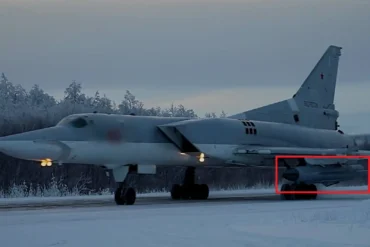
This intercept was not an isolated event. According to NATO sources and the RAF, the Baltic skies saw an unusual surge in Russian aerial activity. In the week leading up to the incident, RAF jets were scrambled six times in six days, intercepting 15 Russian military aircraft. These included:
- Il-20 ‘COOT A’ intelligence platforms,
- An-30 ‘CLANK’ photographic reconnaissance aircraft,
- Tu-142 maritime patrol bombers,
- Often escorted by Su-27 ‘FLANKER’ air-superiority fighters.
RAF operations are conducted under Operation CHESSMAN, led by 140 Expeditionary Air Wing, with joint contributions from NATO allies, including the United States and Sweden. This cooperative effort ensures airspace integrity, supports rapid response operations, and deters any unauthorized intrusions or military coercion.
The Aircraft: Combat Profiles in Confrontation
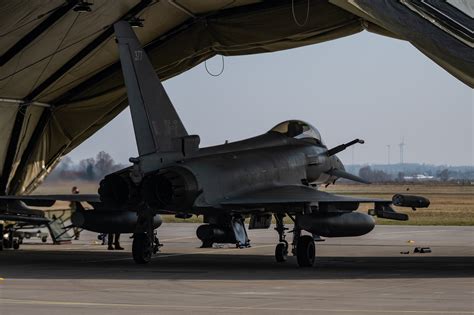
Eurofighter Typhoon FGR4
The RAF’s Eurofighter Typhoon FGR4 is among the most advanced multirole fighter platforms in Europe’s arsenal. Engineered for both air superiority and precision ground strike, it features:
- Twin EJ200 turbofan engines with afterburners, enabling speeds of Mach 2.0+,
- A combat radius of approximately 1,390 km,
- Captor-M radar and PIRATE infrared search and track system for advanced target acquisition,
- A Defensive Aids Sub-System (DASS) for electronic warfare and survivability,
- Weapon loadouts including AMRAAM, ASRAAM, Paveway IV, and Brimstone missiles.
In the 8 June intercept, the Typhoons demonstrated their value not only as airborne guardians, but as symbols of NATO’s forward deterrence stance.
Sukhoi Su-24M ‘Fencer D’
On the opposing side, the Sukhoi Su-24M is a low-level, supersonic tactical bomber designed during the Cold War to penetrate NATO defenses. Despite its age, it remains a threat due to its capabilities:
- Twin AL-21F-3A engines, achieving Mach 1.4,
- Variable-sweep wings for high-speed, low-altitude penetration,
- A combat radius of 600 to 1,100 km, depending on payload,
- Terrain-following radar for nap-of-the-earth flight,
- A two-person crew with targeting systems for precision strikes,
- Able to deliver guided missiles, conventional bombs, and electronic warfare pods.
The aircraft’s choice for a near pass of the USNS William McLean indicates a tactical message wrapped in strategic ambiguity.
Strategic Implications: More Than a Flyby
This incident underscores a deepening pattern of Russian provocation, particularly in strategically sensitive regions like the Baltic Sea. Such maneuvers serve multiple purposes for the Kremlin:
- Testing NATO response times and readiness,
- Demonstrating Russian reach and intent to domestic and international audiences,
- Creating psychological pressure during maritime and aerial operations,
- And probing newer NATO members’ coordination, such as Sweden’s recent accession.
These tactics are not random. They mirror historical Soviet behaviors but in a contemporary, digitally networked, and nuclear-capable environment. NATO, for its part, sees each engagement as a data point, refining its interception protocols, coalition air command interoperability, and early warning radar systems.
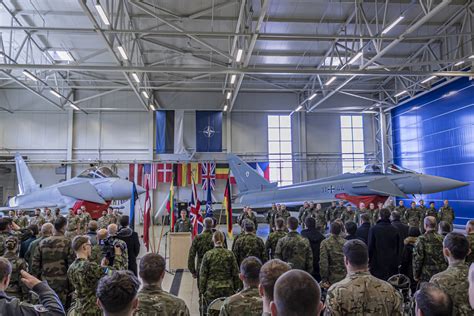
Operation CHESSMAN: Britain’s Forward Presence
The deployment of RAF units to Poland as part of Operation CHESSMAN reflects a broader strategy of forward military presence, aimed at discouraging Russian adventurism. Personnel from across RAF commands are embedded with allied squadrons and operate under real-world combat readiness conditions.
This mission strengthens ties with:
- Poland, a frontline NATO state with increasing military investments,
- The United States, maintaining leadership of joint task forces in the Baltic and Arctic regions,
- Sweden and Finland, enhancing northern flank resilience after their NATO accession.
The importance of this multinational framework is made evident every time allied aircraft scramble in minutes to shadow, deter, or intercept threats.
Escalation Risks and Rules of Engagement
Though no weapons were fired during the 8 June encounter, the potential for miscalculation remains high. Low passes near naval vessels—especially those transporting fuel and munitions—risk triggering defensive responses, especially in congested or contested airspace.
Both sides adhere to a general protocol of air identification zones (ADIZ) and notice to air missions (NOTAMs), but aggressive flying near sensitive ships creates gray zones in international maritime law.
The UK Ministry of Defence and U.S. Department of Defense have refrained from commenting on specifics of the engagement beyond affirming their right to operate in international waters and airspace.
Conclusion: A Familiar, Dangerous Pattern
The RAF interception of Russian Su-24 bombers buzzing the USNS William McLean is not an isolated incident but part of an ongoing geopolitical chess match playing out in the skies over Europe. As NATO forces remain vigilant, each encounter adds to the archive of modern military brinkmanship, reinforcing the necessity for unified deterrence and rapid interoperability.
As tensions persist, the line between posturing and provocation continues to blur—especially when fast jets with combat payloads maneuver near unarmed logistics vessels. The challenge now lies in ensuring that readiness does not become routine, and that discipline triumphs over escalation.