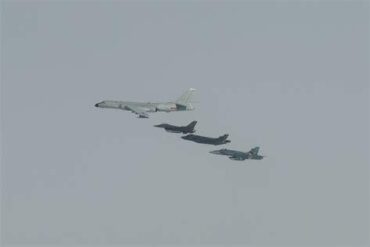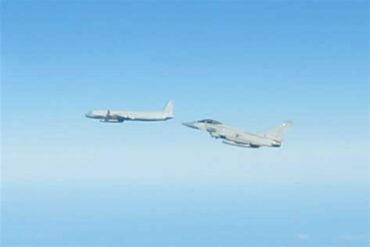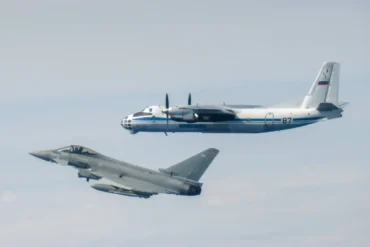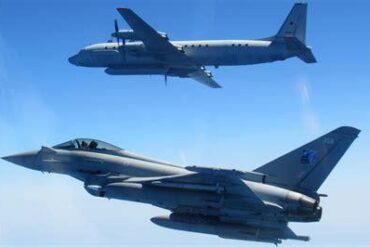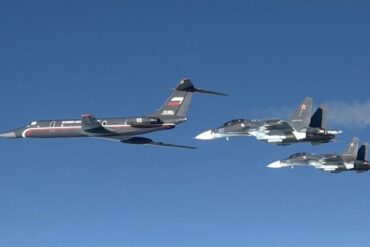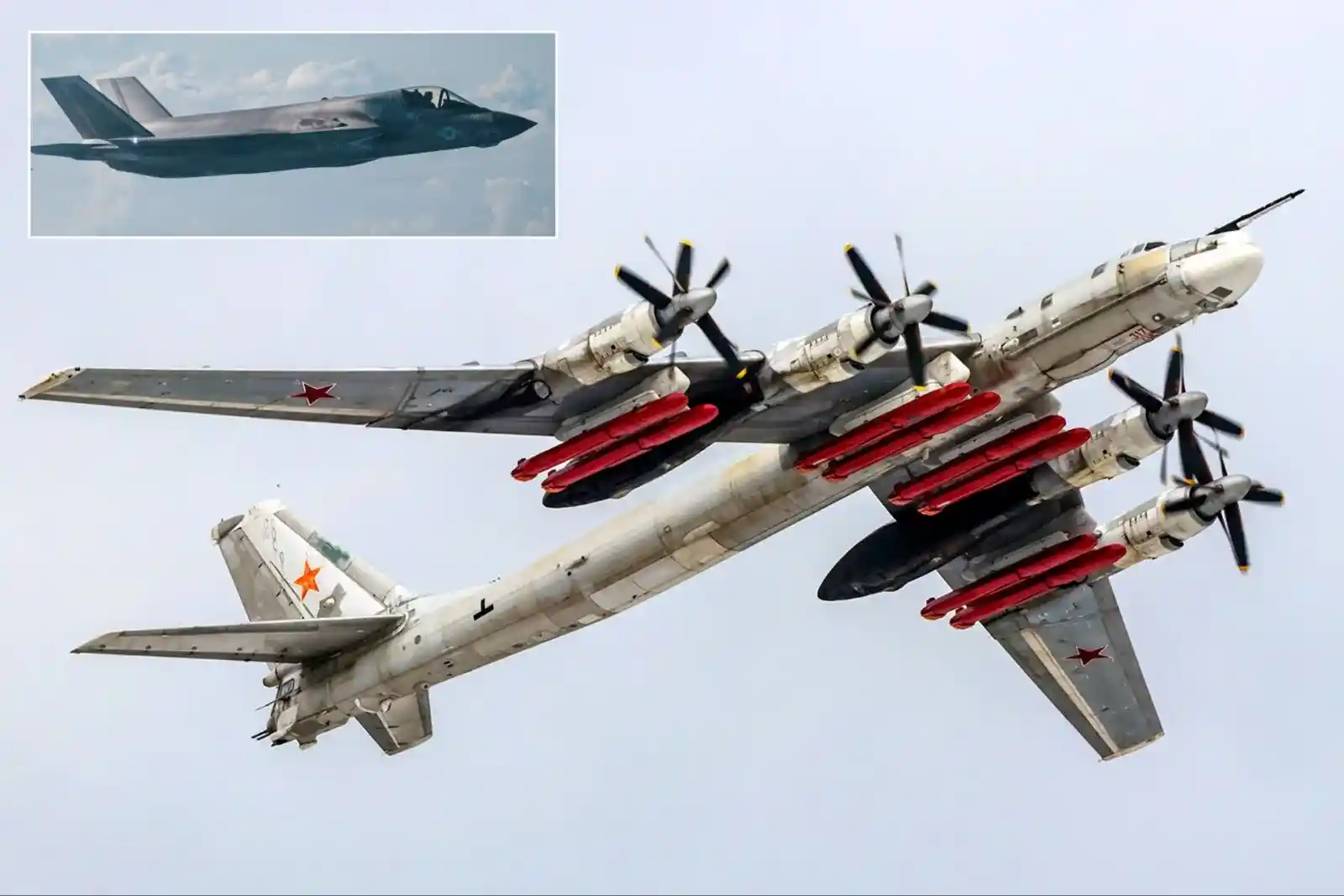
On February 19, 2026, the North American Aerospace Defense Command (NORAD) detected a coordinated Russian air formation operating inside the Alaska Air Defense Identification Zone (ADIZ), triggering a rapid and layered intercept response by the United States and Canada. The formation—comprised of two Tupolev Tu-95 strategic bombers, two Sukhoi Su-35 fighter escorts, and one Beriev A-50 airborne early warning aircraft—remained in international airspace but entered the buffer zone where aircraft are expected to identify themselves for security monitoring purposes.
In response, NORAD scrambled a formidable package: two F-35 Lightning II fighters, two F-16 Fighting Falcons, a U.S. Air Force E-3 Airborne Warning and Control System (AWACS) aircraft, and four KC-135 Stratotankers to sustain operations across the vast Arctic distances. The intercept demonstrated the resilience of North America’s integrated aerospace defense architecture at a time when Russian long-range aviation patrols near the continent have become a recurring strategic signal.
The aircraft never breached U.S. or Canadian sovereign airspace. Yet their presence inside the ADIZ—an early warning perimeter extending beyond territorial boundaries—activated established identification and tracking procedures. In an era of renewed great-power competition, such missions are rarely incidental. They are calibrated displays of reach, readiness, and resolve.
Inside the Alaska Air Defense Identification Zone
The Alaska ADIZ functions as a security buffer designed to provide early detection of approaching aircraft. While it does not constitute sovereign airspace, aircraft operating within it are expected to file flight plans and identify themselves. The zone is monitored through a layered system integrating ground-based long-range radar, space-based sensors, and airborne surveillance platforms.
This architecture is jointly managed by the United States and Canada under NORAD, a binational command established during the Cold War to defend North American airspace. Its mission has evolved from countering Soviet bomber threats to addressing modern risks that include cruise missiles, advanced aircraft, and emerging hypersonic systems. The ADIZ remains a critical early-warning mechanism in that defensive chain.
When unidentified or non-cooperative aircraft appear inside the zone, interceptors are launched not as an act of aggression but as a method of visual identification, deterrence, and reassurance. The process is deliberate, standardized, and constant—proof that deterrence today depends as much on disciplined routine as on dramatic escalation.
The Russian Formation: Strategic Signaling in Motion
The Russian aircraft composition reveals a structured operational profile rather than a routine transit. The Tu-95 Bear, a Cold War-era turboprop bomber still active in Russia’s long-range aviation fleet, is powered by four Kuznetsov NK-12 engines with distinctive contra-rotating propellers. Despite its vintage appearance, the aircraft remains strategically relevant due to its endurance—exceeding 12,000 kilometers of range—and its capacity to carry advanced stand-off weapons such as the Kh-101 cruise missile, assessed to reach distances beyond 2,500 kilometers.
This stand-off capability allows the bomber to theoretically launch precision strikes without penetrating defended airspace. That reality preserves its deterrent value decades after its introduction.
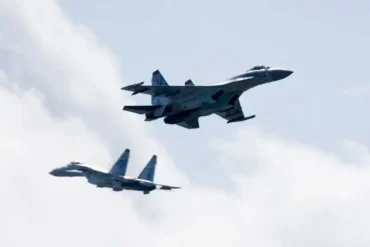
Flanking the bombers were two Su-35 Flanker-E fighters, Russia’s advanced air-superiority platform. Equipped with the Irbis-E passive electronically scanned array radar, the Su-35 can reportedly detect large aerial targets at ranges of several hundred kilometers. Armed with R-77 beyond-visual-range air-to-air missiles, the fighters enhance survivability and protect the bombers during long-distance patrols.
Completing the formation was the Beriev A-50 Mainstay, an airborne early warning aircraft based on the Il-76 transport airframe. Its rotating dorsal radome houses the Shmel radar system, designed to track multiple airborne targets simultaneously and coordinate command-and-control functions. The presence of the A-50 indicates a coordinated training or signaling mission rather than an isolated bomber patrol.
NORAD’s Response: Fifth-Generation Precision Meets Proven Interceptors
NORAD’s intercept package blended cutting-edge technology with battle-tested reliability. The F-35 Lightning II, a fifth-generation stealth fighter, brings sensor fusion capabilities that merge radar, infrared, and electronic data into a unified operational picture. Its AN/APG-81 active electronically scanned array (AESA) radar and distributed aperture infrared system enable long-range detection and persistent tracking without broadcasting a large radar signature.
Complementing the F-35s were F-16 Fighting Falcons, aircraft capable of speeds exceeding Mach 2 and armed with AIM-120 AMRAAM missiles for beyond-visual-range engagements. The F-16 remains a dependable quick-reaction interceptor, frequently deployed for homeland defense missions due to its agility and cost-effective readiness profile.
Above them, the E-3 AWACS extended radar coverage across broad sectors, acting as an airborne command center. Its ability to track aircraft hundreds of kilometers away ensures that interceptors operate with superior situational awareness. The KC-135 Stratotankers played an equally vital role, providing in-flight refueling to sustain the mission across Arctic distances where forward basing options are limited.
This layered response underscores a key strategic principle: air defense in the Arctic is as much about logistics and endurance as it is about speed.
Why the Arctic Matters More Than Ever
Geography remains destiny in aerospace defense. The Arctic represents the shortest air corridor between Eurasia and North America. For long-range bombers and advanced missile systems, polar routes reduce transit times and complicate early-warning calculations.
Beyond its military geometry, the Arctic is gaining economic and geopolitical weight. Melting sea ice is gradually opening maritime routes such as the Northern Sea Route, while vast reserves of energy and critical minerals lie beneath its terrain. Nations bordering the region—including Russia, the United States, and Canada—are investing in infrastructure, surveillance, and force posture adjustments to secure their strategic approaches.
Russia has revitalized Arctic bases, expanded radar coverage, and modernized airfields capable of supporting long-range aviation. Meanwhile, NORAD modernization efforts focus on over-the-horizon radar systems, enhanced satellite tracking, and next-generation intercept capabilities. The February 19 intercept fits squarely within this broader pattern of presence and counter-presence.
Strategic Messaging Without Escalation
Flights like this are choreographed within international law. Operating in international airspace allows Russia to demonstrate capability without crossing into sovereign territory. For Moscow, the patrol signals sustained strategic aviation reach. For Washington and Ottawa, the intercept confirms vigilance and alliance cohesion.
The choreography matters. Fighters approach, establish visual identification, and escort until the formation exits the monitored zone. Communication channels remain open. The encounter becomes a measured exchange of presence rather than confrontation.
Yet the subtext is unmistakable. The inclusion of escort fighters and an airborne command platform signals operational integration. The deployment of fifth-generation interceptors signals technological advantage. Both sides are rehearsing competence.
In the Arctic sky, distance magnifies symbolism. A bomber’s silhouette against polar clouds carries decades of strategic history. An F-35’s sensor sweep reflects the evolution of airpower from raw speed to information dominance.
The February 19 event did not alter borders or ignite crisis. It reaffirmed a reality: the Arctic is no longer peripheral to global security planning. It is central terrain in the geometry of deterrence. As long as long-range aviation patrols continue, NORAD’s layered shield will remain active—quietly tracking, escorting, and signaling that North American airspace, even at its outermost buffer, is neither unobserved nor undefended.