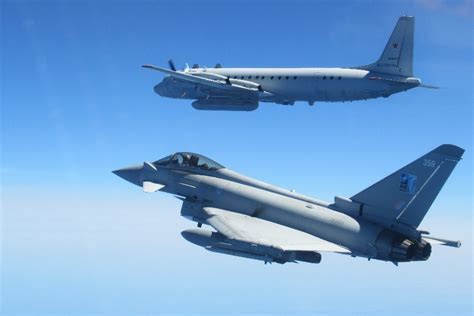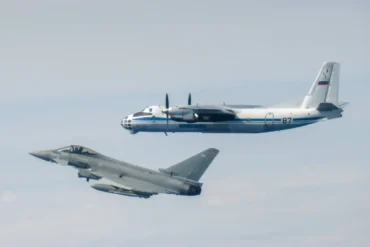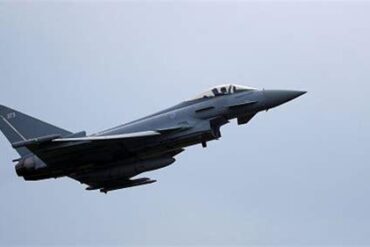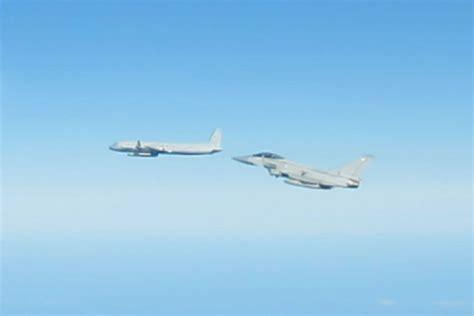
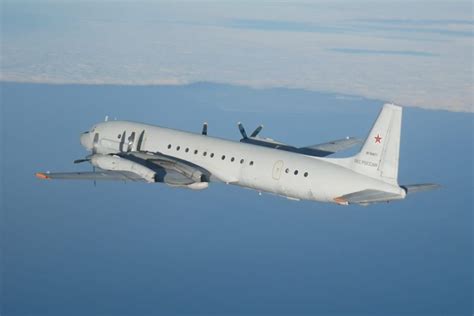
On a tense Saturday over the Baltic Sea, Royal Air Force (RAF) Typhoon FGR4 fighters executed a precision intercept of a Russian Ilyushin Il-20M reconnaissance aircraft, reinforcing NATO’s commitment to defending allied airspace amid rising geopolitical tensions. The aircraft, operating under NATO’s Enhanced Air Policing mission “Chessman,” were scrambled from Malbork Air Base in northern Poland, underlining the constant vigilance maintained by the alliance.
Strategic Interception Near NATO Airspace
The Russian Il-20M, designated by NATO as “Coot-A,” is a sophisticated communications intelligence (COMINT) and electronic signals reconnaissance platform. Its flight path—first intercepted by other NATO forces before altering course—triggered rapid coordination among NATO members. Earlier in the day, three sets of NATO aircraft had already engaged and disengaged from the aircraft as it maneuvered near the airspace of Kaliningrad. When the Il-20M reversed direction and approached Polish airspace, the RAF Typhoons were immediately launched to intercept.
The RAF Typhoons—fighter aircraft renowned for their speed, agility, and state-of-the-art radar systems—engaged the Il-20M as it exited Kaliningrad’s airspace and transitioned into international airspace above the Baltic Sea north of Poland. Maintaining a non-threatening escort position, typically at a 3 o’clock or 9 o’clock angle depending on weather and heading, the Typhoons mirrored the Russian aircraft’s trajectory until Danish QRA fighters took over the mission.
The Il-20M: A High-Value Russian Asset
The Il-20M “Coot-A” plays a pivotal role in Russia’s strategic electronic warfare and surveillance apparatus. Outfitted with multiple antennas, sensor pods, and signal gathering systems, the aircraft is designed to monitor and intercept a wide range of electronic emissions—communications, radar signatures, and telemetry—from NATO systems. Operating near sensitive NATO boundaries, particularly in the Baltic Sea region, the Il-20M poses both a strategic challenge and a statement of Russia’s surveillance intent.
Its flight near NATO airspace is not an isolated incident. Such maneuvers are often interpreted as tests of readiness or efforts to map radar and response patterns. While the aircraft technically remained in international airspace, its close proximity to Polish territory and shift in heading signaled behavior inconsistent with routine civilian aviation.
Quick Reaction Alert: The RAF’s Forward Deployed Force
RAF personnel involved in this interception were from No. II (Army Cooperation) Squadron, operating under the 140th Expeditionary Air Wing (EAW). These forward-deployed aircrews form the core of NATO’s Enhanced Air Policing (eAP) strategy—specifically its operation “Chessman,” a British-led effort to bolster aerial security along NATO’s eastern flank. The presence of Swedish personnel, marking Sweden’s recent accession to NATO, further reinforces the multi-national character of these deterrence efforts.
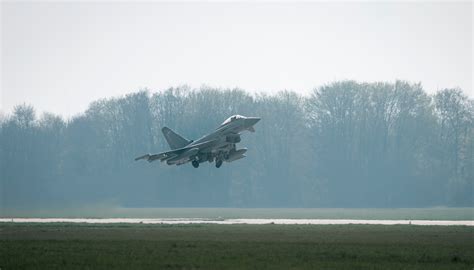
The RAF’s detachment at Malbork Air Base is specifically equipped for QRA duties, which involve immediate launch capabilities and constant readiness to intercept unidentified or non-compliant aircraft. The fast-response nature of this mission demonstrates the seamless interoperability of NATO assets, with control passed efficiently between British and Danish fighter wings.
Kaliningrad’s Role and Russia’s Aerial Strategy
Kaliningrad Oblast, a Russian exclave nestled between NATO members Poland and Lithuania, remains a critical vector in Moscow’s forward-based surveillance operations. Home to a robust suite of air defense systems, missile installations, and command centers, it provides Russia with a strategically fortified launchpad for air and naval operations in the Baltic.
The flight path of the Il-20M—first entering, then leaving, then approaching Kaliningrad’s airspace—mirrors prior reconnaissance missions and is seen as a deliberate move to trigger NATO air defenses and observe their response. In turn, NATO uses these incursions as real-time exercises in interoperability, escalation control, and air dominance.
Maintaining Strategic Deterrence and Avoiding Escalation
The RAF’s interception followed standard NATO air policing protocol. Pilots are trained to approach from neutral angles, maintain steady visual contact, and use non-verbal flight signals to communicate with potentially unresponsive aircraft. These procedures are crucial in avoiding miscalculations or unintended confrontations, particularly when intercepting military aircraft known for limited or no radio contact.
Such intercepts are not merely routine; they are pivotal moments in the tacit dialogue between NATO and Russia. Every maneuver, flight angle, and radio silence sends a message. The RAF’s calm, professional handling of the Il-20M’s interception reflects both discipline and strategic clarity, even in ambiguous circumstances.
Operation Chessman and NATO’s Air Policing Mandate
Operation Chessman underscores the UK’s ongoing commitment to reinforcing NATO’s eastern airspace, a mission that has only grown in urgency since the 2014 annexation of Crimea and the 2022 full-scale invasion of Ukraine. The RAF’s 140th EAW plays a crucial part in deterring further aggression, supporting intelligence collection, and acting as a visible presence along NATO’s frontline states.
RAF Air Vice-Marshal Phil Robinson recently emphasized that “our personnel’s readiness and professionalism reflect the UK’s unwavering dedication to collective defense.” That resolve translates into continuous rotation of aircrews, logistical assets, and command support from across the UK to Poland and beyond.
Danish QRA and Nordic-Baltic Defense Integration
After the initial intercept, the RAF Typhoons handed over escort duties to Danish Quick Reaction Alert (QRA) aircraft, reflecting a broader Nordic-Baltic regional defense integration. Denmark, along with Finland and Sweden, is increasingly vital in NATO’s Baltic Sea posture. The seamless handover illustrates high readiness and joint operational fluency among NATO allies.
The Danish Air Force, operating out of Skrydstrup Air Base, maintains fighter squadrons equipped with F-16 Fighting Falcons—a capable match for regional air policing and intercept operations. The strategic necessity of synchronized patrol coverage ensures that no segment of airspace is left vulnerable.
A Calculated Reminder of NATO’s Shield
While the RAF intercept ended without escalation, the symbolism is unmistakable. A Russian spy plane probing NATO’s response—and NATO’s immediate, professional reply—forms a clear message to adversaries: the skies over allied nations are not open to intimidation.
These air policing missions are more than tactical exercises; they are strategic assertions of sovereignty, cohesion, and resolve. They demonstrate that even in peacetime, NATO is prepared to act decisively and responsibly in the face of ambiguity.
The UK’s continued leadership in these missions, combined with the increasing involvement of Nordic and Baltic allies, reflects a collective shift toward deterrence by presence. As long as Russian surveillance operations persist near NATO airspace, such intercepts will remain not only necessary but emblematic of a deliberate and united defense posture.