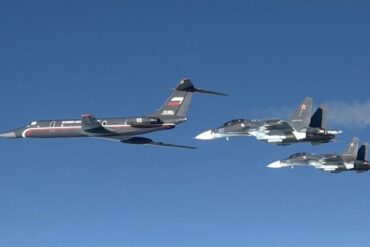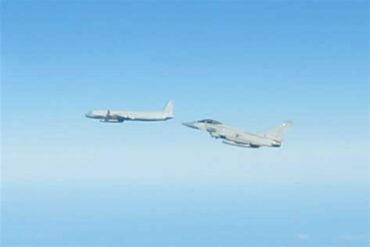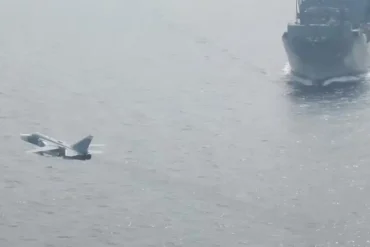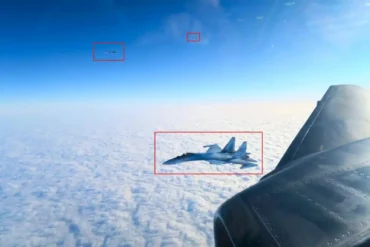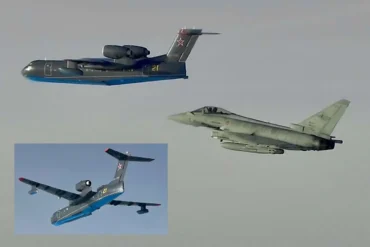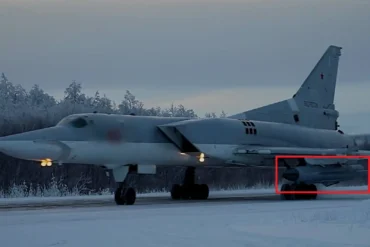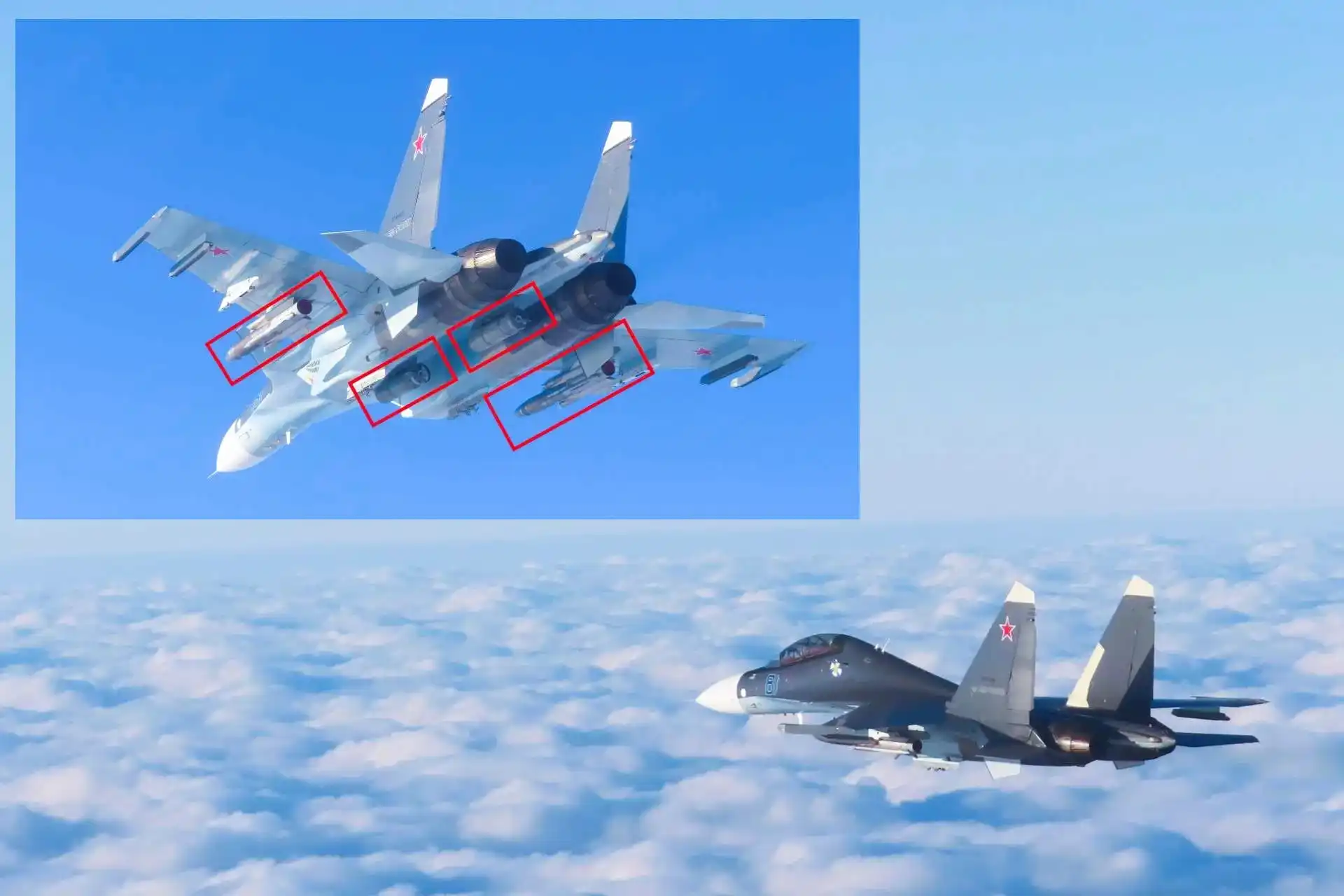
Spain’s EF-18M Hornet fighters, deployed under NATO’s Baltic Air Policing mission, intercepted a Russian Navy Su-30SM2 fighter jet over the Baltic Sea in late January 2026, capturing rare close-range imagery of the aircraft armed with a mixed and highly unusual strike loadout. The encounter, confirmed by the Spanish Ministry of Defence, offers an unusually detailed glimpse into how routine air policing missions are increasingly intersecting with aircraft configured for high-intensity combat operations near NATO airspace.
The interception took place on January 28, 2026, when Spanish pilots from the 15th Wing operating out of Šiauliai Air Base, Lithuania, were scrambled on quick reaction alert (QRA) to identify Russian military aircraft flying close to Allied borders. As has become common in the Baltic region, the Russian aircraft were operating in international airspace without active transponders and without filed flight plans, triggering NATO’s standard identification procedures.
What made this particular intercept stand out was not merely its proximity or professionalism, but the striking weapons configuration carried by one of the Russian jets. The Spanish Hornet pilots visually identified and photographed a Su-30SM2 carrying Kh-31 missiles alongside RBK-500 series cluster bombs, a combination rarely documented so close to NATO-controlled airspace.
NATO Baltic Air Policing Meets High-Intensity Reality
Baltic Air Policing was originally conceived as a straightforward sovereignty mission, ensuring that Lithuania, Latvia, and Estonia, which lack their own fighter fleets, could rely on Allied aircraft to monitor and defend their airspace. Over time, however, the mission has evolved into something far more complex. The increased tempo of Russian military aviation activity has transformed routine intercepts into encounters with aircraft configured for real-world strike missions rather than symbolic presence flights.
The Spanish detachment, operating under the “Vilkas” call sign, was tasked with identifying multiple Russian aircraft approaching NATO airspace from the direction of the Kaliningrad exclave. Guided by NATO’s Combined Air Operations Centre, the EF-18M Hornets climbed to intercept, established visual contact, confirmed aircraft types and markings, and escorted the formation away from Allied airspace in accordance with established rules of engagement.
One aircraft immediately drew attention: a Su-30SM2 bearing the Russian Navy marking “81 Blue” (RF-81885). Unlike many previous intercepts involving clean or lightly armed fighters, this jet carried a visibly heavy and diverse weapons load, signalling a posture far removed from peacetime training flights.
The Su-30SM2 and Kaliningrad’s Expanding Strike Role
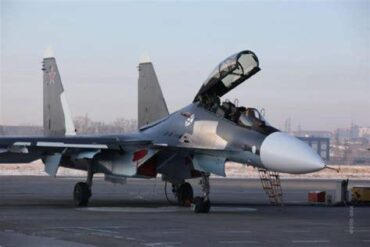
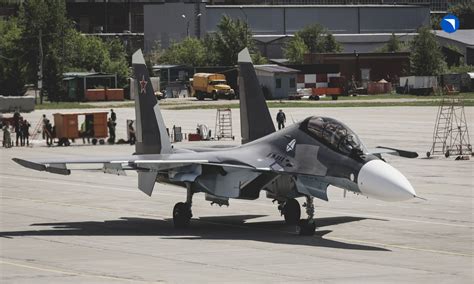
The intercepted aircraft is assessed to belong to the 4th Guards Naval Attack Aviation Regiment, based at Chernyakhovsk Air Base in Kaliningrad. This regiment operates under the Baltic Fleet’s Naval Aviation Command and fields a mix of Su-30SM, Su-30SM2, and Su-24M aircraft, giving Russia a versatile air arm dedicated to maritime and coastal strike operations.
The Su-30SM2 represents the most advanced naval variant of the Su-30 family. It incorporates systems derived from the Su-35S, most notably the Irbis-E passive electronically scanned array (PESA) radar. This radar significantly extends detection and tracking ranges, enabling the aircraft to monitor dozens of aerial and surface targets simultaneously while engaging multiple threats. Combined with upgraded mission computers, electronic warfare systems, and datalinks, the Su-30SM2 is optimised for air superiority, maritime strike, and suppression of enemy air defences.
Within Russian doctrine, Kaliningrad-based Su-30SM2s act as a flexible extension of the region’s already formidable anti-access/area denial (A2/AD) network. They complement ground-based missile systems and naval assets, allowing Russian commanders to project power rapidly across the Baltic Sea while complicating NATO’s defensive planning.
A Rare and Revealing Weapons Loadout
The imagery released by Spain shows the Su-30SM2 carrying two Kh-31 family missiles on its inner wing pylons and two RBK-500 cluster bombs on mid-wing stations, supported by external fuel tanks. This configuration is noteworthy not only for its rarity but for the breadth of mission profiles it enables in a single sortie.
The Kh-31 is a ramjet-powered, supersonic air-to-surface missile designed for high-speed penetration of defended airspace. In its Kh-31A variant, it functions as an anti-ship missile, using an active radar seeker to engage surface vessels at ranges of roughly 70 kilometres. In the Kh-31P and Kh-31PD variants, it becomes an anti-radiation missile, homing in on radar emissions and capable of ranges exceeding 100 kilometres, depending on the version.
Paired with these missiles, the RBK-500 series represents a very different kind of threat. These 500-kilogram cluster bombs can be loaded with a range of submunitions, from high-explosive fragmentation bomblets to SPBE-D sensor-fuzed anti-armour submunitions capable of autonomously detecting and attacking vehicles from above. A single RBK-500 can disperse well over a hundred bomblets, saturating large areas and making it particularly effective against airfields, troop concentrations, and lightly protected infrastructure.
Together, this mix allows a single aircraft to conduct stand-off strikes against ships or radar sites while retaining the ability to deliver area-effect munitions against ground targets in the same mission. It is a configuration far more consistent with combat operations than with routine patrols.
Strategic Signalling in the Baltic Theatre
The presence of such a loadout near NATO airspace inevitably raises questions about intent. From a military standpoint, Russian Naval Aviation units in the Baltic have increasingly trained for integrated strike missions, combining missile launches and conventional bombing against simulated airfields, coastal targets, and amphibious forces. Flying a Su-30SM2 with this configuration in international airspace may serve several purposes simultaneously.
Operationally, it provides realistic training for aircrews tasked with executing complex strike profiles under the watchful eye of NATO fighters. Politically and strategically, it functions as a form of signalling, demonstrating that Kaliningrad-based aviation is prepared to employ the same kinds of weapons and tactics seen in other theatres, including Ukraine, in the Baltic region.
For NATO pilots, intercepting an aircraft visibly armed with cluster munitions and supersonic missiles changes the character of what might otherwise be considered a routine mission. The encounter underscores how quickly a crisis could escalate if miscalculations or accidents occur in such crowded and contested airspace.
Legal and Normative Contrasts on Display
The RBK-500 bombs observed during the intercept also highlight a profound legal and ethical divide between Russia and many NATO members. Spain is a signatory to the Convention on Cluster Munitions, having ratified the treaty in 2009 and eliminated its own stockpiles. The convention bans the use, production, and transfer of cluster munitions due to their indiscriminate effects and long-term danger to civilians.
Russia, by contrast, is not a party to the convention and continues to regard cluster munitions as legitimate weapons. Their use has been widely documented in conflicts such as Syria and Ukraine, where unexploded submunitions have caused significant civilian harm long after hostilities.
The sight of a Russian aircraft carrying such weapons near Allied borders brings this asymmetry into sharp focus. For NATO planners, it reinforces the reality that any conflict in the Baltic would involve weapons systems and tactics that many Allies have deliberately renounced on humanitarian grounds.
Kaliningrad’s Central Role in Regional Deterrence
Kaliningrad’s transformation into a heavily militarised enclave has been one of the defining features of European security over the past decade. The region hosts S-400 air defence systems, Bastion-P coastal defence missiles, Iskander-M ballistic missiles, and a reinforced naval presence. The addition of modernised Su-30SM2 squadrons adds a mobile and adaptable strike element to this already dense network.
From a deterrence perspective, this concentration of capabilities gives Russia significant leverage in the Baltic Sea. From a vulnerability standpoint, it also creates a compact target set that would be exposed to Allied air and missile power in a high-intensity conflict. The intercept by Spanish Hornets illustrates both sides of this equation: Kaliningrad’s aircraft can threaten wide areas, but they are also constantly monitored and challenged by NATO forces.
An Ordinary Intercept With Extraordinary Implications
On the surface, the January 28 intercept followed well-rehearsed procedures that NATO pilots execute hundreds of times each year. Yet the details revealed by Spain’s release show how the strategic environment has shifted. Routine air policing now routinely involves aircraft configured for real strike missions, blurring the line between peacetime vigilance and wartime readiness.
For NATO, the episode reinforces the need for persistent air policing, seamless coordination with ground-based air and missile defences, and clear crisis-management mechanisms to prevent miscalculation. For Russia, it demonstrates a willingness to operate visibly armed aircraft close to Alliance airspace as part of a broader strategy of deterrence and signalling.
In the tight and politically charged airspace over the Baltic Sea, even a standard intercept can offer a snapshot of the forces, doctrines, and risks shaping Europe’s northeastern flank. The close-range images captured by Spanish EF-18M Hornets are not just striking photographs; they are a visual reminder that the Baltic has become a frontline where preparedness, restraint, and professionalism coexist with unmistakable signs of high-end military confrontation.