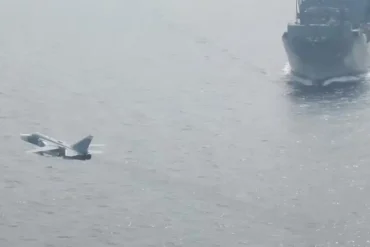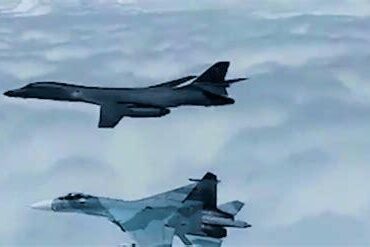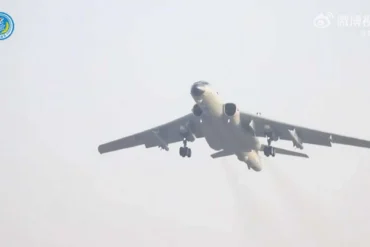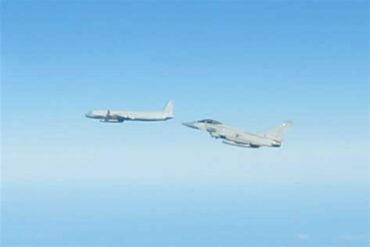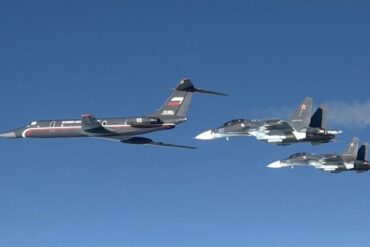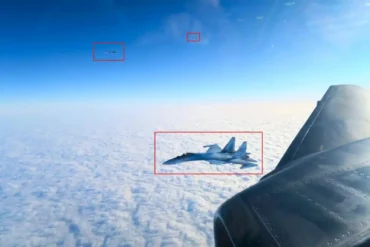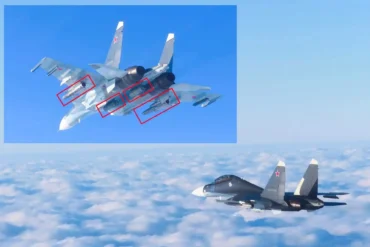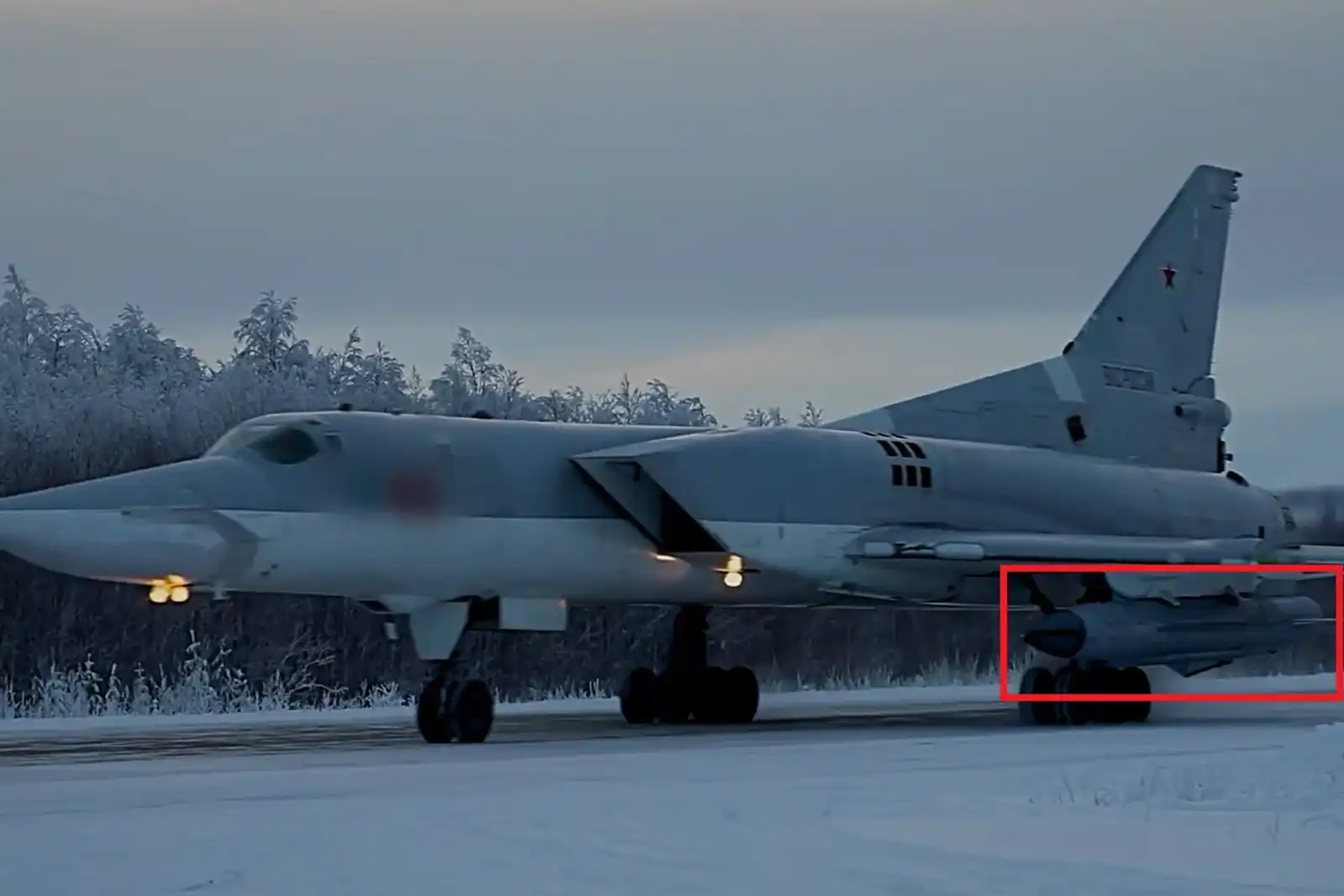
The surge in long-range Russian aviation activity over northern Europe entered another high-visibility phase as Tu-22M3 bombers armed with Kh-32 stand-off missiles flew a more than five-hour patrol over the Baltic Sea on November 27. The mission, escorted by Su-35S and Su-27 fighters and shadowed at intervals by NATO aircraft, aligned closely with Moscow’s strategy of demonstrating credible strike reach against the Alliance’s maritime posture during a heightened period of regional tension.
Russia’s Defence Ministry framed the flight as a scheduled patrol executed in full compliance with international airspace rules. Yet the aircraft selection and missile configuration tell a more precise story: a deliberate showcase of maritime strike capability using the Tu-22M3 Backfire-C, a platform built for high-speed penetration and heavy anti-ship weapon employment. Operating over neutral waters but within launch range of NATO naval targets, the flight re-established a classic Soviet-era tactic—projecting power into the Baltic without crossing territorial airspace.
The Tu-22M3’s role in this theatre is not symbolic. Its variable-geometry wings and boosted NK-25 engines allow sustained supersonic speeds, giving the bomber a uniquely flexible strike profile. Configured for Kh-22 or Kh-32 employment, the aircraft functions as a stand-off launch node able to threaten large surface combatants, carrier groups, and critical infrastructure while remaining outside most modern naval air-defence envelopes.
Kh-32 Missiles Extend the Threat Envelope Across Northern Europe
The centrepiece of the mission’s deterrent value is the Kh-32, the modernized successor to the Cold War–era Kh-22. Designed to overcome the layered missile defences of contemporary fleets, the Kh-32 ascends to high altitudes before diving toward its target at extreme velocity, compressing reaction time for intercepting systems. Open-source assessments place its engagement range at 800–1,000 kilometres, giving Russia the ability to target ports, logistics hubs, and ships across almost the entire Baltic basin.
The missile’s guidance upgrades and resistance to electronic interference reflect Russia’s attempt to preserve relevance for legacy platforms through selective modernization. Its role in Ukraine—where both Kh-22 and Kh-32 have been used extensively against infrastructure—also reinforces how these ageing but potent systems remain integral to Russia’s long-range strike doctrine.
Fighter Escorts Shape a Multi-Layered Air Picture
Supporting the bomber formation were Su-35S and Su-27 fighters, whose presence created a layered defence bubble around the Tu-22M3s. The Su-35S, with its long-range Irbis-E radar and infrared search-and-track suite, provides early detection of interceptors approaching from any vector. In the tight and heavily monitored airspace of the Baltic region, this escort structure delivers both protection and situational awareness, preventing close inspection by NATO aircraft except under carefully controlled conditions.
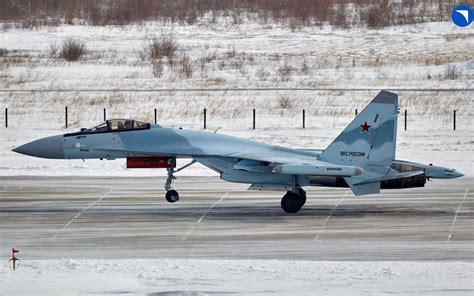
Russian media emphasised the presence of foreign aircraft shadowing the formation, an expected outcome in a region where NATO air policing operates continuously. These interactions have become almost ritualistic: Alliance fighters move in for visual identification, Russian escorts maintain a predictable defensive posture, and both sides record the encounter for public affairs releases.
A Platform With Decades of Evolution and Persistent Strategic Relevance
The Tu-22M series dates back to the 1970s, originally designed to counter NATO carrier groups. The M3 variant introduced improved avionics, stronger engines, and expanded strike capability. Ongoing modernization efforts—particularly the Tu-22M3M upgrade—integrate new digital systems and precision-strike compatibility, signaling that Russia views the aircraft as a long-term strategic asset.
This longevity is paired with vulnerability. Ukrainian long-range drone strikes and the reported downing of a Tu-22M3 by a modified S-200 system in 2024 inflicted significant losses. Yet Russia has continued to deploy the bombers in both combat and patrol roles, leveraging their payload capacity and psychological impact. The Baltic flight therefore served as both a training sortie and a message of continuity: despite attrition, Russia will not retire its long-range aviation presence.
Baltic Geography Amplifies the Mission’s Deterrent Value
The Baltic Sea is one of the world’s most compressed strategic environments. From international airspace, a Tu-22M3 can hold targets at risk across Finland, Sweden, Estonia, Latvia, Lithuania, Poland, and segments of northern Germany without breaching territorial boundaries. This makes every such flight inherently political, even when labeled as routine.
The geography favours stand-off systems. A Baltic-launched Kh-32 could reach deep inland with minimal warning. Shipborne missile defences face an extremely narrow reaction window, especially against high-velocity dive profiles. These constraints force NATO planners to rely more on persistent surveillance, dispersal of naval assets, and pre-emptive posture adjustments rather than on last-ditch interception.
Strategic Messaging to NATO and the Nordic Region
Russia has conducted recurring Tu-22M3 patrols over the Baltic between 2023 and 2025, often corresponding with spikes in regional tension or notable developments in the war in Ukraine. With Finland and Sweden now fully integrated into NATO, Russia’s northern flank faces its most consolidated Alliance alignment in history. Long-range bomber patrols offer Moscow a signalling tool that does not violate sovereign airspace yet clearly communicates capability and intent.
For NATO states surrounding the Baltic, these missions underscore a hard reality: their ports, logistics corridors, and naval task groups remain vulnerable to stand-off strike systems even when Russia’s bomber fleet is operating far from their borders. The Alliance must continuously divert fighters, tankers, and radar assets to monitor these flights—stretching already limited European airpower resources.
Beyond a Training Flight: A Real-Time Indicator of Power Balance
The November 27 sortie was publicly described as routine, yet its strategic weight is unmistakable. It showcased Russia’s ability to field missile-carrying bombers under fighter escort, rehearse maritime strike profiles in congested airspace, and sustain long-range aviation operations despite battlefield losses and industrial pressure.
This pattern, now entrenched across 2025, reflects an evolving reality in European security: every Russian bomber patrol over the Baltic doubles as a strategic communiqué. The region’s airspace has become a signalling arena where presence, posture, and payload are read as carefully as diplomatic statements. Each flight is not merely a training mission—it is an ongoing measure of the shifting balance between Moscow and the Euro-Atlantic alliance.