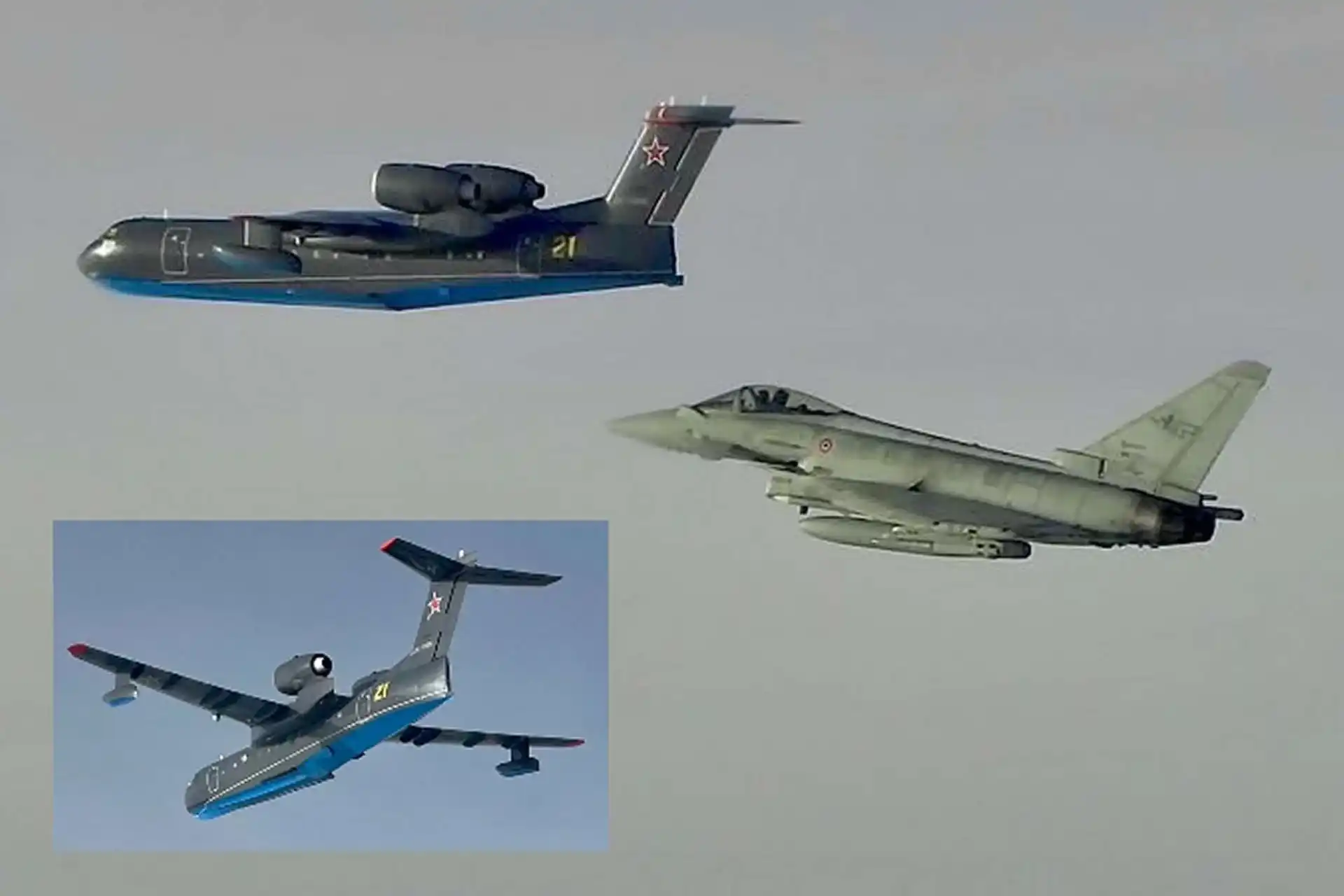
On January 16, 2026, NATO’s continuous air policing efforts along its eastern flank were put to the test as Italian Eurofighter Typhoon jets were scrambled to intercept a rare Russian Beriev Be-200 aircraft flying near the Baltic Sea, close to NATO-monitored airspace. This incident highlights NATO’s ongoing vigilance and the complexity of handling military air traffic in the tense region. While the Beriev Be-200 is not typically associated with military operations, its appearance sparked a rapid response from NATO, emphasizing the alliance’s high-alert status and the challenging dynamics of airspace management in the face of increasing Russian military activity.
Eurofighter Typhoons Deployed for Identification
The interception was carried out by Italian Air Force Eurofighter Typhoons, which had been stationed at the Ämari Air Base in Estonia as part of NATO’s routine Baltic air policing mission. The mission’s goal was to visually identify the Russian Be-200 aircraft, which had been detected flying in the Baltic Sea region near NATO’s eastern airspace boundary. This operation is part of NATO’s broader strategy to ensure airspace security by maintaining constant surveillance and responding quickly to potential threats.
The Eurofighters were deployed under standard quick reaction alert procedures, which are designed to ensure that NATO can identify any aircraft that might be a potential threat or pose a risk to the safety and security of its airspace. Importantly, the Be-200 was flying within international airspace, meaning there was no breach of NATO’s sovereign airspace, but the mission was nonetheless crucial for monitoring and ensuring that the aircraft’s intentions were clear.
The Rare Appearance of the Beriev Be-200
The Russian Beriev Be-200 is a multi-role amphibious aircraft that is rarely seen in NATO’s operating picture. Unlike the typical targets of air policing missions, such as bombers, fighter jets, or reconnaissance platforms, the Be-200’s primary functions are far more specialized. This aircraft is designed for a wide range of roles, including firefighting, search and rescue, transport, and maritime utility operations. It is capable of carrying up to 12,000 liters of water for firefighting and can transport approximately 72 passengers in a civilian configuration.
Its presence in NATO’s airspace monitoring system is unusual, especially in the context of a high-density air and maritime corridor like the Baltic Sea, where airspace is continuously surveilled. The Be-200’s appearance created operational ambiguity for NATO, as its true intentions were unclear at the time of detection. The aircraft’s dual-use nature as both a humanitarian and military asset meant that it could serve multiple purposes, and NATO needed to ensure that the flight did not escalate into a more provocative military activity.
The Importance of Air Policing in the Baltic
The Baltic Sea region is a critical area for NATO’s air policing missions, with tensions in the region escalating since 2022. The close proximity of civil and military air traffic, along with frequent Russian military aircraft maneuvers, necessitates constant vigilance and rapid response capabilities. NATO’s air policing mission is structured around quick deployment of fighter jets to intercept and identify aircraft in a timely manner, ensuring that no miscalculations or misunderstandings occur.
In this case, the Eurofighter Typhoons were well-suited to the task. Capable of speeds up to Mach 2 and operating at altitudes exceeding 55,000 feet, the Typhoon is equipped with advanced sensor systems, including the PIRATE infrared search-and-track system, which enables it to detect and track aircraft in the region. These advanced capabilities make the Eurofighter Typhoon an ideal platform for ensuring the safe identification of aircraft in such sensitive environments. The ability to visually identify and track aircraft, and then maintain a safe distance, is a critical part of NATO’s mission to prevent escalation and preserve air safety.
The Strategic Significance of the Be-200’s Appearance
The presence of the Be-200 near NATO’s airspace was a notable event, not necessarily because of the platform’s mission profile, but because of the broader operational implications. The Be-200, designed for maritime roles, could be used for humanitarian or emergency tasks, such as conducting search-and-rescue operations or transporting critical supplies across the region. However, its appearance in the Baltic could also serve a different purpose—one related to testing NATO’s reaction times and protocols.
The aircraft’s association with maritime emergency roles and its potential use in personnel or equipment transportation adds to the strategic complexity. The Be-200’s relatively large size and payload capacity mean that it could serve a variety of purposes, including moving personnel or equipment between coastal bases. This capability, in conjunction with its multi-role profile, could potentially be used to test NATO’s reaction to an aircraft that is not a clear-cut threat but still requires identification. This creates an environment where NATO must act swiftly to maintain situational awareness without escalating tensions unnecessarily.
A Routine Training or Strategic Signaling?
While there are many plausible explanations for the Be-200’s appearance near NATO’s airspace, two primary interpretations stand out. The first and least provocative explanation is that the flight served a routine readiness purpose. Given the Be-200’s association with search-and-rescue and maritime operations, it is possible that the flight was part of a training exercise or proficiency mission. The Baltic Sea’s challenging weather conditions and dense air traffic patterns make it a critical area for training, ensuring that Russian crews remain familiar with long-range overwater navigation, communications procedures, and emergency response protocols.
On the other hand, the presence of the Be-200 could have served a more subtle signaling purpose. While the aircraft is not primarily used for intelligence gathering, its large size and unique profile could be used as a form of “soft probing.” By sending a multi-role aircraft into NATO’s monitoring area, Russia could gauge NATO’s response times, interception strategies, and the general level of readiness in the region. This would allow Russia to assess how NATO reacts to non-traditional aircraft near its airspace without causing the overt escalation associated with a military bomber or reconnaissance platform.
NATO’s Preparedness in the Face of Growing Tensions
NATO’s response to the Be-200 sighting emphasizes the alliance’s preparedness and its commitment to maintaining airspace integrity in the Baltic region. The intercept was conducted in a controlled and professional manner, with NATO officials confirming that no airspace violation occurred. However, the incident underscores the ongoing challenges faced by NATO in a region where tensions are high, and the margin for error is narrow. The ability to detect, identify, and monitor even atypical platforms is a cornerstone of NATO’s deterrence strategy, as it ensures that the alliance remains ready to respond to any potential threat, no matter how unusual or ambiguous the situation may seem.
In a region where every action and reaction is scrutinized, NATO’s ability to adapt to emerging challenges is crucial for maintaining stability and preventing miscalculation. The Be-200 interception serves as a reminder that even rare and unexpected aircraft can trigger complex operational procedures, requiring quick decision-making, careful analysis, and prompt action to ensure the safety and security of NATO’s airspace.