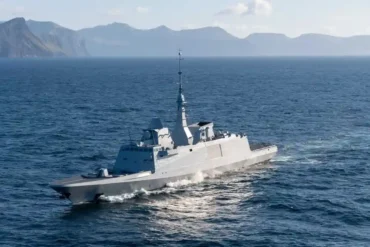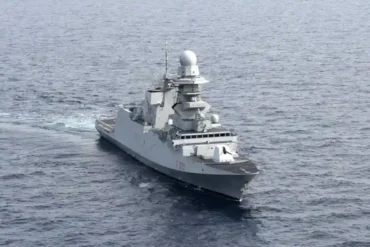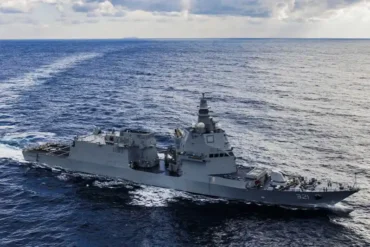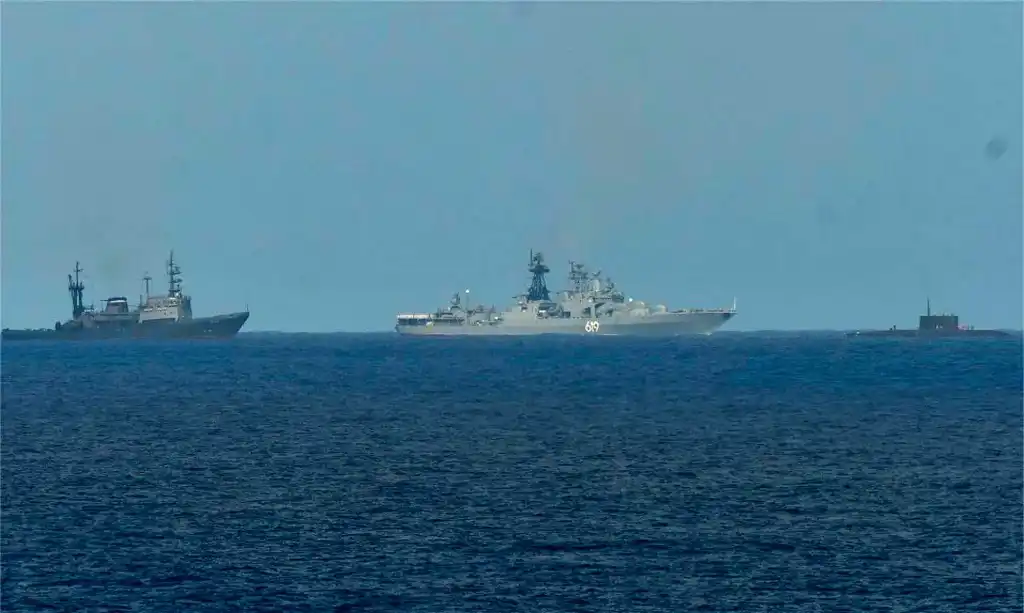
The central Mediterranean has once again become a theater of close naval scrutiny as the Italian Navy’s ITS Virginio Fasan, a Carlo Bergamini-class FREMM frigate, conducted persistent shadowing operations against the Russian Kilo-class submarine Krasnodar. The encounter unfolded under the framework of Standing NATO Maritime Group Two (SNMG2), highlighting the sharpening edge of undersea competition between NATO and Russia in one of the world’s most strategically dense maritime corridors.
The operation, confirmed by NATO Maritime Command, involved continuous surface and subsurface tracking as the Russian submarine transited through the region under escort. The presence of both allied and Russian naval assets in close proximity underscored a familiar but increasingly consequential pattern: deliberate signaling, disciplined restraint, and constant intelligence collection in contested waters where miscalculation carries strategic weight.
This interaction was not an isolated patrol but part of a broader NATO maritime security posture aimed at maintaining situational awareness across the Alliance’s southern flank. As undersea platforms grow quieter and more capable, surface combatants like Virginio Fasan play a decisive role in denying anonymity to submarines operating near critical sea lines of communication.
NATO Surveillance Operation in a Crowded Strategic Sea
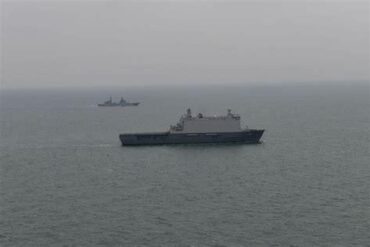
According to operational disclosures released on January 26, 2026, ITS Virginio Fasan was tasked with tracking Krasnodar, a Project 636.3 Improved Kilo-class submarine, as it moved through the central Mediterranean. The submarine was accompanied by the Udaloy-class destroyer Severomorsk and additional Russian support vessels, forming a compact surface-undersea task group designed to protect high-value assets during transit.
The Mediterranean’s geography compresses naval activity into narrow passages surrounded by NATO territory, making discretion difficult and detection more likely. In this environment, NATO’s approach emphasizes persistent presence rather than episodic interception, ensuring that Russian movements are monitored continuously rather than reactively. The shadowing operation reflected this doctrine, combining surface sensors, airborne assets, and allied intelligence feeds into a unified operational picture.
The Stealth and Strike Profile of the Krasnodar
The Krasnodar represents one of Russia’s most effective conventional submarines operating beyond its home waters. Designed for low acoustic signatures, the Improved Kilo-class has earned a reputation within NATO as a “black hole” due to its difficulty to detect in littoral environments. Armed with Kalibr land-attack cruise missiles, the submarine offers Moscow a flexible tool for both deterrence and long-range precision strike.
Its combat record adds weight to its presence. In previous Mediterranean deployments, Krasnodar demonstrated its ability to launch missiles against targets in Syria, reinforcing Russia’s capacity to project power from beneath the sea. In the context of 2026, such patrols are widely interpreted as strategic messaging, reminding NATO that Russian submarines can operate close to Alliance territory while holding critical infrastructure at risk.
Severomorsk and the Protective Escort Formation
The inclusion of Severomorsk, an Udaloy-class destroyer, added an important layer to the Russian formation. Optimized for anti-submarine warfare, the destroyer brings hull-mounted sonar, towed arrays, and embarked helicopters capable of detecting and deterring hostile submarines. Its role during the transit was to shield Krasnodar from potential underwater threats while signaling Russia’s intent to operate openly rather than covertly.
This surface escort also served a diplomatic purpose. By pairing a submarine with a visible destroyer, Russia reduced ambiguity around its movements, framing the transit as a lawful naval passage while still compelling NATO to commit resources to tracking and analysis.
Italian FREMM Capabilities in Anti-Submarine Warfare
The ITS Virginio Fasan is among the most capable anti-submarine warfare frigates in Europe. As part of Italy’s FREMM program, the ship integrates advanced sonar suites, MU90 torpedoes, and embarked ASW helicopters equipped with dipping sonar and sonobuoys. These systems allow the frigate to maintain contact across multiple layers of the water column, even against quiet diesel-electric submarines.
Beyond hardware, the engagement showcased Italy’s growing operational confidence within NATO frameworks. Italian crews routinely operate in multinational task groups, blending national expertise with allied command structures. This interoperability is essential in the Mediterranean, where rapid information sharing often determines whether a contact is fleeting or sustained.
Standing NATO Maritime Group Two and Regional Deterrence
SNMG2 is one of NATO’s four permanent maritime groups and functions as a high-readiness naval force capable of immediate deployment. Its mission spans freedom of navigation, collective defense, and real-time maritime awareness, particularly across the Mediterranean and adjacent seas. The group’s rotational composition ensures a continuous allied presence without overburdening individual navies.
Italy’s role within SNMG2 has expanded steadily, supported by geography and investment in modern surface combatants. As Russian naval activity increases, Italian leadership within the group has become a stabilizing factor, reinforcing NATO’s ability to respond proportionally while avoiding escalation.
A Contested Maritime Future
The shadowing of Krasnodar illustrates how the Mediterranean has evolved into a contested undersea battlespace where surveillance, signaling, and deterrence intersect daily. Submarine movements now carry implications beyond immediate military calculations, touching on energy security, undersea communications, and alliance credibility.
For NATO, maintaining visibility over such deployments is essential to preserving strategic balance. For Russia, demonstrating freedom of movement remains a core objective. The quiet pursuit by ITS Virginio Fasan captured this dynamic perfectly: professional, restrained, and unmistakably purposeful, reflecting a maritime rivalry defined less by confrontation than by constant, watchful proximity.