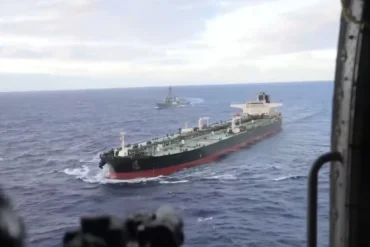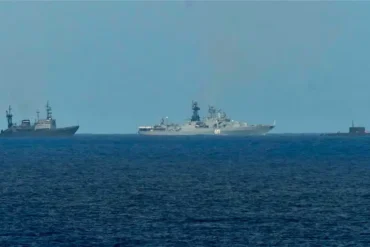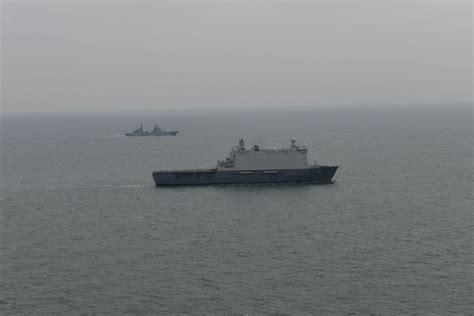
The Royal Netherlands Navy has conducted a closely monitored interception and escort of a Russian warship and accompanying oil tanker as the vessels transited the Dutch sector of the North Sea, underscoring the increasingly watchful posture adopted by NATO navies across Europe’s most strategically sensitive maritime corridors. The operation, confirmed by the Dutch Ministry of Defense, reflects a pattern that has become familiar yet no less significant: Russian naval movements pressing against the outer edges of NATO’s maritime perimeter, met by disciplined, highly procedural responses from alliance members.
According to Dutch defense officials, the offshore patrol vessel DSS Galatea was dispatched to shadow the Russian Steregushchy-class frigate Boiky and the fleet oiler General Skobolev as they entered Dutch-controlled waters from the south. The Dutch ship maintained continuous surveillance and escort until the Russian vessels exited the Netherlands’ Exclusive Economic Zone (EEZ), at which point responsibility for monitoring was transferred seamlessly to allied NATO naval forces operating in adjacent waters. The operation unfolded without incident, but its implications extend well beyond routine seamanship.
This episode illustrates how the North Sea has evolved into a quiet but intensely monitored theater of strategic signaling. While international law permits the passage of foreign military vessels through EEZs, the concentration of energy infrastructure, undersea data cables, and commercial shipping lanes has transformed these waters into a frontline of maritime awareness. Each transit is now logged, analyzed, and folded into a broader intelligence picture that stretches from the Arctic to the Mediterranean.
A Routine Escort With Strategic Weight
The Dutch Ministry of Defense described the escort as a standard procedure, yet officials were careful to emphasize the precision and coordination involved. As soon as the Russian vessels crossed into the Dutch EEZ, DSS Galatea established visual and electronic contact, maintaining a steady presence designed to observe, document, and deter any deviation from internationally accepted navigation norms. This posture is neither confrontational nor passive; it is calibrated, deliberate, and unmistakably visible.
Such escorts serve several purposes at once. They reassure domestic audiences and commercial operators that maritime approaches are being actively protected. They provide NATO with real-time data on Russian ship behavior, sensor use, and formations. Just as importantly, they send a clear message to Moscow that movements near European waters are neither unnoticed nor uncontested, even when they remain legally permissible.
The North Sea, bounded by some of NATO’s most economically vital states, has become a particular focus of this vigilance. Offshore wind farms, gas pipelines, and dense shipping traffic mean that any foreign naval activity carries heightened sensitivity, especially when paired with auxiliary vessels capable of sustaining prolonged operations.
Understanding the Role of the Exclusive Economic Zone
The legal framework underpinning these interactions is defined by the United Nations Convention on the Law of the Sea (UNCLOS). An EEZ extends up to 200 nautical miles from a nation’s coastline, granting it sovereign rights over natural resources and economic activity, while still allowing freedom of navigation for foreign military vessels. In practice, however, EEZs have become zones of strategic friction, where legality and security concerns intersect.
For NATO navies, the EEZ is no longer just an economic boundary. It is an early-warning buffer and a surveillance envelope where unusual patterns of movement are scrutinized. Repeated Russian transits through multiple European EEZs have sharpened this focus, particularly when such movements coincide with geopolitical tension elsewhere.

A Pattern of Persistent Russian Naval Activity
Dutch officials noted that this was not an isolated incident. DSS Galatea has reportedly escorted multiple Russian transits in recent days, indicating a sustained tempo rather than a one-off passage. This mirrors reports from other NATO members, painting a broader picture of increased Russian naval presence across European maritime approaches.
Portugal has monitored Russian warships operating near its Atlantic EEZ, while Ireland has raised concerns over heightened activity by Russian-linked commercial and auxiliary vessels close to critical undersea infrastructure. The United Kingdom’s Royal Navy has likewise tracked Russian units, including the intelligence-gathering ship Yantar, operating near subsea cables in the North Atlantic. Together, these episodes suggest a coordinated effort by Moscow to maintain visibility and operational familiarity across NATO-adjacent waters.
The Russian Vessels at the Center of the Transit
The Boiky is a modern Steregushchy-class frigate, displacing approximately 2,200 tons and designed for high-intensity operations in littoral and near-ocean environments. Armed with Kalibr-NK cruise missiles, advanced air-defense systems, and anti-submarine warfare capabilities, the vessel represents a versatile platform capable of both combat and signaling missions. Its sensor suite allows it to collect valuable electronic and acoustic data during transits, even when no overt intelligence activity is visible.
Accompanying the frigate, the General Skobolev plays a crucial logistical role. As a fleet oiler, it enables extended deployments by refueling warships at sea, reducing reliance on foreign ports and increasing operational endurance. The pairing of a frontline combatant with a replenishment vessel is a strong indicator of intent, suggesting more than a simple point-to-point transit.
The Dutch Response: Capability and Restraint
The Dutch Navy’s choice of DSS Galatea reflects a doctrine centered on presence and persistence rather than escalation. The Holland-class patrol vessel is optimized for EEZ enforcement, maritime surveillance, and escort missions. Equipped with a modern combat management system, a 76 mm naval gun, and facilities for an NH90 maritime helicopter, Galatea is well suited to shadowing foreign warships while remaining non-provocative.
This balance is critical. NATO navies aim to avoid incidents that could spiral into diplomatic crises, while still demonstrating readiness and control. The professionalism displayed during such escorts reinforces alliance credibility and reduces the risk of miscalculation at sea.
Strategic Implications for NATO’s Northern Waters
The steady increase in Russian naval activity across European EEZs has prompted renewed discussion within NATO about maritime domain awareness and infrastructure protection. The North Sea, in particular, hosts a dense network of energy installations and data cables that underpin European economies. Any ambiguity surrounding foreign naval operations near these assets is treated seriously.
From a strategic perspective, Russia’s approach appears deliberate. By operating frequently and visibly near NATO waters, Moscow tests response times, observes patrol patterns, and normalizes its presence in contested maritime spaces. These actions fall below the threshold of confrontation, yet they exert constant pressure on alliance surveillance and command structures.
As a result, NATO members are accelerating investments in multi-layered maritime monitoring, including unmanned systems, seabed sensors, and enhanced information-sharing frameworks. The Dutch escort of Boiky and General Skobolev is thus one chapter in a much larger narrative: a quiet, persistent contest for awareness and influence across Europe’s northern seas, where vigilance itself has become a strategic asset.