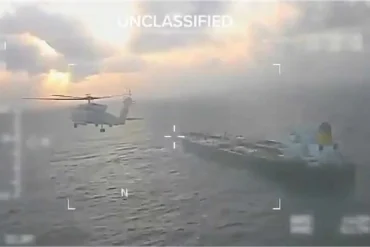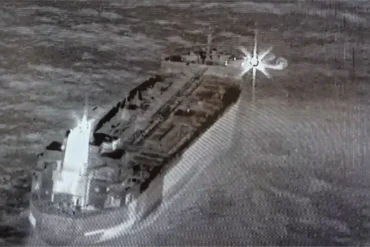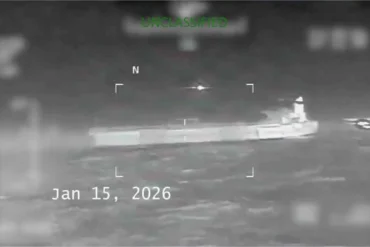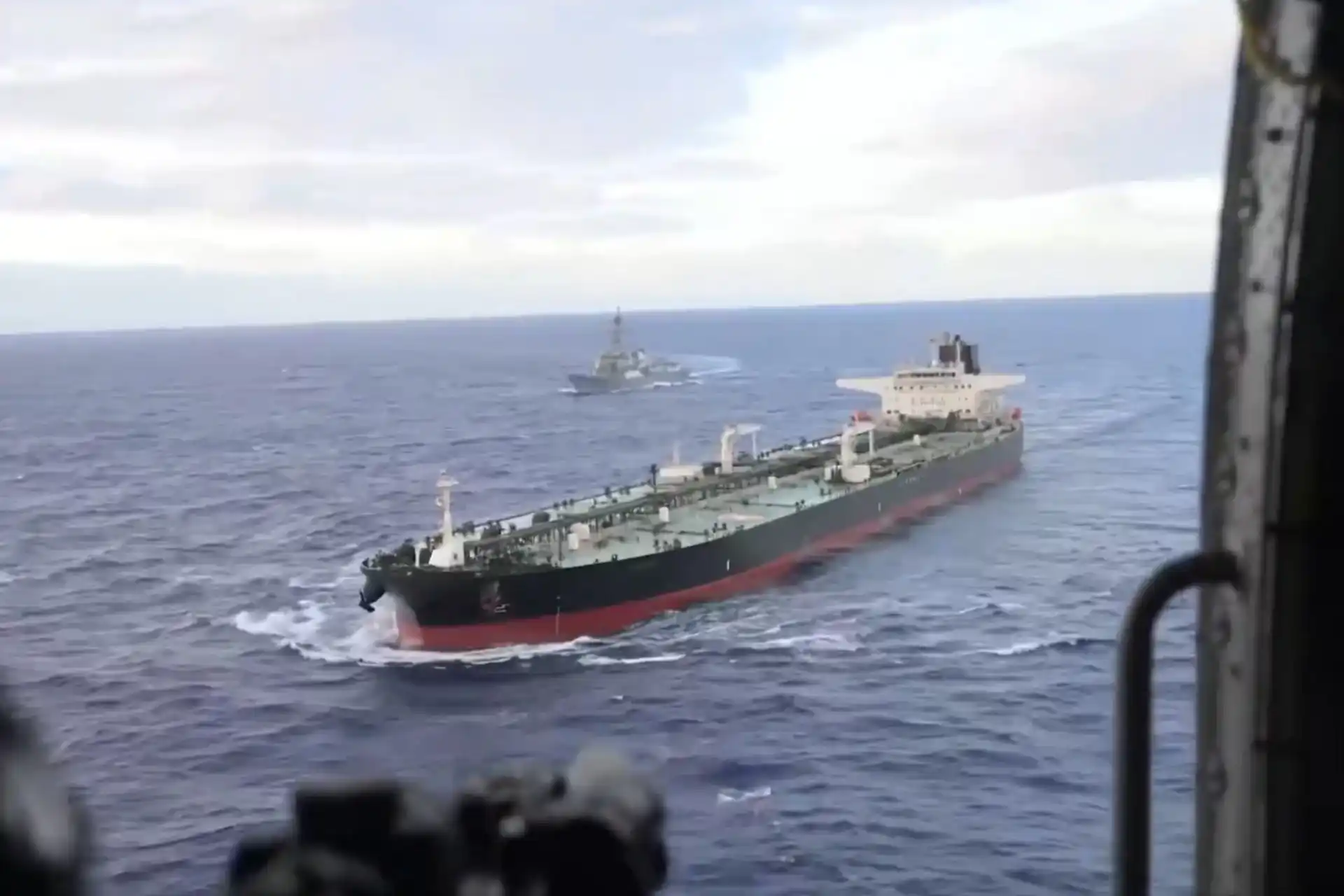
The interception of the Suezmax oil tanker Aquila II in the Indian Ocean marks one of the most expansive maritime enforcement operations undertaken by the United States in its ongoing sanctions campaign against Venezuela. After a 10,000-mile pursuit that began in the Caribbean, U.S. forces boarded the vessel on February 9, 2026, seizing approximately 700,000 barrels of Venezuelan crude oil allegedly transported in violation of Washington’s maritime quarantine targeting PDVSA-linked energy exports.
Defense Secretary Pete Hegseth confirmed that the tanker had departed Venezuelan waters in early January, its cargo reportedly organized by Petróleos de Venezuela SA (PDVSA). U.S. officials assert that the shipment was bound for Asian markets through channels designed to bypass sanctions, part of a broader pattern involving vessels described as a “shadow fleet.”
The scale of the operation underscores a growing willingness by U.S. authorities to enforce sanctions far beyond traditional regional waters. The Indian Ocean boarding demonstrates not only geographic reach but also a sophisticated fusion of maritime surveillance technology and coordinated naval capability.
How the 10,000-Mile Pursuit Unfolded
Tracking Aquila II required sustained, multi-layered monitoring. U.S. forces relied on a blend of satellite reconnaissance, Automatic Identification System (AIS) tracking data, and shipborne radar sensors to monitor the vessel’s movements as it traversed major sea lanes. AIS, a maritime transponder system designed to broadcast a ship’s identity and position, has increasingly become a focal point in sanctions enforcement. Vessels attempting to evade detection often deactivate or manipulate these signals, creating digital blind spots that must be filled by satellite imaging and signal intelligence.
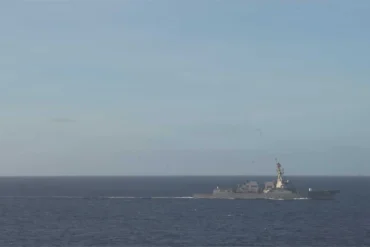
The U.S. Coast Guard Cutter Munro (WMSL 755), a Legend-class National Security Cutter, played a key role in the initial tracking phase. With a displacement of roughly 4,500 tons and a top speed of 28 knots, the cutter possesses both endurance and speed advantages over heavily laden tankers. Its operational range of approximately 12,000 nautical miles enables prolonged deployments without immediate logistical support.
Munro’s integrated combat systems process tactical data links in real time, while its onboard MH-60 Seahawk helicopter extends surveillance coverage more than 400 nautical miles beyond the horizon. These airborne assets provide overwatch during complex boarding operations and maintain situational awareness across vast ocean expanses.
The Strategic Importance of the Suezmax Class
Understanding the significance of Aquila II requires examining the vessel itself. A Suezmax tanker is engineered to transit the Suez Canal at full load, typically measuring around 275 meters in length with a deadweight tonnage between 120,000 and 200,000 tons. When fully loaded, its draft can exceed 16 meters, limiting maneuverability in shallow or constrained waters.
Powered by slow-speed two-stroke diesel engines generating more than 20,000 kilowatts, such vessels cruise at roughly 14 knots under load. While optimized for fuel efficiency and cargo capacity, these ships lack rapid acceleration capabilities. In a sustained monitoring scenario, this makes evasion difficult once higher-speed enforcement vessels establish proximity.
The physical scale of a Suezmax tanker also shapes boarding strategy. Securing control requires coordinated entry onto the bridge and engine room—critical control nodes that determine navigation and propulsion. Specialized Coast Guard teams conduct these operations under a graduated enforcement model, maintaining controlled escalation options while ensuring crew safety and environmental protection.
Inter-Service Coordination and Maritime Enforcement Doctrine
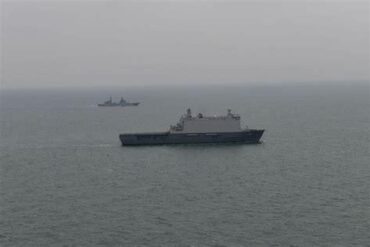
Although the boarding team was led by Coast Guard specialists, such operations frequently involve support from U.S. Navy surface combatants. Previous interdictions in the same sanctions framework have included destroyers such as USS Pinckney and USS John Finn, along with the expeditionary mobile base USS Miguel Keith. These vessels provide command-and-control infrastructure, helicopter support, and layered defensive capabilities.
This form of inter-service coordination reflects an evolving maritime enforcement doctrine. Rather than isolated interdictions, the United States has constructed a persistent surveillance architecture capable of tracking large commercial vessels across hemispheres. The Aquila II seizure represents at least the eighth tanker interdiction since December under the current enforcement campaign.
The Expanding “Shadow Fleet” and Sanctions Evasion Tactics
U.S. authorities describe Aquila II as part of a broader network of vessels engaged in sanctions evasion. These tankers often employ tactics such as:
- Frequent name changes and reflagging
- AIS signal deactivation or manipulation
- Complex ship-to-ship transfers at sea
- Layered ownership structures obscuring beneficial control
Earlier seizures included the tanker Skipper in the Caribbean and Marinera—formerly known as Bella 1—in the North Atlantic. Another vessel, M Sophia, was detained under comparable circumstances. Each case reflects a pattern of adaptive logistics designed to circumvent financial and maritime restrictions imposed on Venezuelan oil exports.
Such enforcement actions carry geopolitical consequences. Venezuelan officials have condemned the seizures as violations of international norms, arguing that extraterritorial enforcement disrupts lawful trade. Washington, by contrast, maintains that sanctions compliance extends across international waters when linked to designated entities.
Legal and Geopolitical Implications
The Aquila II operation intensifies debate surrounding maritime jurisdiction and sanctions enforcement authority. International maritime law traditionally emphasizes freedom of navigation on the high seas. However, sanctions regimes introduce layers of financial and legal constraints that extend beyond territorial waters.
By executing a boarding in the Indian Ocean—far from U.S. shores—the United States signals that its enforcement perimeter is not geographically confined but legally defined by the sanctioned status of cargo and corporate entities involved. This approach raises complex questions regarding sovereignty, compliance enforcement, and the future architecture of global maritime governance.
The broader impact may ripple into global energy markets. Although 700,000 barrels represents a fraction of daily global oil consumption, repeated interdictions contribute to supply uncertainty and increased insurance costs for tankers operating in politically sensitive trade corridors.
A Maritime Enforcement Campaign With Global Reach
The seizure of Aquila II reflects more than a single interdiction; it illustrates a systemic strategy. Persistent surveillance, inter-service coordination, and legal assertion combine into a sanctions enforcement framework capable of spanning oceans. The 10,000-mile pursuit demonstrates logistical endurance and technological integration rarely visible outside conventional naval warfare operations.
As the campaign continues, the strategic message is unmistakable: vessels linked to sanctioned energy exports face interception regardless of routing or distance. The Aquila II case underscores the convergence of economic policy and naval power, where maritime domain awareness becomes a decisive instrument in geopolitical competition.
In an era where oil tankers can traverse continents with cargo valued in the tens of millions of dollars, enforcement actions such as this redefine the operational boundaries of sanctions policy. The Indian Ocean boarding stands as a vivid example of how economic statecraft increasingly unfolds on the world’s oceans, enforced not only by legislation but by steel hulls, rotor blades, and persistent digital surveillance.