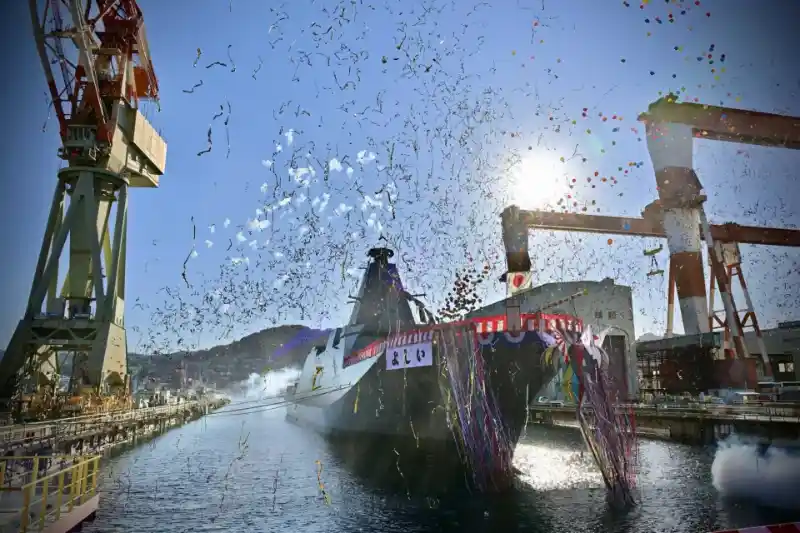
On December 22, 2025, a pivotal moment in Japan’s naval modernization program unfolded as Mitsubishi Heavy Industries (MHI) launched the twelfth and final vessel of the Mogami-class frigate series, the JS Yoshii (FFM-12), at its historic Nagasaki Shipyard. This event not only marked the end of hull construction for Japan’s cutting-edge multi-mission frigate fleet but also underscored Tokyo’s strategic pivot toward enhanced maritime security and autonomous naval operations amid rising regional tensions.
Ceremony Marks Milestone for Japan’s Maritime Self-Defense Force
The launch ceremony, attended by approximately 200 defense officials, shipbuilders, and dignitaries, was headlined by Japan’s newly appointed Minister of Defense, Shinjiro Koizumi. With ceremonial precision, Koizumi announced the vessel’s name — Yoshii — drawing inspiration from the Yoshii River in Okayama Prefecture. This marks the first time the name has graced a ship in either the Japan Maritime Self-Defense Force (JMSDF) or its predecessor, the Imperial Japanese Navy, and is the first of its class named after a river in the Chugoku region.
With this milestone, MHI completes its critical role in the Mogami-class Frigate (FFM) Program, having constructed ten of the twelve ships. The launch of JS Yoshii transitions the focus from steelwork and hull fabrication to systems outfitting, combat system integration, and sea trials, with delivery slated for fiscal year 2026 and commissioning expected around March 2027.
A Capstone in Japan’s Frigate Modernization — The Mogami-Class Defined
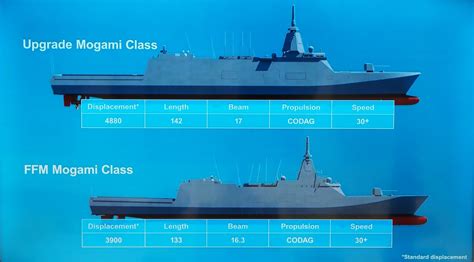
The Mogami-class frigate, also referred to as the FFM series, represents a quantum leap in Japan’s naval architecture, designed to meet an evolving spectrum of missions. Measuring 133 meters in length with a beam of 16.3 meters, the JS Yoshii displaces approximately 3,900 tonnes. It operates with a compact crew of about 90 personnel, highlighting the design’s commitment to automation and minimal manning, a stark departure from legacy platforms like the Abukuma- and Asagiri-classes.
This class was envisioned to perform multidimensional roles — encompassing anti-surface, anti-air, anti-submarine, and mine warfare missions — all within a single, stealth-optimized hull. The sleek profile and reduced radar cross-section reflect Japan’s intention to enhance survivability in high-threat environments, especially under modern anti-ship missile surveillance regimes.
Combat Systems and Armament: Built for Power and Precision
JS Yoshii boasts a Combined Diesel and Gas (CODAG) propulsion system, delivering over 70,000 horsepower, enabling speeds up to 30 knots (approximately 55.6 km/h). Its advanced propulsion system provides both fuel efficiency during long patrols and rapid maneuverability during high-intensity operations.
The ship is armed with a suite of weapons that enable it to engage threats across domains:
- 16-cell Mk-41 Vertical Launching System (VLS) for anti-air and potential anti-submarine missiles
- Mk-45 Mod-4 5-inch naval gun, offering land attack and surface warfare capabilities
- Two triple torpedo tubes for close-in anti-submarine warfare
- Type 17 anti-ship missiles, launched via two quadruple launchers, extending surface strike range
- SeaRAM missile system with 11 interceptors for close-in air defense
- Two 12.7mm remote weapon stations for close-range threats
Its flight deck and hangar support a single Mitsubishi SH-60L helicopter, significantly enhancing reconnaissance, anti-submarine, and search-and-rescue operations.
Integrated Mine Warfare and Unmanned Systems Capability
The Mogami-class shifts Japan’s traditional reliance on dedicated mine countermeasure vessels by integrating mine warfare systems directly into a combat-ready frigate hull. The JS Yoshii features an advanced sonar suite capable of detecting both moored and bottom mines, providing critical undersea domain awareness. Its mine-laying capability and support for area denial operations further underscore its tactical flexibility.
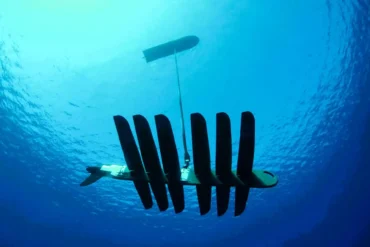
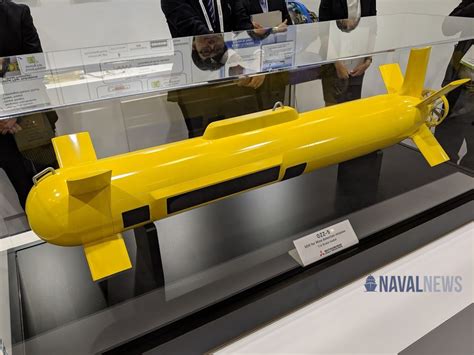
Of particular note is the inclusion of the OZZ-5 Unmanned Underwater Vehicle (UUV), capable of entering contested zones to conduct remote sensing and mine identification, a key enabler for future autonomous naval warfare. Future upgrades will include Variable Depth Sonar (VDS) and Towed Array Sonar Systems (TASS) to strengthen its anti-submarine warfare (ASW) suite.
Strategic Role and Operational Context in Northeast Asia
The launch of JS Yoshii comes at a critical juncture in the security architecture of East Asia. With increasing activity in the East China Sea, including contested waters near the Senkaku Islands and rising incursions by both Chinese and Russian naval assets, Japan is consolidating its forward defense posture.
The JS Yoshii is expected to be assigned to a newly formed Patrol and Defense Group, tasked with persistent maritime domain monitoring, presence missions, and rapid response. By fielding assets like Yoshii, Japan reinforces its ability to project credible deterrence while maintaining freedom of navigation across critical sea lanes of communication (SLOCs).
From Domestic Innovation to Global Impact: Mogami-Class Export Potential
The Mogami-class program has not only been a domestic cornerstone but is now evolving into a platform with international appeal. In August 2025, Australia selected a variant of the Upgraded Mogami-class as part of its frigate replacement program, indicating growing confidence in Japan’s naval design philosophy and industrial base.
With the launch of JS Yoshii, the original twelve-ship Mogami-class run is complete, paving the way for the New FFM-class, which will incorporate lessons learned and expand capability envelopes. These next-generation frigates are expected to deliver increased range, endurance, and modularity to support unmanned systems integration.
Conclusion: End of a Chapter, Beginning of a Naval Future
The JS Yoshii is more than the twelfth vessel in a shipbuilding series — it is the capstone of a transformative era in Japan’s maritime defense. Combining cutting-edge sensors, automation, multi-domain weapons systems, and integrated unmanned technologies, Yoshii exemplifies the strategic foresight embedded in Japan’s naval doctrine.
As this final hull proceeds through harbor and sea trials, and eventually sails as part of Japan’s increasingly agile and technologically advanced fleet, it will carry the legacy of its class and set the standard for the future of frigate warfare in the Indo-Pacific. The name Yoshii will not merely denote a ship — it will signify Japan’s unwavering commitment to maritime security, defense innovation, and regional stability.
With the Mogami-class legacy secured, eyes now turn to the next evolution in Japanese naval might, as Tokyo prepares to assert its role not just as a regional defender, but as a global standard-bearer for modern naval excellence.