The United States has approved a $25 million Foreign Military Sales (FMS) contract for the delivery of 20 unmanned surface vehicles (USVs) to Japan, a move designed to sharpen allied maritime awareness as submarine patrols and naval deployments intensify across the Indo-Pacific. The award, announced by the U.S. Department of Defense on February 17, 2026, assigns production and integration work to Liquid Robotics Inc., with program completion scheduled by February 16, 2028. While the dollar figure is modest by defense procurement standards, the operational meaning is anything but modest. Persistent sensing, when quietly woven into everyday maritime traffic patterns, changes the strategic texture of a region that already hums with undersea competition and surface maneuver.
Strategic Context: Persistent Eyes on a Restless Ocean
Japan’s southwestern approaches sit at the hinge point of the Western Pacific, where commercial arteries overlap with military transit routes and undersea patrol corridors. The East China Sea, the waters around the Ryukyu island chain, and the sea lanes linking the Philippine Sea to the broader Pacific form a mosaic of strategic pressure points. In recent years, the density of submarine activity and surface deployments has increased, stretching the attention of crewed patrol aircraft and frontline warships. The newly awarded USVs extend Japan’s ability to watch these waters without stretching sailors thin. They provide quiet, persistent presence where endurance matters more than speed, and continuity matters more than spectacle.
The contract includes control software, payload integration, and launch-and-recovery equipment, signaling that the capability Japan receives will be shaped by mission systems as much as by hulls. This approach matters. Modern maritime awareness is not a single sensor but a choreography of data streams—acoustic, electro-optical, electronic emissions, and vessel identity signals—stitched together into a coherent picture. Persistent platforms that can host modular payloads become the scaffolding on which that picture is built.
Likely Platform and Why Endurance Wins at Sea
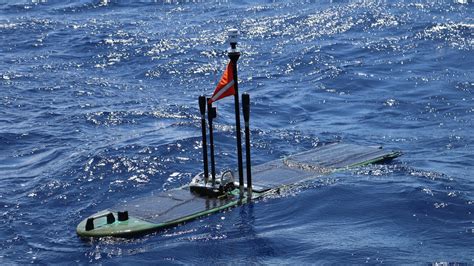
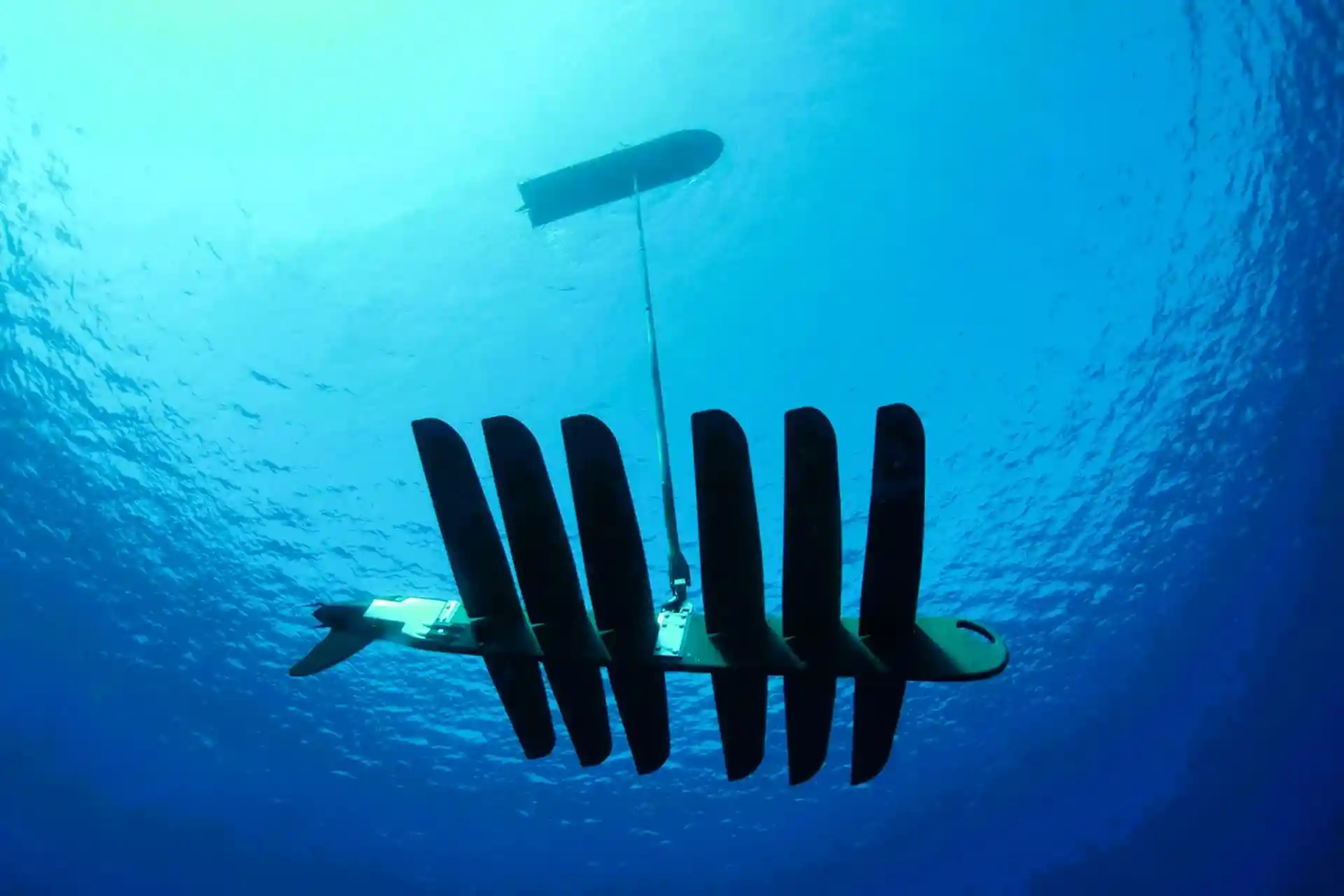
The contract does not name a specific vehicle, but Liquid Robotics is globally associated with the Wave Glider family of USVs, making it the most plausible platform. The Wave Glider’s design is not flashy, and that is its strength. A surface float carries solar panels and communications equipment, tethered to a submerged glider that converts wave motion into forward propulsion. The result is a wave-and-solar hybrid that can remain at sea for months, sometimes approaching a year, depending on payload and servicing cycles. Speeds are deliberately modest, optimized for persistence and station-keeping rather than sprinting. In a surveillance context, endurance is the superpower. A platform that never seems to leave becomes part of the seascape, quietly listening and reporting.
This architecture supports modular payloads: passive acoustic arrays for submarine detection, AIS receivers to track shipping, electro-optical and infrared sensors for surface monitoring, and electronic support measures to sense emissions. The reference to payload integration in the contract suggests Japan will tailor configurations to its operational geography, pairing endurance with sensors tuned to chokepoints and transit lanes where detection yields the most strategic value.
Operational Impact for Japan’s Maritime Domain Awareness
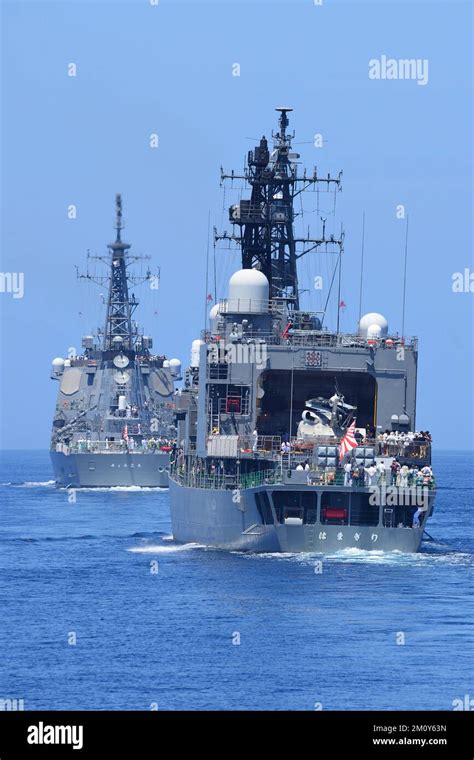
For the Japan Maritime Self-Defense Force, these USVs reinforce a layered surveillance architecture already anchored by P-1 maritime patrol aircraft, Aegis-equipped destroyers, and seabed sensor networks. The unmanned layer fills the temporal gaps between crewed patrols, maintaining a listening presence when aircraft return to base and ships rotate stations. Equipped with thin-line passive acoustics, mobile USVs can act as tripwires along likely submarine routes, cueing crewed assets toward contacts of interest. In surface monitoring roles, they observe vessel behavior patterns over time, making anomalies easier to spot against the baseline rhythm of commercial traffic.
Their low logistical footprint matters in practice. Launch and recovery equipment can be deployed from modest platforms, and satellite communications allow data to flow directly to shore-based command centers. The result is a distributed sensor web that expands coverage without demanding a proportional expansion of crews. In the arithmetic of readiness, that ratio—more coverage per sailor—translates into resilience.
Interoperability and the Quiet Power of Standards
Procuring USVs through the Foreign Military Sales framework aligns Japan’s systems with U.S. data standards and operational concepts. Interoperability is not a buzzword here; it is the connective tissue of deterrence. Sensor data that flows seamlessly between allied command centers shortens the distance from detection to decision. In contested environments, that compression of time can be the difference between tracking a fleeting undersea contact and losing it in the acoustic noise of a busy sea.
Over time, persistent USVs can plug into a broader Indo-Pacific sensor grid, contributing to a multinational mosaic of maritime awareness. This is not about a single platform dominating a sea. It is about weaving many quiet threads into a net that is hard to slip through without being noticed.
Grey-Zone Deterrence and Everyday Security
The strategic utility of USVs extends beyond high-end conflict scenarios. Grey-zone activities—ambiguous actions that probe boundaries without triggering open conflict—thrive in the shadows between patrols. Persistent unmanned sensors reduce the size of those shadows. Monitoring coast guard maneuvers, maritime militia patterns, and sustained presence around disputed features becomes a matter of continuous observation rather than episodic response. The platforms’ low-profile presence also carries a stabilizing logic. They gather information without escalating encounters that might arise from sending crewed ships into every sensitive corner.
In peacetime, the same platforms support environmental monitoring, maritime safety, and disaster response by providing weather and sea-state data and maintaining communications relays in austere conditions. Dual-use utility strengthens political support for persistent deployment, anchoring security investments in everyday public value.
A Modest Contract with Strategic Weight
The $25 million figure understates the strategic leverage of endurance. Naval competition in the Indo-Pacific is not only a contest of hull counts and missile ranges; it is a contest of information density over time. Persistent sensors tilt that contest by raising the probability that covert movement is noticed and tracked. The presence of autonomous sentinels complicates planning for any actor seeking to maneuver unseen, and it nudges the strategic environment toward transparency, where miscalculation is harder to sustain.
Work on the program is managed by the Air Force Test Center at Eglin Air Force Base, an arrangement that reflects the joint, networked nature of modern sensing architectures. The delivery timeline through 2028 points to a phased integration, allowing Japan to tune payloads and operational concepts as the platforms enter service. The quiet genius of the approach is its scalability. Once the scaffolding of control software, data links, and payload integration is in place, expanding the network becomes a matter of adding nodes rather than reinventing the system.
What This Signals for the Indo-Pacific Balance
The delivery of 20 USVs will not redraw naval balances on a map, but it will redraw them in the invisible realm where signals become insight. Persistent sensing elevates maritime transparency, which in turn raises the cost of stealthy coercion. In an environment where escalation dynamics hinge on who knows what, and when, endurance becomes strategic capital. Japan’s adoption of wave-powered autonomous platforms signals a shift toward surveillance as a structural pillar of deterrence rather than a periodic activity of patrol cycles.
The ocean does not announce its secrets. It whispers through currents, noise, and fleeting contacts. Persistent unmanned systems listen patiently, turning whispers into patterns. In a restless Indo-Pacific, that patience is power.