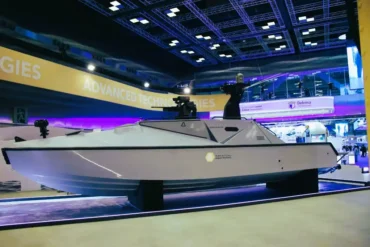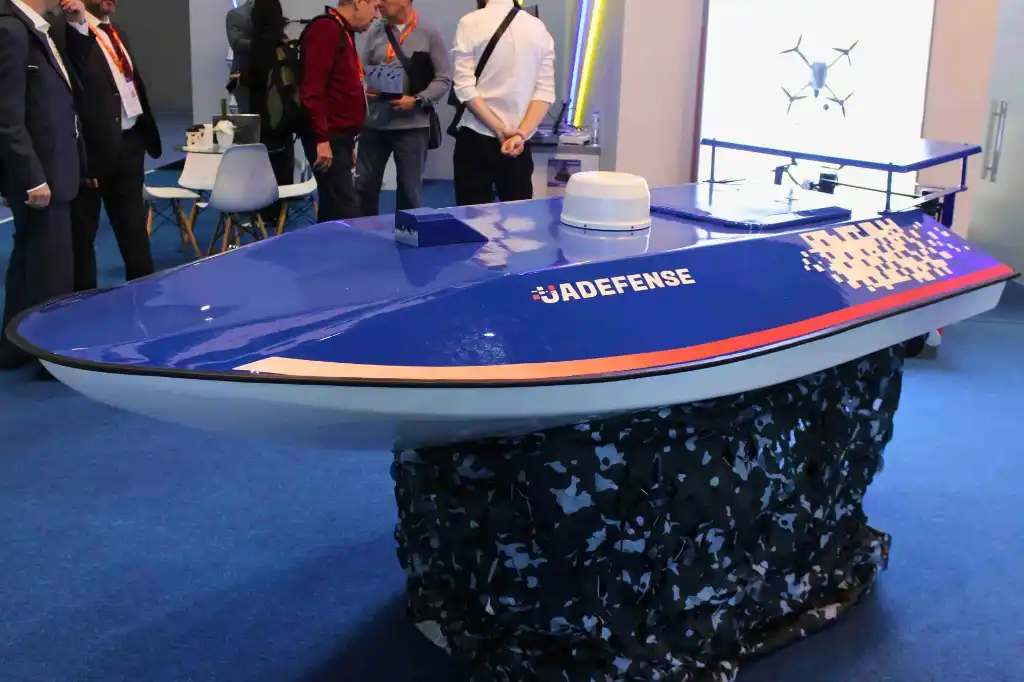
Ukraine’s defense sector continues to translate battlefield experience into deployable technology, and the public debut of the MAK unmanned surface vessel (USV) at UMEX 2026 signals another step in the rapid evolution of naval autonomy. Designed for coastal waters and inland rivers, the MAK reflects a clear focus on survivability, modularity, and affordability in environments increasingly shaped by electronic warfare and asymmetric threats.
Developed by the Ukrainian company UAdefense, the MAK is positioned as a multi-role maritime drone rather than a single-purpose weapon. Its design philosophy emphasizes flexibility, allowing the same platform to shift between surveillance, patrol, logistics support, and precision missions with minimal reconfiguration. This adaptability mirrors Ukraine’s recent operational experience, where unmanned naval systems have proven effective against conventionally superior adversaries.
Unlike traditional patrol craft, the MAK is optimized for low observability. Its compact form and electric propulsion reduce both acoustic and electromagnetic signatures, improving survivability in contested waters. These characteristics are especially relevant for riverine operations, where detection ranges are short and reaction times minimal, and where unmanned platforms can operate persistently without risking personnel.
The MAK’s physical dimensions reinforce its role as a discreet yet capable platform. Measuring 2.7 meters in length and 1.1 meters in width, the vessel weighs 98 kilograms without batteries and up to 140 kilograms when fully equipped. With a maximum payload capacity of 60 kilograms, the USV can carry a wide range of mission-specific modules without compromising performance.
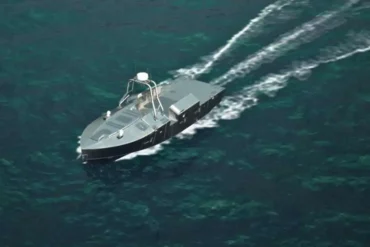
Propulsion is provided by a propeller-driven electric system, enabling a top speed of 40 kilometers per hour. Depending on payload and mission configuration, the operational range extends from 30 to 50 kilometers, sufficient for coastal patrols, river crossings, and forward-deployed reconnaissance tasks. The electric architecture not only supports stealth but also simplifies maintenance and logistics, aligning with Ukraine’s emphasis on scalable production.
Navigation and autonomy are central to the MAK’s design. The vessel employs a multi-sensor navigation suite integrating Global Navigation Satellite System (GNSS) data with internal validation mechanisms. Crucially, the system is engineered to detect GNSS jamming and spoofing, a persistent feature of modern electronic warfare environments. When satellite navigation is degraded or denied, the MAK can maintain autonomous movement and execute recovery behaviors without exclusive reliance on external positioning signals.
Situational awareness is supported by day and night video systems, enabling continuous observation under varying light and weather conditions. These sensors provide real-time visual feedback for operators while also supporting autonomous mission execution, such as route following, area monitoring, or target observation.
Communications resilience is another defining feature. The MAK uses a multi-channel communications architecture that combines satellite links, MESH radio networks, LTE connectivity, and fiber-optic control. This layered approach ensures redundancy, allowing the vessel to dynamically switch between channels as conditions change. In high-threat electromagnetic environments, the fiber-optic control mode enables operations even when radiofrequency communications are heavily contested or entirely denied.
Command and control functions are managed through a unified operator interface, supporting mission planning, telemetry monitoring, and payload management in real time. UAdefense states that the MAK is compatible with joint naval command-and-control architectures, making it suitable for integration with other unmanned systems and manned naval assets. This interoperability supports concepts such as distributed operations and swarm tactics, where multiple unmanned platforms operate cooperatively to overwhelm defenses or extend surveillance coverage.
The MAK’s emergence cannot be separated from Ukraine’s recent operational history. Ukrainian unmanned surface vessels have already demonstrated their ability to penetrate layered defenses, conduct long-range maritime strikes, and impose disproportionate costs on adversary naval forces, including elements of the Russian Black Sea Fleet. These experiences have accelerated domestic expertise in autonomy, communications resilience, and low-cost naval innovation.
By presenting the MAK at UMEX 2026, UAdefense signals its intent to move from bespoke wartime solutions toward a standardized, export-ready platform. The vessel encapsulates broader trends shaping modern naval warfare: the shift toward uncrewed systems, the prioritization of modular payloads, and the demand for platforms capable of operating in GNSS- and RF-degraded environments.
As coastal and riverine zones gain strategic importance, particularly in conflicts involving contested littorals and inland waterways, systems like the MAK illustrate how combat-driven innovation is redefining naval capability development. For Ukraine, the MAK is not only a technological product but also a strategic statement about the future of maritime operations in high-threat, resource-constrained environments.