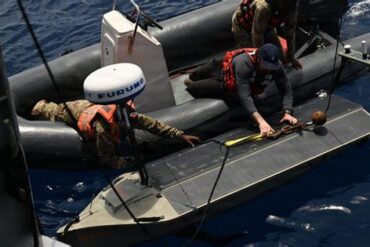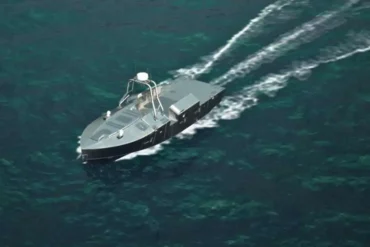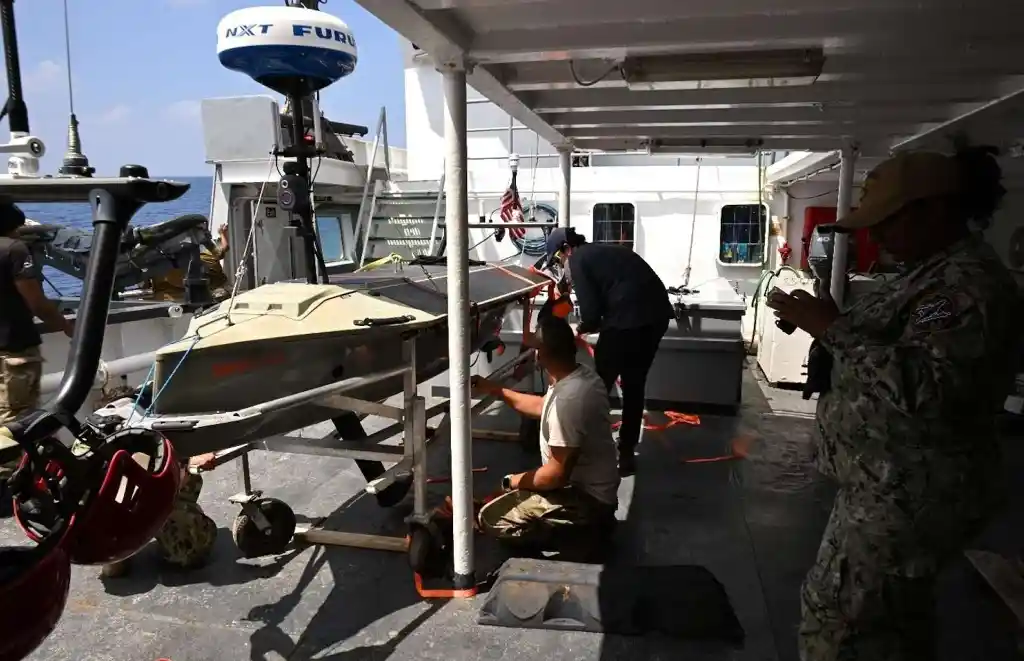
The U.S. Navy has marked a significant operational milestone in the Western Indian Ocean, executing the first-ever launch of a Lightfish unmanned surface vessel (USV) from a partner nation’s ship during Exercise Cutlass Express 2026 near Seychelles. Confirmed by U.S. Sixth Fleet on February 10, 2026, the event was more than a technical demonstration. It was a calculated signal that unmanned maritime systems are no longer experimental adjuncts to fleet operations but are rapidly becoming integrated, coalition-ready tools designed for distributed and resilient deployment.
The launch occurred during a deliberately constrained “limited connection” scenario on February 9, designed to stress command-and-control pathways, validate autonomous navigation protocols, and simulate degraded communications in operationally realistic conditions. By conducting the deployment from a partner vessel rather than a U.S. hull, the Navy underscored a strategic shift: persistent maritime surveillance capabilities must be exportable, adaptable, and operable within allied frameworks.
Exercise Cutlass Express, long focused on improving maritime security cooperation in East Africa and the Western Indian Ocean, provided an ideal proving ground. In a region defined by vast sea lanes, smuggling routes, illegal fishing networks, and increasing geopolitical friction, surveillance endurance is often more decisive than firepower.
Lightfish USV: Compact Design, Strategic Endurance
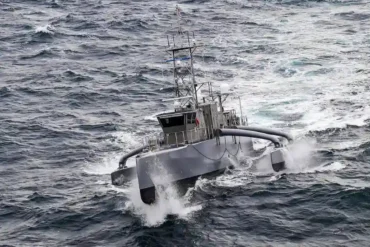
Unlike the Navy’s larger unmanned surface experiments such as the Ghost Fleet Overlord vessels, Lightfish occupies a different operational niche. Measuring approximately 11.4 feet in length and 3.4 feet in width, the craft is intentionally compact, portable, and optimized for persistence rather than speed. Its composite hull and retractable keel allow it to be transported and launched from relatively small ships without extensive deck modifications or specialized cranes.
Performance specifications are modest by design. The vessel cruises at roughly 2 knots, with a sprint capability up to 4.5 knots. That limited speed reflects a deliberate engineering tradeoff: endurance over dash capability. Powered primarily by a 415-watt solar array paired with a 4.0 kWh lithium-ion battery, the Lightfish can remain at sea for up to six months, covering distances exceeding 6,000 nautical miles under favorable solar conditions. An optional 100-watt methanol fuel cell provides supplemental energy during extended periods of reduced sunlight, ensuring mission continuity.
This energy architecture is not an incidental feature. It transforms the Lightfish from a short-duration reconnaissance drone into a persistent maritime sensor node capable of sustained presence across remote sea areas where crewed patrol assets are scarce and expensive to operate.
Operating Under Degraded Communications
The “limited connection” component of the Seychelles deployment was central to its significance. Modern naval operations increasingly assume contested or disrupted communications environments. Satellite links may be jammed, bandwidth may be constrained, and remote operators may lose continuous control. Lightfish is designed specifically to function within that reality.
The vessel’s onboard systems include GNSS/GPS navigation, an inertial measurement unit (IMU), AIS transmit-and-receive capability, 2D LiDAR for collision avoidance, and multiple high-definition cameras. Embedded autonomy software allows the USV to execute mission plans independently when connectivity drops, maintaining course, avoiding obstacles, and continuing surveillance tasks until communications are restored.
This approach reflects a broader doctrinal evolution. Instead of relying on constant human teleoperation, unmanned systems are increasingly engineered for supervised autonomy. The operator defines mission parameters; the platform executes within those bounds. That distinction matters in regions where connectivity is unreliable or intentionally disrupted.
Modular Architecture and Open Integration
A defining characteristic of the Lightfish platform is its modularity. The craft supports multiple physical interfaces including RS232, RS485, and Ethernet, enabling rapid integration of third-party sensors and command-and-control modules. Open application programming interfaces (APIs) allow what developers refer to as “backseat driver” autonomy packages to be installed, effectively decoupling core navigation from mission-specific payload software.
This architecture aligns with the Navy’s push toward modular open systems. In practical terms, it means partner nations can integrate their own surveillance tools or feed Lightfish data into existing maritime operations centers without proprietary lock-in. The Seychelles launch demonstrated that the USV could be deployed, recovered, and integrated into a coalition operational picture without extensive customization.
The deployment vessel, the Seychelles Coast Guard auxiliary Saya De Malha (A605), provided a tangible example of this interoperability. The ability to launch and recover a U.S.-developed unmanned system from a partner deck without heavy modifications reinforces a key objective: expanding maritime domain awareness without permanently forward-stationing additional U.S. ships.
Strategic Context: Expanding Presence Without Expanding Footprint
In the AFRICOM theater, maritime presence is both critical and resource-intensive. Vast ocean areas, dispersed patrol zones, and limited hull availability create surveillance gaps that adversaries and illicit networks can exploit. A persistent USV such as Lightfish offers a cost-effective force multiplier.
By positioning solar-powered unmanned vessels along suspected smuggling routes or near choke points, coalition forces can maintain continuous watch without diverting crewed ships from other missions. AIS tracking enables monitoring of vessel movements, while onboard cameras and sensors provide additional situational awareness. Data can then cue patrol craft for boarding operations or investigative follow-up.
Rear Adm. Kelly Ward’s remarks linking unmanned innovation to warfighting readiness and freedom of navigation were not rhetorical flourish. Distributed unmanned systems complicate adversary planning. They create a surveillance web that is harder to suppress than a handful of high-value manned assets.
This deployment also intersects with gray-zone competition. In contested maritime spaces, the ability to maintain a visible yet non-escalatory presence carries strategic weight. A small, persistent USV signals observation without the political friction of deploying a destroyer.
Development Trajectory and Operational Lessons
The Seychelles milestone fits into a broader pattern of operational experimentation. Seasats, the developer of Lightfish, has emphasized the platform’s exportability and communication flexibility. Connectivity options reportedly include cellular networks, Iridium satellite links, Starlink, and MANET radios, providing redundancy across diverse environments.
Operational transits have tested the vessel’s resilience. In August 2025, a Lightfish completed an approximately 7,500-nautical-mile transit from San Diego to Japan, reportedly encountering a close proximity situation with China’s Type 055 destroyer Nanchang near Guam. Such incidents highlight the dual nature of unmanned systems: they extend surveillance reach but also introduce new dynamics in encounters between rival naval forces.
The Navy has also evaluated Lightfish in enterprise-scale command-and-control scenarios. A Naval Information Warfare Center Atlantic-led crossing in 2025 involved deliberate oversight handoffs among multiple fleets, previewing how distributed unmanned assets might be managed across geographic boundaries. That experiment directly informs the work of Commander Task Force 66, established in May 2024 as a fully uncrewed, all-domain task force.
Task Force 66 currently operates dozens of unmanned surface vessels and continues to expand its operational concepts. The partner-deck launch in Seychelles suggests that the next phase will emphasize coalition normalization rather than isolated testing.
Coalition Integration as the Future of Maritime Unmanned Systems
The most consequential aspect of the Lightfish deployment is not technical but organizational. Demonstrating that a partner navy can launch, operate, and recover a U.S.-developed USV under degraded communications shifts unmanned systems from experimental assets to coalition enablers.
Future iterations are likely to involve repeated launches from varied ship classes, expanded operations under contested connectivity, and deeper integration into combined maritime operations centers. Rather than serving as isolated sensor pickets, Lightfish platforms could operate as nodes within a larger unmanned ecosystem that includes aerial drones, subsea vehicles, and larger surface craft.
The Indian Ocean launch was therefore not a singular event but an inflection point. It illustrated a model in which maritime security is sustained through distributed, persistent, and partner-enabled unmanned systems. As naval competition intensifies and operational budgets tighten, the appeal of a six-month, solar-powered sentinel quietly extending the reach of coalition fleets becomes strategically compelling.
The Lightfish deployment off Seychelles demonstrated that the future of naval presence may be measured not only in tonnage and firepower, but in endurance, interoperability, and the ability to operate seamlessly alongside allies in the world’s most strategically contested waters.