The U.S. Marine Corps is steadily turning the shoreline into a precision-strike chessboard, and a new contract award accelerates that transformation. Oshkosh Defense has received a $16.9 million contract modification to deliver additional Remotely Operated Ground Unit (ROGUE-Fires) carriers for the Navy Marine Expeditionary Ship Interdiction System (NMESIS), reinforcing the Corps’ ability to hold hostile surface combatants at risk from dispersed coastal positions. The award, issued on February 20, 2026, supports continued fielding of unmanned, land-based anti-ship missile launchers aligned with the Marine Corps’ Expeditionary Advanced Base Operations concept, a force design built for contested littorals and archipelagic terrain.
This contract uses a hybrid structure that blends firm-fixed-price procurement with cost-plus-fixed-fee engineering support, signaling that NMESIS is moving from early fielding toward sustained capability expansion while continuing to mature software, command-and-control integration, and autonomous systems performance. The result is a program that evolves while it scales—rare in defense acquisition, and strategically intentional. The Marines are not just buying launchers; they are buying adaptability in a fast-changing maritime threat environment.
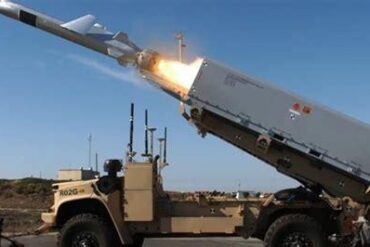
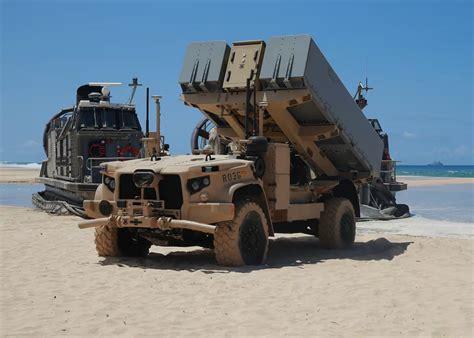
The NMESIS architecture pairs the Naval Strike Missile (NSM) with an unmanned, highly mobile ground carrier derived from Oshkosh’s Joint Light Tactical Vehicle (JLTV). The launcher typically carries two NSMs, each capable of sea-skimming flight profiles, terminal maneuvering, and precision guidance through advanced imaging infrared seekers. With effective ranges exceeding 100 nautical miles, these missiles give small Marine units the power to deny maritime corridors, threaten surface combatants, and complicate adversary fleet maneuver without relying on large naval platforms to be forward and exposed.
Oshkosh ROGUE-Fires Carrier Powers Unmanned Coastal Strike
The ROGUE-Fires carrier forms the mobile backbone of NMESIS. Oshkosh Defense has stripped the JLTV of its crew compartment and replaced it with drive-by-wire controls, remote teleoperation, secure communications links, and growing levels of autonomous navigation. The platform retains the JLTV’s independent suspension, off-road mobility, and ruggedized drivetrain, allowing it to traverse beaches, jungle tracks, and austere island road networks where traditional launch platforms would struggle. This combination of survivability and mobility is the quiet superpower of NMESIS: the launcher can move, hide, strike, and relocate before counterfires arrive.
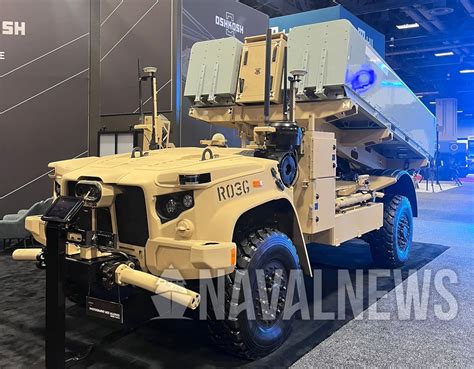
The unmanned design sharply reduces risk to personnel during the most dangerous phases of coastal missile operations—movement into firing positions and rapid displacement after launch. In a battlespace saturated with long-range sensors and precision fires, survivability depends on denying the enemy clean targeting solutions. ROGUE-Fires accomplishes this by compressing the kill chain timeline: launch, move, vanish. The vehicle’s remote-control architecture also allows Marines to operate from covered command nodes, integrating data from naval, air, and space-based sensors without exposing crews to direct threat.
NMESIS and the Naval Strike Missile: Precision Sea Denial from Land
At the heart of NMESIS sits the Naval Strike Missile, a stealthy, sea-skimming anti-ship cruise missile designed for contested littorals. Its low observable profile, terrain-following approach, and terminal maneuvering complicate shipboard defenses. The missile’s imaging infrared seeker allows discrimination of targets amid cluttered coastal environments, reducing the risk of decoys and enabling precise aimpoints against high-value vessels. This is not blunt sea denial; it is surgical pressure applied at the edges of maritime maneuver space.
By anchoring NSM launchers to mobile, unmanned ground platforms, the Marine Corps gains a persistent presence along chokepoints and archipelagos. These units can lie in wait across islands and coastlines, shaping maritime traffic patterns and imposing risk on hostile task groups. The strategic effect is asymmetric: relatively low-cost, land-based systems impose outsized operational costs on adversary navies forced to allocate escorts, counter-ISR assets, and strike packages to suppress dispersed launchers.
Expeditionary Advanced Base Operations in Practice
NMESIS is a concrete expression of Expeditionary Advanced Base Operations (EABO), the Marine Corps’ vision for operating inside contested maritime zones. EABO relies on small, distributed units that establish temporary forward positions to provide sensing, fires, and logistics support to the naval force. In practice, NMESIS-equipped teams turn shorelines into anti-access terrain. They extend the fleet’s striking reach, complicate adversary maneuver, and create overlapping zones of denial without building permanent bases that invite preemptive strikes.
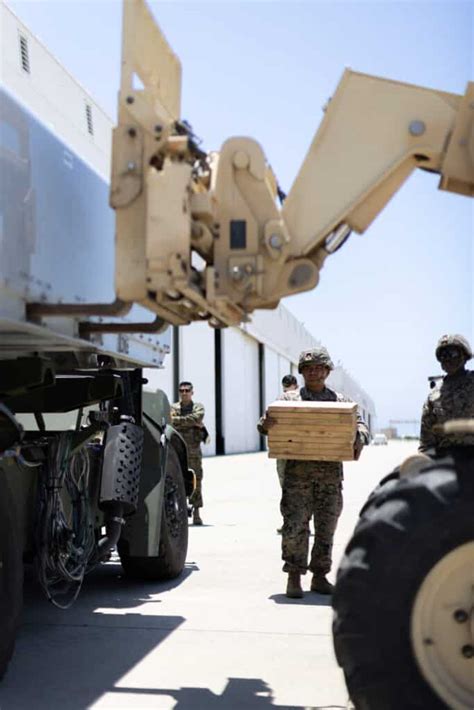
The additional ROGUE-Fires carriers funded by this contract expand the density and redundancy of these coastal strike nodes. Redundancy matters. Distributed maritime operations depend on resilience: losing a single launcher should not collapse the network. More carriers mean more options for deception, repositioning, and operational tempo. They also allow the Marine Littoral Regiments to sustain pressure over longer periods, rotating platforms through concealment and maintenance cycles while keeping missiles in play.
Contract Structure Signals Ongoing Integration with Naval Kill Chains
The hybrid nature of the contract points to continued refinement of NMESIS within a broader joint targeting architecture. Cost-plus-fixed-fee components typically support software maturation, sensor integration, and command-and-control interoperability. NMESIS is not meant to operate in isolation. It draws targeting cues from a web of naval sensors, airborne ISR, and potentially space-based surveillance. The launchers become endpoints in a distributed kill chain, firing based on fused data rather than organic line-of-sight alone. This networked approach reduces exposure time and enhances responsiveness, compressing the window between detection and strike.
The quiet revolution here is software. As autonomy improves and data fusion becomes more seamless, ROGUE-Fires platforms can shift from remote-controlled tools into semi-autonomous participants in a wider sensing-and-fires ecosystem. That evolution tightens the tempo of coastal strike operations and raises the cost of adversary countermeasures, which must now defeat not just missiles, but the network that feeds them.
Indo-Pacific Deterrence and Cost-Imposition Strategy
The strategic logic behind NMESIS is most vivid in the Indo-Pacific, where narrow straits, island chains, and vast distances reward distributed lethality. Land-based anti-ship missiles positioned along contested littorals force peer navies to operate farther from shore, constraining their freedom of maneuver and stretching their air defense coverage. This is deterrence by geometry: shape the map, shape the options. A modest investment in unmanned launchers can impose heavy operational burdens on fleets that rely on concentration of force at sea.
This contract’s dollar value, while significant, underscores a broader cost-imposition strategy. Compared with the price of new surface combatants or submarines, mobile coastal missile units deliver disproportionate deterrent effect per dollar. They also complicate adversary planning by multiplying launch points and forcing resource-intensive suppression campaigns. In strategic terms, NMESIS turns coastlines into a maze where every corner might bite back.
Industrial Base and Fielding Momentum
For Oshkosh Defense, the award reinforces its position as a cornerstone supplier of tactical mobility and unmanned ground systems. Leveraging the mature JLTV production ecosystem reduces technical risk and accelerates delivery timelines, keeping the Marine Corps’ fielding tempo high. The continuity of JLTV-based platforms also simplifies logistics, training, and sustainment, which matters when operating across austere island chains with thin supply lines.
Fielding momentum matters strategically. Programs that linger in demonstration phases lose credibility with operators and adversaries alike. This contract modification signals that NMESIS is moving into sustained acquisition, embedding itself into force structure rather than living on the margins of experimentation. As additional Marine Littoral Regiments stand up, demand for ROGUE-Fires carriers will likely track unit activations, creating a steady pipeline of capability growth.
A Shoreline That Bites Back
The deeper story behind this award is not procurement trivia; it is a shift in how the United States contests maritime space. By fusing unmanned mobility, precision missiles, and networked targeting, the Marine Corps is turning coastlines into dynamic, lethal terrain. NMESIS makes the shoreline an active participant in naval warfare, a place where small teams wield strategic influence. The contract with Oshkosh Defense accelerates that transformation, adding more teeth to a concept designed to make contested waters feel uncomfortably narrow for any fleet that tries to pass through.