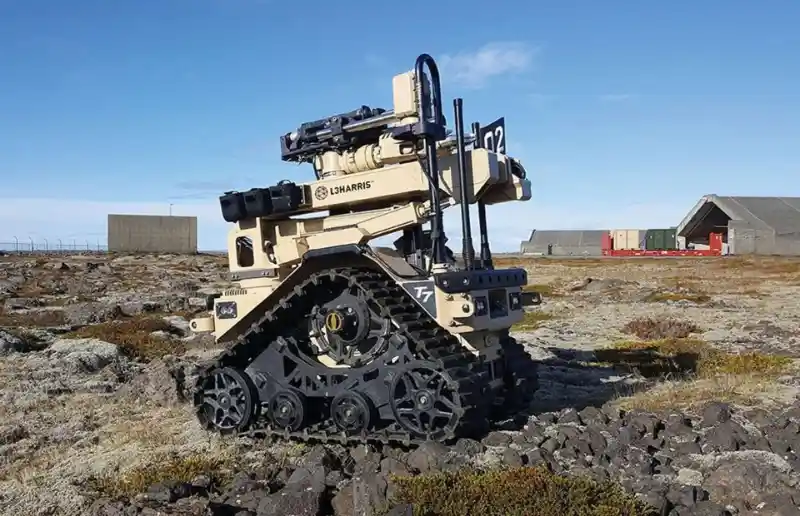
The U.S. Navy and U.S. Marine Corps are accelerating the modernization of their explosive ordnance disposal capabilities with the acquisition of 34 large T7 unmanned ground vehicles from L3Harris Technologies, a move that underscores how seriously explosive threats now shape access, tempo, and risk in modern military operations. Deliveries are scheduled to begin in 2026, marking a decisive step toward reducing the exposure of EOD technicians in some of the most dangerous environments the armed forces face.
Rather than treating robotics as a niche enhancement, the naval services are positioning the T7 as a core enabler of expeditionary and littoral missions. From contested ports and forward operating sites to urban infrastructure and narrow maritime access points, improvised explosive devices and unexploded ordnance remain among the most persistent and politically sensitive hazards confronting U.S. forces. The T7 program reflects a deliberate shift toward remote-first EOD operations, where robots take on tasks once considered unavoidable for human technicians.
The contract announced by L3Harris in mid-January 2026 includes not only the vehicles themselves but also operator training and multi-year support, signaling long-term integration rather than a limited procurement. For Navy and Marine planners, the emphasis is clear: sustain operational access while keeping personnel out of the lethal “last meters” where explosive threats are designed to claim lives and shape strategic outcomes.
A Heavy Robot Built for Real-World Explosive Threats
The T7 unmanned ground vehicle is not a lightweight reconnaissance robot. Weighing roughly 710 pounds, it is engineered to survive and operate in environments that resemble active crisis zones rather than controlled test sites. Its tracked, skid-steer design allows it to climb stairs, traverse rubble, and negotiate steep inclines exceeding 45 degrees, with stability on side slopes approaching 30 degrees. These attributes matter in shipboard compartments, damaged ports, urban terminals, and cluttered littoral terrain where explosive devices are often deliberately placed to complicate access.
Endurance is another defining characteristic. Powered by twelve BB-2590 batteries, the T7 can operate for more than eight hours, depending on mission profile. That endurance enables extended inspection, surveillance, and render-safe procedures without repeated battery swaps that would otherwise slow operations or force technicians back into hazardous areas.
Mobility alone, however, is only the foundation. The T7’s value to Navy and Marine EOD units lies in its ability to replace human proximity with precision manipulation at standoff distances, fundamentally changing how explosive threats are approached and neutralized.
Manipulation and Sensors That Redefine Standoff Safety
At the heart of the T7’s mission capability is its high-reach, high-lift robotic arm, designed to handle tasks that previously required technicians to kneel inches from potential detonation points. The manipulator can reach approximately 2.2 meters horizontally and 3.1 meters vertically, lifting over 113 kilograms close to the chassis and more than 27 kilograms at full extension. This performance allows operators to reposition heavy suspect objects, place disruptors accurately, or remove explosive devices from vehicles without repeated repositioning.
Force-sensing at the gripper provides tactile feedback that helps operators avoid excessive pressure when handling fragile or booby-trapped components. Integrated tools such as a non-conductive wire cutter reduce the need for manual intervention, while support for up to four disruptors, including large-caliber options, expands the range of render-safe techniques available from a protected distance.
Equally important is the multi-layered camera suite, designed to eliminate blind spots during critical moments. Driving cameras at the front and rear are supplemented by four corner cameras, a 30x zoom pan-tilt-zoom mast, a zoomable gripper camera, and optional mid-arm views. This configuration allows detailed inspection under seats, inside trunks, through vehicle windows, and beneath structures where explosive devices are often concealed.
Designed for Contested Electromagnetic Environments
Modern EOD operations increasingly assume that explosive threats coexist with electronic warfare. Remote detonation methods, commercial triggers, and improvised command links force EOD teams to operate alongside active jamming systems that can disrupt both enemy devices and friendly equipment. The T7 is engineered specifically for this reality.
Its communications architecture supports line-of-sight control beyond 1,000 meters and non-line-of-sight control beyond 300 meters, while electromagnetic shielding allows operation in environments saturated with friendly jammers. This capability is not merely technical; it changes command decisions in real time. The ability to jam aggressively without losing robot control enables commanders to maintain momentum, keep critical infrastructure open, and deny adversaries the leverage that explosive threats are meant to create.
Why the Navy and Marines Are Investing Now
The timing of the T7 procurement reflects a broader reassessment of how explosive hazards influence modern conflict. For the Marine Corps, particularly under the framework of Expeditionary Advanced Base Operations, small, distributed units operating inside adversary weapons envelopes face disproportionate risk from IEDs and unexploded ordnance. A single device can disrupt logistics, delay reinforcement, or impose early casualties that carry strategic and political consequences.
For the Navy, expeditionary shore operations, port security, and protection of maritime chokepoints remain vulnerable to sabotage and proxy tactics that favor deniability. Explosive threats around piers, fuel depots, and access routes can slow or halt naval operations without a single shot fired. The T7 provides a means to counter those threats quickly while minimizing escalation risks associated with personnel losses.
From Legacy Robots to Enterprise EOD Systems
U.S. forces have relied on ground robots for explosive ordnance disposal for decades, with systems such as PackBot and TALON proving their value in Iraq, Afghanistan, and homeland defense missions. However, many of those platforms were optimized for portability and inspection rather than heavy manipulation and extended endurance.
The T7 represents an evolution toward robot-as-primary-tool, a concept already embraced by the U.S. Air Force. In 2021, the Air Force selected the T7 to replace the aging ANDROS F6A fleet, citing not only enhanced capability but also modular sustainment that allows rapid subassembly replacement in the field. For Navy and Marine units operating far from depot-level support, that approach reduces downtime and preserves operational readiness.
Strategic Impact Beyond Bomb Disposal
The introduction of the T7 into naval service has implications that extend beyond individual EOD missions. By pushing the technician’s decision point farther from the threat, the system enables faster clearance, reduced exposure, and greater operational confidence. In scenarios where multiple dispersed sites must be secured simultaneously, the ability to deploy robust robots rather than scarce specialists becomes a force multiplier.
Coalition interoperability also plays a quiet but important role. The T7 is already in service with allied forces such as the United Kingdom and Australia, creating opportunities for shared training, common procedures, and logistics compatibility during multinational operations.
A Clear Signal of How Future Conflicts Will Be Fought
The U.S. Navy and Marine Corps’ adoption of the T7 unmanned ground vehicle is not simply about better tools for bomb technicians. It is a recognition that explosive threats are strategic weapons, shaping access and decision-making long before conventional combat begins. By investing in heavy, resilient, and highly capable robotic systems, the naval services are signaling that future conflicts will demand technological solutions that protect personnel while preserving freedom of maneuver.
As deliveries begin in 2026, the T7 is set to become a defining element of how U.S. expeditionary forces confront one of the oldest and most adaptable threats on the modern battlefield—without placing lives unnecessarily at risk.