Japan’s Ground Self-Defense Force has taken a decisive step toward the future of land warfare by integrating quadrupedal unmanned ground robots into a live airborne combat exercise, marking a visible shift in how the nation prepares its infantry for high-intensity, technology-driven conflict. The demonstration, conducted at the Narashino Training Area in Chiba Prefecture, reflects a broader transformation underway inside Japan’s defense establishment as it adapts to increasingly complex regional security dynamics.
The exercise unfolded under the watchful eyes of senior Japanese defense officials and allied commanders, underscoring its strategic significance. By deploying robotic systems alongside airborne infantry, Japan signaled that robotics are no longer confined to experimentation or rear-area support, but are moving closer to the front line of maneuver warfare. This evolution mirrors trends seen across allied militaries, yet Japan’s public debut of such systems in a high-profile multinational drill gave the moment added weight.
At the core of the demonstration was the concept of human-machine teaming in contested environments. Airborne forces, traditionally operating with limited logistical support and high exposure to risk, are prime candidates for robotic augmentation. The Narashino drill illustrated how unmanned ground systems can extend the reach, awareness, and resilience of light infantry formations without increasing the physical burden on soldiers.
A Public First for Robotic Ground Systems in Airborne Units
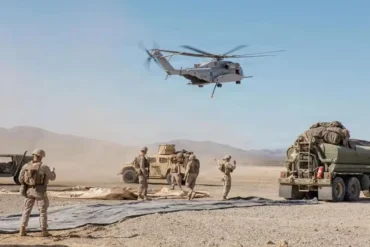
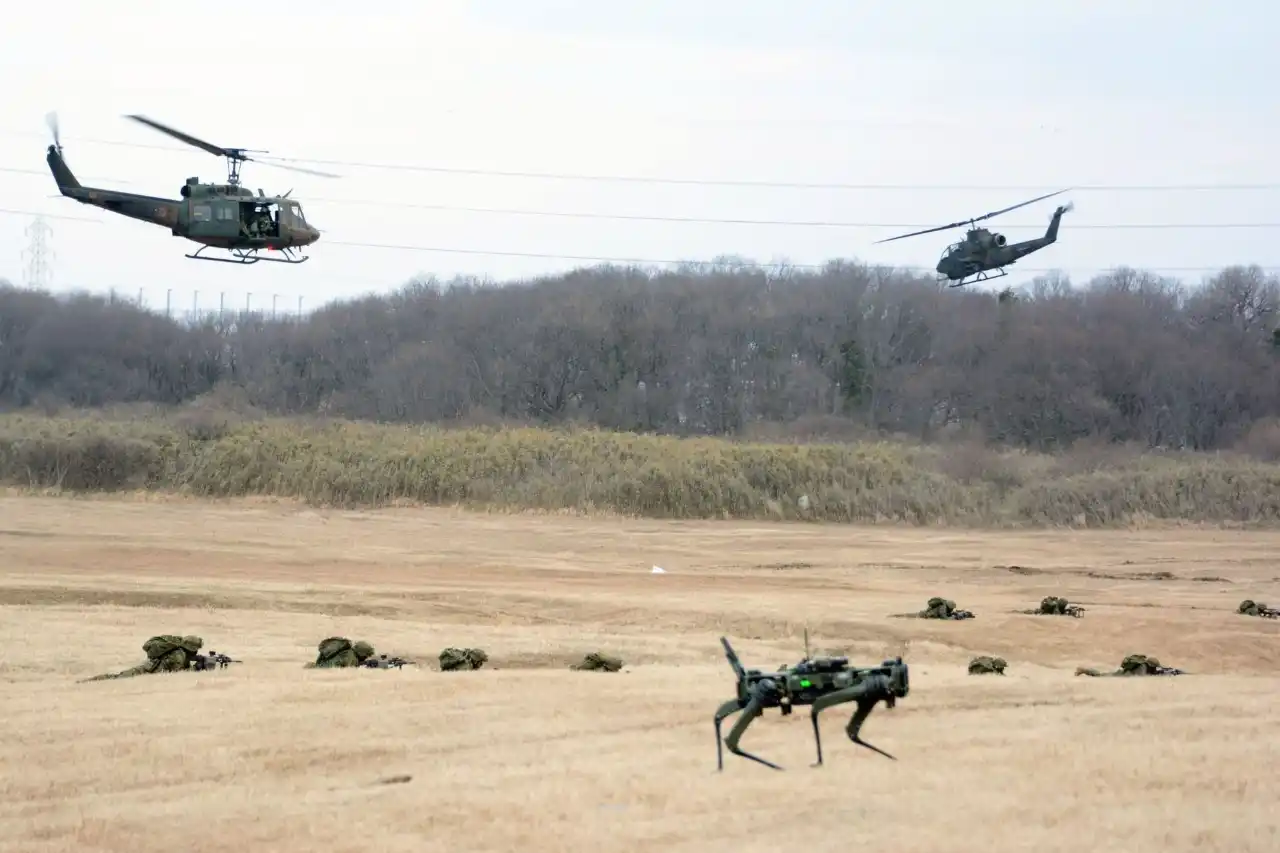
The Narashino exercise marked the first publicly acknowledged instance of quadrupedal robots operating in direct coordination with Japan’s airborne infantry. Following simulated insertion by CH-47 Chinook helicopters, the robots maneuvered across uneven terrain alongside dismounted troops, maintaining formation and adapting to obstacles that would challenge traditional wheeled platforms. This visual demonstration carried symbolic value, reinforcing the idea that unmanned systems are becoming normalized elements of Japan’s maneuver units.
Observers noted one robot advancing toward a Japanese main battle tank before assuming a static position near the reviewing stand, where Defense Minister Shinjiro Koizumi and senior allied officers were present. The choreography of the event was deliberate, designed to convey confidence in the reliability and operational maturity of the technology. For the approximately 10,000 invited spectators, the message was clear: Japan’s ground forces are embracing a more digitized and autonomous battlefield.
The Vision 60 and the Rise of Military Quadrupedal Robotics
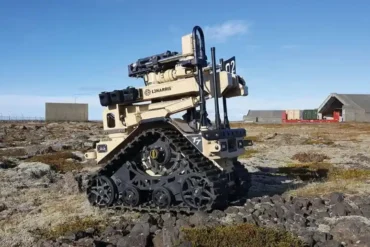
The quadrupedal platform showcased during the drill was the Vision 60, developed by US-based firm Ghost Robotics. Weighing roughly 112 pounds, the system is engineered for operations in unstructured and hazardous terrain where conventional unmanned vehicles often struggle. Its four-legged design enables it to climb stairs, traverse rubble, and maintain stability on slopes, making it particularly well-suited for airborne and light infantry missions.
What sets the Vision 60 apart is its modular architecture. The platform can be fitted with a wide range of payloads, including electro-optical and low-light cameras, LiDAR sensors, communications relay packages, manipulator arms, and CBRN detection modules. This flexibility allows commanders to tailor the robot to specific mission requirements, whether conducting reconnaissance, providing force protection, or supporting logistics in austere environments.
Built for Harsh Conditions and Frontline Reliability
Operational resilience is central to the Vision 60’s appeal. The system is rated to operate in temperatures ranging from minus 45 to plus 55 degrees Celsius, with an IP67 rating that ensures functionality in rain, snow, dust, and shallow water. Advanced leg actuation allows it to outperform tracked or wheeled robots on broken ground, while self-righting capabilities enable recovery after slips or overturns.
Field-replaceable legs and robust internal systems reduce downtime during extended deployments, a critical factor for airborne units operating far from established support infrastructure. These design choices align closely with Japan’s emphasis on rapid deployment and sustained operations in challenging terrain, particularly in scenarios involving island defense or disaster response.
Operational Lessons From the Narashino Airborne Scenario
During the simulated airborne assault, the quadrupedal robots were employed as forward-moving assets, extending the sensor envelope of infantry elements advancing across elevated terrain. Their ability to move ahead of troops without risking human life highlights a key advantage of unmanned systems: risk displacement rather than risk elimination. By placing sensors and communication nodes in exposed positions, commanders gain actionable intelligence while preserving soldier safety.
For airborne forces, which often face limited situational awareness immediately after insertion, such capabilities are transformative. Robots equipped with multi-camera arrays and autonomous navigation can scout routes, identify obstacles, and monitor potential threat avenues, effectively acting as persistent electronic scouts that never tire.
From Disaster Relief to Combat Integration
Japan’s interest in quadrupedal robotics did not begin at Narashino. The Ground Self-Defense Force previously deployed similar systems during disaster relief operations following the January 2024 Noto Peninsula earthquake. In that context, damaged roads and debris fields restricted access for conventional vehicles, while robots proved capable of navigating confined spaces to conduct search missions and deliver supplies.
This dual-use experience strengthened confidence in the technology and demonstrated its relevance across both civil defense and military missions. The transition from humanitarian assistance to airborne combat integration reflects a deliberate strategy: validate systems in low-risk environments before introducing them into high-risk operational scenarios.
Allied Convergence on Unmanned Ground Systems
Japan is not alone in exploring quadrupedal robots for military applications. US Air Force security units have evaluated similar platforms for base defense, perimeter patrols, and sensor carriage, reducing manpower demands while increasing persistence. The appearance of such systems during a Japanese-led multinational exercise underscores a growing convergence among allied militaries on the utility of unmanned ground vehicles.
Participating nations in the Narashino drill included Australia, Canada, France, Germany, Italy, the Netherlands, the Philippines, Poland, Singapore, Thailand, Türkiye, and the United Kingdom, reinforcing the exercise’s role as a platform for interoperability and shared learning. While the robots themselves were unarmed, their integration into coalition training environments sends a strong signal about the future shape of combined operations.
Strategic Implications for Japan’s Defense Posture
The high-visibility inclusion of quadrupedal robots reflects Japan’s response to a deteriorating regional security environment characterized by rapid technological advancement and increasing emphasis on mobility and resilience. Unmanned ground systems offer a politically and operationally palatable entry point into robotics-enabled warfare, enhancing capability without crossing the sensitive threshold of armed autonomous platforms.
For Japan’s Ground Self-Defense Force, the Narashino demonstration was more than a technical showcase. It served as a strategic communication tool, signaling intent to modernize land forces, deepen interoperability with allies, and prepare infantry units for operations in sensor-saturated and contested battlespaces. As multinational exercises continue to evolve, the sight of quadrupedal robots moving alongside paratroopers is likely to become less novel and more routine, reflecting a new normal in ground combat operations.
In this context, Japan’s airborne drill stands as an early indicator of how robotics will reshape infantry doctrine—not by replacing soldiers, but by amplifying their effectiveness, endurance, and survivability on tomorrow’s battlefield.