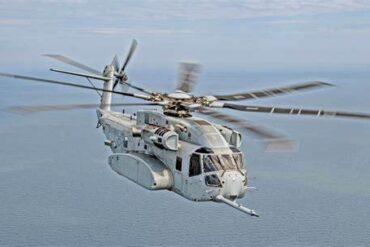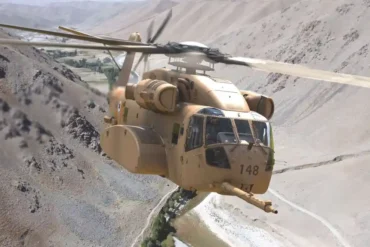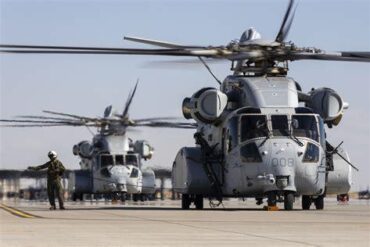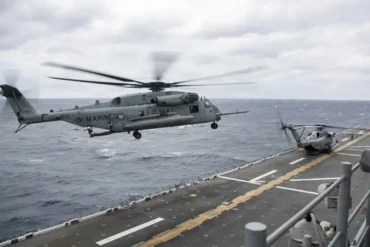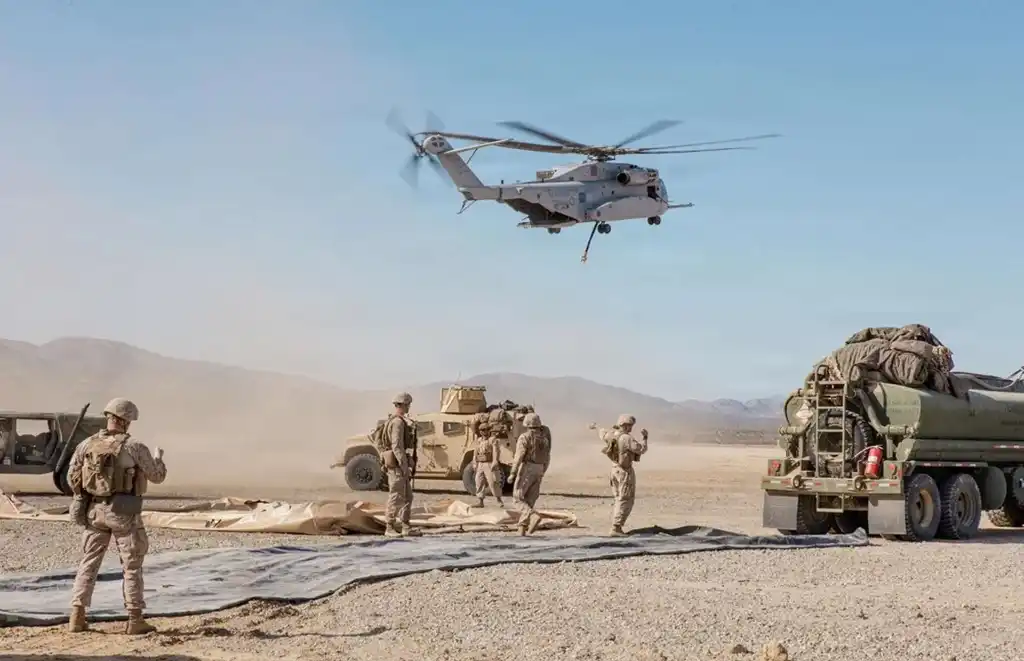
The U.S. Marine Corps is sharpening its edge for future high-end conflict by testing the CH-53K King Stallion in demanding heavy-lift and contested refueling scenarios at Marine Corps Air Ground Combat Center Twentynine Palms, California. During Service Level Training Exercise (SLTE) 1-26, Marines integrated heavy helicopter assault support with expeditionary aviation logistics under simulated threat conditions designed to replicate a surveillance-saturated battlefield. The exercise underscored a critical operational reality: in modern warfare, sustainment nodes are as strategically significant as maneuver forces.
At the center of the drill was a CH-53K King Stallion from Marine Heavy Helicopter Squadron 461 (HMH-461), executing heavy-lift operations while ground elements from Marine Wing Support Squadron 272 (MWSS-272) rapidly established a Forward Arming and Refueling Point (FARP). The coordinated action demonstrated how aviation logistics must function in an environment where adversaries employ long-range fires, electronic warfare, and persistent unmanned surveillance to disrupt support infrastructure.
The activity at Twentynine Palms was not a routine refueling rehearsal. It was a deliberate stress test of expeditionary aviation under simulated contested conditions, where timing, mobility, and signature management determine survivability. The Marine Corps is refining how it sustains combat aviation when traditional rear-area sanctuaries are no longer guaranteed.
CH-53K King Stallion: Heavy Lift Designed for the High-Threat Fight
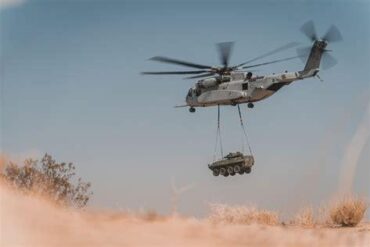
The CH-53K King Stallion represents the Marine Corps’ most advanced heavy-lift helicopter, engineered to transport substantial payloads across extended distances in harsh environments. The aircraft can carry approximately 27,000 pounds over a 110-nautical-mile mission radius in high-and-hot conditions, with a maximum external lift capability approaching 36,000 pounds, depending on configuration. This performance allows Marine Air Ground Task Forces (MAGTFs) to reposition equipment, artillery, vehicles, and supplies without reliance on fixed airfields.
In a distributed maritime or littoral campaign, heavy-lift aviation becomes a decisive enabler. The CH-53K’s digital fly-by-wire flight controls, advanced composite rotor blades, and powerful GE38 engines provide increased lift capacity compared to legacy platforms. However, its true value lies in enabling operational flexibility—supporting dispersed units operating within contested zones where rapid movement and sustainment are essential for survival.
The aircraft’s survivability suite includes advanced infrared countermeasures, radar warning receivers, missile warning systems, and countermeasure dispensers, tailored to mitigate threats ranging from shoulder-fired missiles to integrated air defense systems. These features reflect a broader recognition that heavy-lift aircraft are high-value targets in peer conflict.
Forward Arming and Refueling Points in Contested Environments
The establishment of a Forward Arming and Refueling Point (FARP) by MWSS-272 was central to SLTE 1-26. FARPs reduce turnaround time for aircraft by allowing refueling and rearming closer to operational areas rather than requiring return to fixed bases. In theory, this enhances sortie generation. In practice, it introduces new vulnerabilities.
A FARP becomes a temporary logistics beacon. In a battlespace defined by persistent surveillance drones, electronic intelligence, and pattern-of-life analysis, such nodes risk rapid detection and targeting. The Marine Corps is therefore institutionalizing rapid emplacement, low-signature operations, and swift displacement as core competencies.
At Twentynine Palms, Marines practiced fuel distribution, site security integration, and communications management under simulated adversary observation. The Tactical Training and Exercise Control Group injected emerging threat scenarios, including electronic warfare disruptions and indirect fire simulations, to test resilience. The objective was not merely speed, but adaptability—maintaining operational tempo while mitigating exposure.
MWSS-272: The Backbone of Expeditionary Aviation Sustainment
Marine Wing Support Squadron 272 provides the aviation ground support functions that enable continuous flight operations. Its mission portfolio includes expeditionary fuel services, engineer support, motor transport, airfield communications, firefighting and rescue, airfield services, and explosive ordnance disposal. In distributed operations, these capabilities shift from background support to frontline enablers.
The desert environment at Twentynine Palms amplifies logistical complexity. Heat and dust strain engines and filtration systems. Distances complicate fuel calculations and resupply timelines. Open terrain heightens exposure to observation. These conditions force Marines to refine camouflage discipline, emissions control, and rapid teardown procedures.
SLTE 1-26 incorporated base recovery after attack drills, reinforcing the principle that sustainment nodes must remain functional even after simulated strikes. The ability to repair damage, reroute fuel lines, and reestablish communications under pressure determines whether aviation assets can continue generating combat power.
Contested Logistics as a Core Warfighting Function
Modern military doctrine increasingly recognizes logistics as a contested domain. Adversaries equipped with long-range precision fires, cyber capabilities, and unmanned systems can disrupt supply chains without engaging frontline units directly. For the Marine Corps, which is adapting to a distributed operational concept focused on littoral and expeditionary warfare, the implications are profound.
Within this framework, FARPs are transient nodes in a dynamic network rather than static facilities. Mobility and unpredictability become defensive measures. The Marine Corps’ Force Design initiatives emphasize smaller, dispersed units capable of operating within adversary weapons engagement zones. Heavy-lift platforms like the CH-53K enable the repositioning of sensors, air defense assets, and logistics packages without constructing large, targetable bases.
Twentynine Palms serves as a proving ground because it mirrors the unforgiving nature of contested terrain. The combination of environmental stressors and simulated adversary injects compresses decision cycles. Command and control discipline, timing precision, and sustainment endurance are tested simultaneously.
Integrating Heavy Lift with Multi-Domain Operations
The CH-53K’s role extends beyond cargo transport. In a multi-domain fight, heavy-lift aviation contributes to operational maneuver, enabling rapid deployment of ground combat elements and air defense systems. Integration with escort aircraft, deconfliction with fires, and coordination with electronic warfare units are essential to protect these high-value assets.
Time management becomes operational currency. Fuel windows must align with security posture. Landing zones must be secured and cleared. Communications must remain resilient under simulated jamming. Each variable compounds risk. SLTE 1-26 compressed these factors into realistic training scenarios, forcing Marines to synchronize aviation and ground support elements with minimal margin for error.
The exercise also highlighted the importance of adaptability in sortie generation. Rather than relying on predictable logistics hubs, the Marine Corps is developing the ability to establish, operate, and dismantle sustainment sites rapidly. This agility complicates adversary targeting cycles and enhances survivability.
Preparing for Peer-Level Conflict
The scenarios rehearsed in California reflect preparations for potential high-intensity conflict against technologically sophisticated adversaries. Peer competitors are investing heavily in unmanned reconnaissance, long-range strike systems, and electronic warfare capabilities designed to degrade support infrastructure. Sustaining aviation operations under such conditions demands more than robust hardware; it requires doctrinal evolution and disciplined execution.
SLTE 1-26 demonstrated that the CH-53K is not merely a transport aircraft but a linchpin in distributed sustainment architecture. Its lift capacity allows the Marine Corps to reposition heavy assets without expanding its footprint. Meanwhile, MWSS-272’s ability to establish contested FARPs ensures that aviation operations can persist inside surveillance-heavy battlespaces.
Twentynine Palms offered a controlled yet demanding environment to validate these concepts. By combining heavy-lift sorties with contested refueling drills and base recovery simulations, the Marine Corps advanced its objective of institutionalizing expeditionary logistics capable of enduring modern threats.
As adversaries refine detection and strike capabilities, survivable sustainment will determine operational success. The CH-53K and the Marines supporting it are central to that equation—proving that in contemporary warfare, mobility and logistics resilience are inseparable from combat effectiveness.