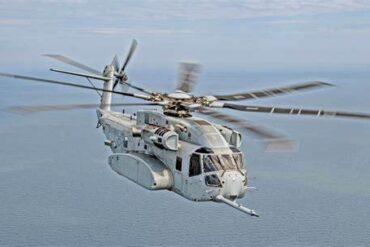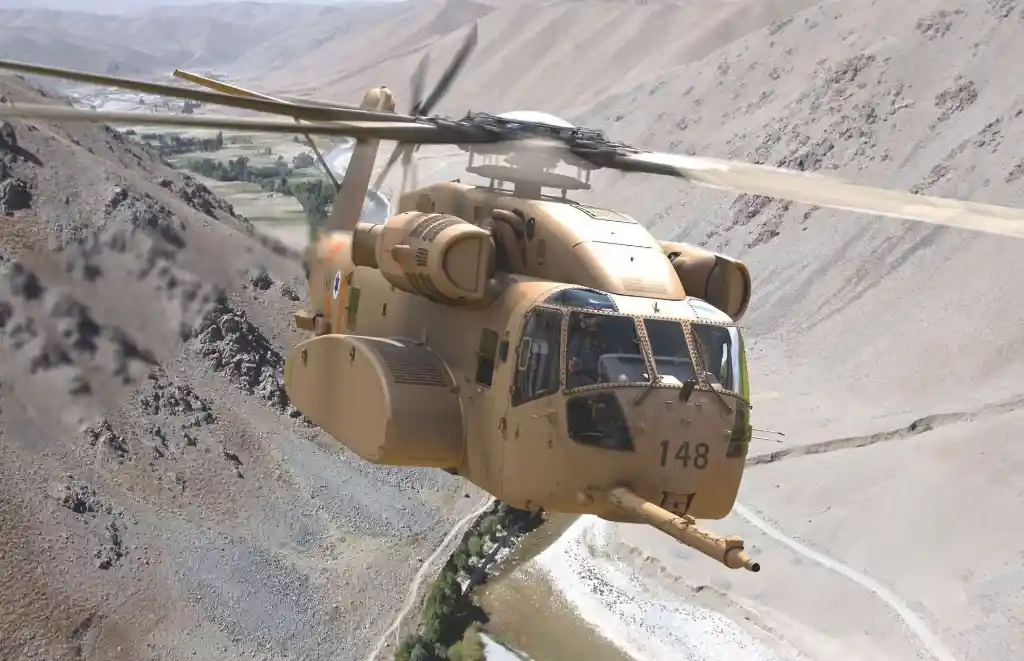
Israel has taken a decisive step to ensure its next-generation heavy-lift helicopters enter service as fully combat-ready platforms rather than transitional airframes awaiting upgrades. In early February 2026, the Israeli Ministry of Defense approved a $130 million integration program with Elbit Systems to embed Israeli-developed avionics, command-and-control architecture, electronic warfare suites, and missile-defense technologies into the CH-53K Pereh fleet. This move reshapes the introduction of the CH-53K from a standard acquisition into a tailored combat aviation program aligned with Israel’s operational realities from day one.
The decision reflects a long-standing Israeli doctrine: platforms are valuable, but mission systems determine battlefield relevance. Rather than accepting a baseline configuration and retrofitting capabilities years later, Israel is synchronizing airframe delivery with combat system integration, ensuring the helicopters arrive ready for high-risk, contested missions across multiple theaters.
Early Missionization as a Strategic Choice
Israel’s approach to the CH-53K Pereh is notable for its timing. The agreement with Elbit Systems was signed while the aircraft are still on the production line, well before the first helicopter is inducted into an operational squadron. Twelve aircraft are covered under the program, each receiving a missionized configuration that prioritizes survivability, connectivity, and crew effectiveness.
This early integration strategy reduces the technical and operational friction that often accompanies post-delivery upgrades. By treating avionics, electronic warfare, and defensive systems as part of a unified baseline rather than bolt-on enhancements, Israel ensures that cockpit ergonomics, software logic, and sensor fusion evolve together. The result is a coherent combat system, not a collection of loosely integrated subsystems.
The CH-53K airframes are being assembled by Sikorsky in Connecticut under the U.S. Foreign Military Sales framework. Once completed, they will move to a dedicated modification line where Israeli-specific systems are installed, tested, and validated as an integrated whole.
Replacing the Yas’ur Legacy with a New Standard
The CH-53K Pereh is slated to replace the venerable CH-53 “Yas’ur,” a helicopter that has served as the backbone of Israel’s heavy-lift capability for decades. The Yas’ur has supported some of Israel’s most demanding missions, including deep insertion of special forces, combat search and rescue, and emergency recovery operations under fire. However, maintaining the aging fleet has become increasingly complex and costly, while performance margins have narrowed in hot, dusty environments.
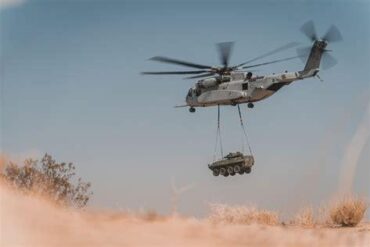
The CH-53K represents a generational leap in heavy-lift design. Its new drivetrain, reinforced structure, and three high-power engines deliver substantially higher internal and external lift capacity. A wider and more flexible cabin allows the transport of vehicles, engineering equipment, and palletized cargo that previously required careful compromises.
For Israel, these improvements are not abstract. Heavy-lift missions often involve time-sensitive movement of combat engineering assets, ammunition resupply, or rapid extraction under threat. Increased lift margins translate directly into operational flexibility, especially when operating from austere landing zones or in degraded environmental conditions.
Israeli Cockpit and Command-and-Control Architecture
What distinguishes the Pereh configuration from a standard CH-53K is the Israeli-developed cockpit and command-and-control environment. Elbit Systems is integrating advanced avionics optimized for low-visibility, night, and all-weather operations, with a focus on reducing pilot workload during the most demanding phases of flight.
The cockpit is designed around enhanced situational awareness, combining navigation data, terrain information, and tactical inputs into a unified display environment. This allows crews to plan and adjust routes dynamically, particularly during low-level ingress and egress profiles where exposure to threats is highest.
Improved command-and-control integration ensures the helicopter is not operating as an isolated asset but as a node within Israel’s broader operational network. Secure communications, datalinks, and mission management tools allow real-time coordination with ground forces, escort aircraft, and command centers, increasing responsiveness and reducing decision latency.

Operating Safely in Degraded Visual Environments
One of the most operationally significant elements of the integration package is the focus on landing zone awareness and obstacle detection. Heavy-lift helicopters are most vulnerable when slowing down, hovering, or maneuvering close to terrain. Israeli systems are designed to help crews identify safe landing zones quickly, even in darkness, dust, smoke, or adverse weather.
By fusing sensor inputs with digital terrain data, the Pereh’s avionics can support rapid assessment of approach paths and touchdown points. This reduces hover time, minimizes predictable flight behavior, and shortens the window during which the aircraft is exposed to ground-based threats. In practical terms, it increases mission tempo while lowering risk to both aircrew and embarked forces.
DIRCM and Electronic Warfare for Contested Airspace
The centerpiece of the survivability upgrade is the integration of a Directed Infrared Countermeasure (DIRCM) system, paired with advanced electronic warfare subsystems. Infrared-guided missiles remain one of the most pervasive threats to rotary-wing aircraft, particularly in regions saturated with man-portable air-defense systems.
DIRCM technology actively detects an incoming missile and disrupts its seeker during the terminal phase, offering protection during precisely those moments when a heavy helicopter is least able to maneuver aggressively. For missions involving insertion, extraction, casualty evacuation, or recovery under fire, this capability is not optional; it is fundamental.
Electronic warfare systems further enhance survivability by providing threat detection, situational awareness, and countermeasures against radar-guided and other electromagnetic threats. Together, these systems allow the CH-53K Pereh to operate with greater confidence in contested environments, rather than relying on permissive airspace assumptions.
Operational Sovereignty and Long-Term Flexibility
Israel’s insistence on indigenous mission systems is also a strategic statement about operational sovereignty. By controlling the avionics and electronic warfare layer, Israel retains the ability to adapt software, tactics, and integration as threats evolve. Updates can be driven by operational lessons learned, not external upgrade cycles.
This approach ensures compatibility with Israel’s existing and future datalink architectures, communications security standards, and multi-domain operational concepts. While the airframe benefits from U.S. logistics and sustainment infrastructure, the mission systems remain firmly under Israeli control, providing long-term flexibility over a service life expected to span decades.
A Readiness Investment, Not an Add-On
The $130 million Elbit Systems agreement should be viewed less as an optional enhancement and more as a readiness investment. By front-loading integration and testing, Israel reduces the risk of capability gaps during the transition from the Yas’ur to the Pereh. Crews will train on a configuration that reflects real-world operational demands, not an interim standard awaiting future upgrades.
As assembly progresses and deliveries approach later in the decade, the CH-53K Pereh will enter service as a fully missionized heavy-lift platform. In doing so, it reinforces Israel’s ability to project force, recover personnel, and sustain operations under the most challenging conditions imaginable, ensuring that heavy-lift aviation remains a decisive enabler rather than a limiting factor.