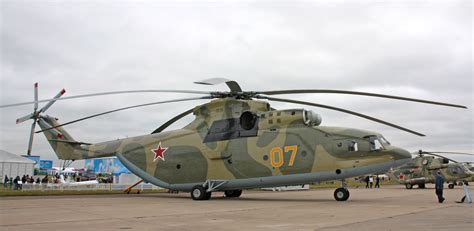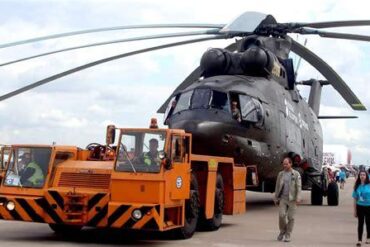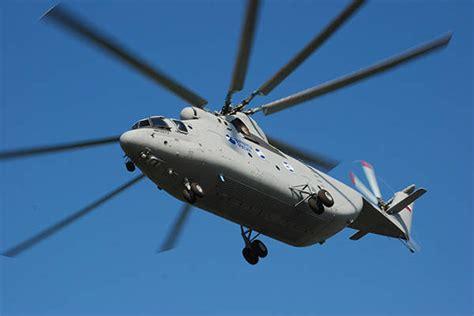
The Mil Mi-26 stands as a monumental achievement in Soviet aviation, representing the pinnacle of heavy-lift helicopter technology. Developed in the 1970s, this colossal rotorcraft was designed to replace earlier, less capable models, providing unparalleled payload capacity and operational flexibility. Upon its entry into service in 1983, the Mi-26 became the largest and most powerful helicopter to ever go into serial production, a title it retains to this day. This article will explore the Mi-26’s design, specifications, operational history, and the critical role it continues to play in both military and civilian operations around the globe.
Design and Development of the Mi-26
The Mil Mi-26 was born out of a need for a helicopter that could carry significantly heavier payloads than its predecessors. In the 1970s, the Soviet Union recognized the limitations of existing heavy-lift helicopters, which were struggling to meet the demands of large-scale military logistics and industrial projects. The Mi-26 was conceived as a direct response to these challenges, incorporating advanced technology to handle heavy and bulky cargo loads.
One of the most striking features of the Mi-26 is its eight-blade main rotor, which is designed to generate an extraordinary amount of lift. This rotor system is paired with a unique gearbox design, allowing the helicopter to handle the tremendous stresses placed upon it during flight while maintaining operational stability. The Mi-26’s immense size, coupled with its sophisticated rotorcraft technology, gives it the ability to carry up to 20 tonnes of cargo, setting it apart from nearly every other helicopter in its class.
The Mi-26’s design also focuses on durability and versatility. Its spacious cargo bay allows it to carry a wide range of oversized items, such as military vehicles, equipment, or even large industrial machinery. Additionally, the cabin can be configured for different operational needs, making the Mi-26 adaptable to both military and civilian missions.
Specifications of the Mil Mi-26
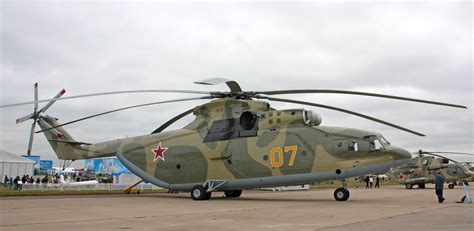
The Mi-26’s specifications underscore its dominance in the heavy-lift helicopter category. These technical details highlight its engineering excellence and operational capacity:
- Maximum Takeoff Weight: 56,000 kg
- Cargo Capacity: Up to 20,000 kg (20 tonnes)
- Maximum Speed: 295 km/h
- Range: 500 km with a 7,700 kg payload
- Main Rotor Diameter: 32 meters
- Engine Power: Two TV3-117VM engines, each producing 6,000 horsepower
- Crew: Two pilots and one flight engineer
These specifications make the Mi-26 not only the largest helicopter in the world but also one of the most capable in terms of payload capacity, speed, and range. Its ability to lift such heavy loads has earned it a reputation as a game-changer in both military and humanitarian applications.
The Mi-26 in Military Service
The Mi-26 was initially developed for military use, where it has proven to be an indispensable asset for transporting large equipment, troops, and supplies. In the Soviet Union, it was deployed during the height of the Cold War, serving a critical role in ensuring the rapid movement of heavy military resources. Since then, it has seen extensive service with various armed forces around the world.
In combat scenarios, the Mi-26 has been employed to transport military vehicles, artillery, and tactical equipment, all of which require heavy-lift capabilities. The helicopter’s unique ability to carry bulky, oversized loads has allowed it to support large-scale military operations, particularly in remote or difficult-to-access regions.
The Mi-26 also played a crucial role in disaster relief and humanitarian missions, particularly during emergencies where conventional transport options are limited. For example, it was used during the Chernobyl disaster, where it was tasked with transporting equipment and supplies to assist in the cleanup efforts. Its ability to quickly move heavy equipment to disaster zones has made it an invaluable tool in response to natural disasters and industrial accidents.
Civilian and Other Operational Uses
While the Mi-26’s military applications are perhaps the most well-known, its civilian uses have also been substantial. Over the years, the Mi-26 has been deployed in a wide range of non-military operations, including firefighting, medical evacuations, and cargo transport for industries such as oil and gas, construction, and mining.
In firefighting operations, the Mi-26 is often used to transport large amounts of water or fire retardants to combat wildfires in remote areas. Its large cargo capacity allows it to carry fire suppression materials in massive quantities, enabling rapid responses to emerging fires. Similarly, the helicopter has been used in medical evacuation (MEDEVAC) missions, where its size and payload capacity are critical for transporting injured individuals or medical equipment over long distances.
Furthermore, the Mi-26 has been employed in industrial operations, where its ability to carry large, heavy components makes it an essential tool for companies in the mining, construction, and energy sectors. Whether moving oil rigs or transporting heavy machinery to remote locations, the Mi-26’s unparalleled lifting power has made it a key asset in large-scale industrial operations.
Notable Records and Achievements
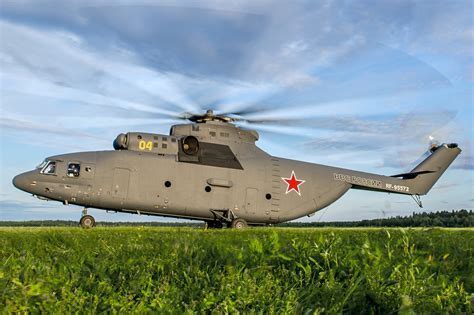
Throughout its service, the Mi-26 has set numerous records that highlight its extraordinary capabilities. Among the most impressive of these achievements is the lifting of 125,000 lbs (approximately 56,700 kg) to an altitude of 2,000 meters, a feat that has yet to be matched by any other helicopter in the world.
In addition to its raw lifting power, the Mi-26 has also been involved in aerial recovery missions. One of the most notable of these missions occurred during the Soviet Union’s involvement in Afghanistan, where the Mi-26 was used to transport large military equipment, including U.S. Chinook helicopters, for repair and recovery. This demonstrated the helicopter’s versatility in handling not only routine transport but also complex recovery operations in challenging environments.
The Mi-26’s Modernization and the Mi-26T2V Variant
Despite being introduced over 40 years ago, the Mi-26 remains a relevant and critical part of many air forces and civilian fleets. To ensure its continued effectiveness, the Mi-26 has undergone several modernization programs, the most recent of which is the Mi-26T2V variant. This upgraded version features advanced avionics, a glass cockpit, and digital flight control systems, which enhance the aircraft’s safety, ease of operation, and efficiency in modern missions.
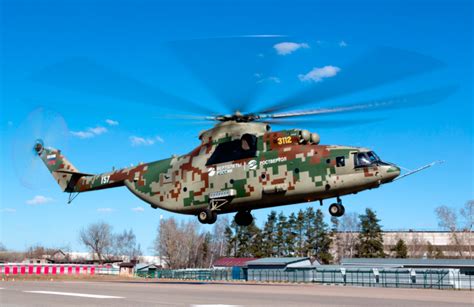
The Mi-26T2V has been developed to meet the demands of modern aviation, offering improved navigation systems and the ability to integrate with other advanced air assets. These upgrades ensure that the Mi-26 remains at the cutting edge of heavy-lift helicopter technology, capable of handling a wide variety of tasks in an increasingly complex operational environment.
Conclusion
The Mil Mi-26 is a true engineering marvel, embodying the cutting-edge of Soviet helicopter technology. With its immense lifting capacity, rugged design, and versatility, the Mi-26 has proven itself as a vital tool in both military and civilian operations. From its military roots to its role in disaster relief and industrial applications, the Mi-26’s legacy continues to grow as it adapts to the demands of the modern world. As long as there are heavy loads to be moved and complex missions to be completed, the Mil Mi-26 will remain an essential asset in global aviation.