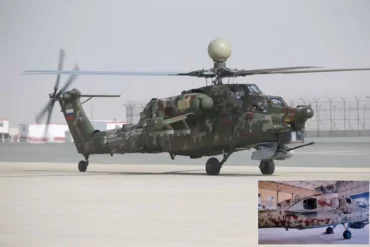
The Mil Mi-28NM Havoc stands as one of the most formidable and advanced attack helicopters in the world today, representing decades of Soviet and Russian military aviation evolution. Initially conceived as a dedicated attack platform, the Mi-28 series has matured into a sophisticated, heavily armed, and highly survivable helicopter, optimized for close air support, anti-armor roles, and battlefield dominance. First flown in the early 1980s and officially introduced in 2009, the Mi-28NM variant has pushed the envelope further with significant improvements in avionics, survivability, and lethality.
Origins and Early Development
The Mi-28 traces its origins to the Soviet Union’s desire for a specialized anti-tank helicopter to complement the widely used Mi-24 Hind, which, despite its firepower, was designed as both a gunship and a troop carrier. In 1972, Mil engineers began working on a more focused design, resulting in the first Mi-28 prototype flying on November 10, 1982. Unlike the multi-role Mi-24, the Mi-28 prioritized armored protection and firepower, adopting a tandem two-seat cockpit, a conventional pod-and-boom layout, and a five-blade main rotor for increased agility and lift.
Despite this promising start, the program faced delays. In 1984, the Soviet military chose the Kamov Ka-50 over the Mi-28 for its single-pilot operation and unique coaxial rotor system, leading to the Mi-28’s temporary sidelining. Nevertheless, Mil persisted, and the Mi-28A prototypes continued flight testing from 1988 to 1991. However, post-Soviet economic turmoil in the early 1990s stalled production, with the Mi-28A ultimately canceled in 1993 due to funding shortfalls.
The Mi-28N: A New Beginning
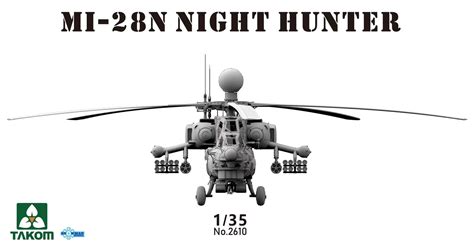
Revitalized by the economic recovery of the 2000s, the Mi-28 program was reborn as the Mi-28N (N stands for “night”), a day-and-night capable variant featuring mast-mounted radar, forward-looking infrared (FLIR) systems, and a highly durable armored fuselage. First flown in 1996 and officially introduced in 2009, the Mi-28N marked a significant leap forward, finally providing Russian forces with a true Western-style attack helicopter, comparable to the American AH-64 Apache.
The Modernized Mi-28NM
The Mi-28NM represents the pinnacle of the Havoc series, reflecting a decade of lessons learned in combat and technological advancements. This modernized version, first flown in 2016 and entering full-scale production in 2019, includes a host of critical upgrades:
- Enhanced VK-2500P Turboshaft Engines – Providing over 2,200 horsepower each, these engines deliver superior hot-and-high performance, essential for operations in challenging environments like Syria and Ukraine.
- Improved Avionics and Radar – A new mast-mounted radar with 360-degree coverage and millimeter-wave targeting capability significantly enhances situational awareness and targeting precision.
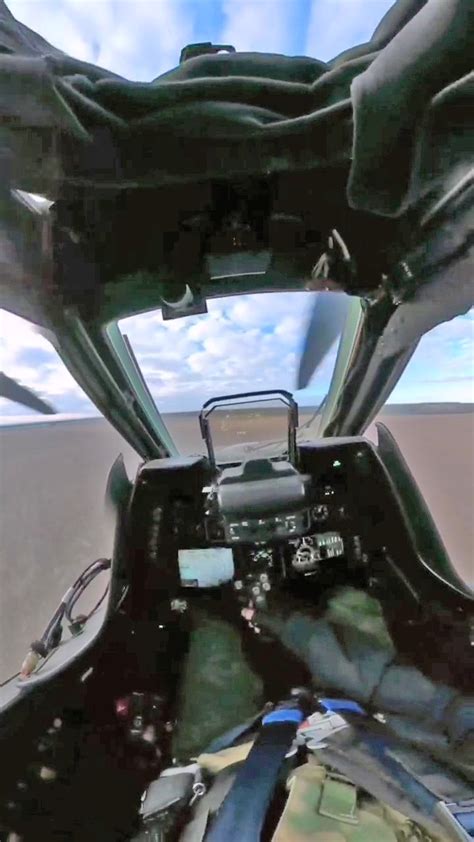
- Digital Cockpit – The NM’s fully digital cockpit integrates helmet-mounted displays, improving crew coordination and reducing pilot workload.
- Increased Survivability – Enhanced armor, energy-absorbing landing gear, and crash-resistant seats significantly improve crew survivability in hostile environments.
Armament and Lethality
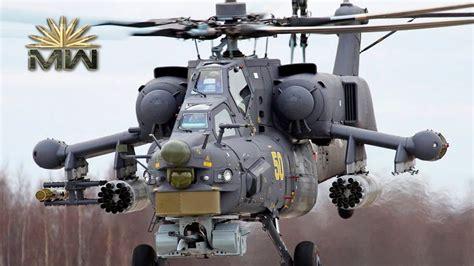
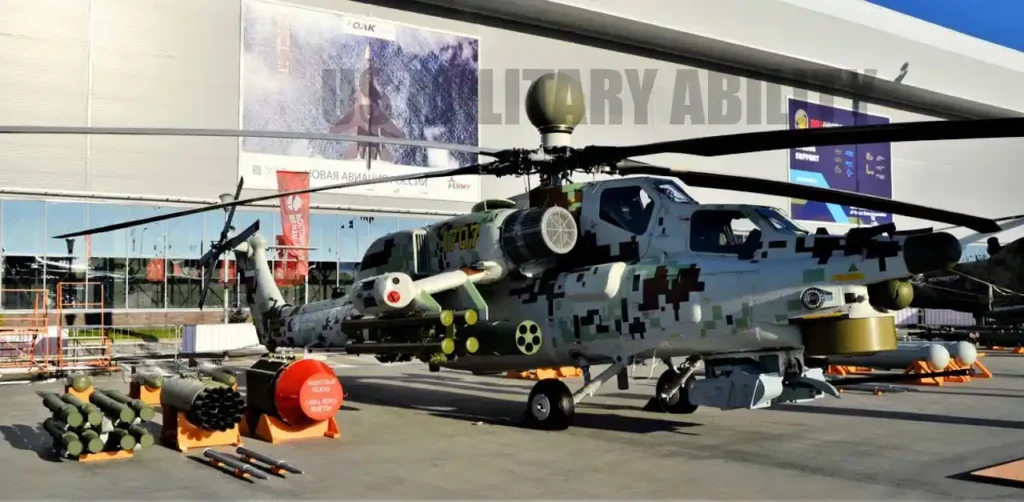
The Mi-28NM’s firepower is formidable, designed to destroy armored vehicles, fortifications, and aerial threats. Its primary weapon is the 30 mm Shipunov 2A42 autocannon, capable of firing at rates between 200 to 800 rounds per minute, with an effective range of 1.5 to 2.5 kilometers. This chin-mounted gun provides excellent forward and side arc coverage, making it deadly in close combat.
Additionally, the Mi-28NM can carry up to 16 9M120 Ataka-V anti-tank guided missiles, each with a range of 6 to 8 kilometers and various warhead options, including high-explosive anti-tank (HEAT), thermobaric, and anti-air variants. Its four stub-wing pylons can also mount a range of rockets, air-to-air missiles like the R-73, and even guided bombs, providing exceptional battlefield flexibility.
Operational History
The Mi-28N first entered Russian service in 2009, quickly proving its worth in real-world combat. Russian forces extensively used it during the Syrian Civil War, including the Battle of Palmyra in 2016, and more recently in Ukraine. Several have been shot down in these conflicts, highlighting the increasing threat of modern anti-aircraft systems but also proving the platform’s resilience and firepower.
Iraq also operates the Mi-28NE, having purchased approximately 30 units in 2012 and used them extensively in combat against insurgents from 2014 onwards. Algeria, a significant export customer, publicly displayed its Mi-28NE fleet for the first time in 2016, reflecting the helicopter’s growing international footprint.
Conclusion
The Mil Mi-28NM remains a critical asset in the modern battlefield, combining heavy firepower, advanced avionics, and exceptional crew survivability. As Russia continues to refine this platform, the Mi-28NM is likely to remain a mainstay of rotary-wing attack aviation well into the coming decades, providing a potent counter to NATO forces and a symbol of Russian aerial might.