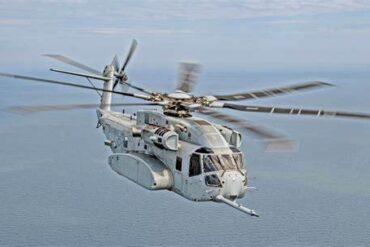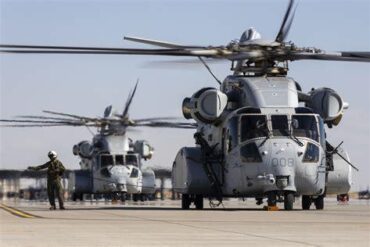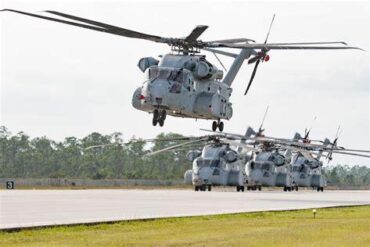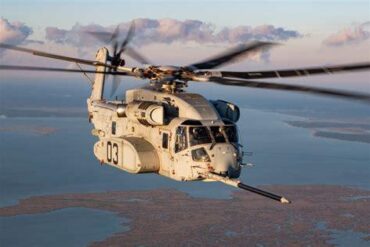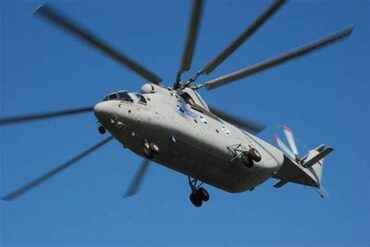
Belgium has formally entered discussions with the United States government and Lockheed Martin-Sikorsky regarding the acquisition of the CH-53K King Stallion, positioning the aircraft as a leading contender in a €1.3 billion heavy transport helicopter program. The talks, held during the International Military Helicopter 2026 conference, signal Brussels’ intent to rebuild and modernize its rotary-wing capabilities with a platform capable of delivering genuine strategic lift, special operations support, and expeditionary reach well into the next decade.
The proposed acquisition would cover approximately 11 heavy transport helicopters, aimed at filling a widening capability gap as Belgium retires legacy fleets and restructures its air component. The CH-53K is being evaluated specifically for missions demanding extreme payload capacity under challenging operational conditions—so-called “high and hot” environments where thinner air and elevated temperatures degrade conventional helicopter performance. In that arena, the King Stallion has been engineered not merely to compete, but to dominate.
Belgium’s decision to engage directly with U.S. Naval Air Systems Command (NAVAIR) and Sikorsky reflects both strategic alignment within NATO and a pragmatic recognition that heavy-lift aviation remains a niche capability dominated by a small number of industrial players.
Belgium’s Helicopter Transition: A Fleet in Transformation
Belgium’s rotary-wing fleet is undergoing one of its most significant transitions in decades. In 2025, the country retired four NH90 Tactical Transport Helicopters (TTH), citing high operating costs and availability constraints. While the maritime-focused NH90 NFH helicopters remain in service for anti-submarine warfare and naval support roles, the broader transport portfolio required decisive restructuring.
Simultaneously, the aging Agusta A109BA fleet—introduced in the early 1990s—has been phased out under a comprehensive modernization strategy. To rebuild capability from the ground up, Belgium signed a contract in June 2024 for 17 Airbus H145M helicopters through the NATO Support and Procurement Agency. Fifteen units are destined for the armed forces, with two allocated to the Federal Police. Deliveries are scheduled from 2026, with operational service entry expected by late 2027. An additional five H145Ms were approved in late 2025, bringing the combined total to 20 aircraft.
However, while the H145M offers flexibility and light utility capabilities, it does not address heavy-lift requirements. That gap is precisely where the CH-53K enters the equation. A separate €1.3 billion heavy transport helicopter plan aims to deliver robust strategic lift by 2028–2030, particularly for special forces operations and multinational NATO deployments.
The CH-53K King Stallion: Engineering for Extreme Lift
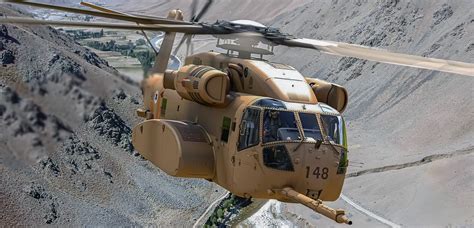
The Sikorsky CH-53K King Stallion represents the most powerful helicopter currently fielded by the U.S. armed forces. Designed as a clean-sheet successor to the CH-53E Super Stallion, the K-model integrates an entirely new airframe, transmission, rotor system, and digital architecture.
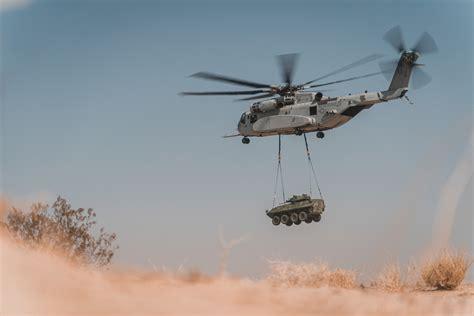
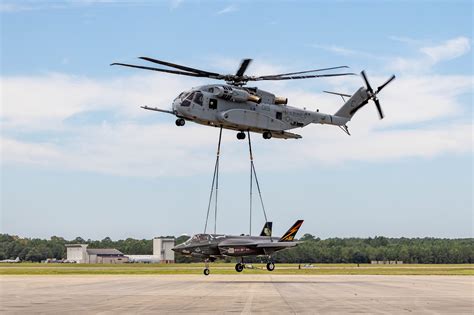
Its performance figures define its strategic appeal. The helicopter can carry 12,247 kilograms over a 204-kilometer mission radius in high and hot conditions, a benchmark unmatched in Western heavy-lift aviation. During testing, it demonstrated the ability to lift 16,329 kilograms on its center hook. Each of its forward and aft hooks supports 11,431 kilograms, allowing for flexible external load configurations.
The aircraft is powered by three General Electric T408 engines, each rated at 5,590 kilowatts. Compared to the earlier CH-53E engines, this configuration delivers a 57 percent power increase while consuming 18 percent less fuel at equivalent output. That balance of raw power and efficiency significantly expands operational flexibility.
Airframe, Rotor System, and Structural Advancements
The CH-53K retains the recognizable silhouette of the Sea Stallion lineage but internally represents a generational leap. Its seven-blade composite main rotor incorporates swept anhedral tips designed to improve aerodynamic efficiency and reduce vibration. The rotor hub uses elastomeric bearings, reducing maintenance complexity and enhancing durability.
The split torque gearbox, weighing approximately 2,390 kilograms, enables higher torque transmission while managing structural loads across the drivetrain. This mechanical refinement allows the helicopter to reach a maximum design gross weight of 39,916 kilograms with external load, compared with 33,339 kilograms for the CH-53E.
Cruise speed reaches 315 km/h, with a range of 852 kilometers under standard atmospheric conditions. The service ceiling extends to 4,900 meters. Such performance envelopes are particularly relevant for NATO operations in mountainous terrain or expeditionary environments.
Internal Cargo Capacity and NATO Interoperability
Heavy lift is not solely about sling loads. Internally, the CH-53K accommodates two full 463L master pallets without disassembly, ensuring seamless interoperability between fixed-wing airlift platforms and rotary-wing transport. The cargo cabin measures 9.1 meters in length, 2.62 meters in width, and 1.98 meters in height, enabling the internal transport of a High-Mobility Multipurpose Wheeled Vehicle (HMMWV).
Floor loading is rated at 1,465 kilograms per square meter, and the internal cargo system supports six wooden pallets at 1,134 kilograms each. Fuel capacity totals 8,650 liters in sponson tanks, with an additional 9,085 liters available through auxiliary cabin tanks, dramatically extending operational endurance.
Air-to-air refueling capability from a KC-130J tanker further amplifies range, with test flights demonstrating 4.5-hour endurance profiles. Automatic blade folding in under two minutes ensures compatibility with amphibious assault ships while preserving deck space efficiency.
Digital Architecture and Maintenance Innovation
The CH-53K’s avionics suite is built around a digital glass cockpit featuring five multifunction displays integrated within a joint interoperable Common Avionics Architecture System (CAAS). Full-authority fly-by-wire flight controls with triple redundancy reduce pilot workload and enhance hover precision in degraded visual environments.
An Integrated Vehicle Health Management System continuously monitors engines, gearboxes, and dynamic components. This supports condition-based maintenance and predictive logistics—an increasingly decisive factor in lifecycle cost management.
Program development was not without turbulence. Following the Critical Design Review in 2010, the aircraft’s maiden flight took place in October 2015 after delays related to titanium quill shaft transmission components. Technical challenges involving engine exhaust reingestion, gearbox service life, and redesigned parts temporarily pressured schedules, pushing operational timelines into the early 2020s.
The U.S. Marine Corps declared initial operational capability in April 2022, and full-rate production approval followed in December 2022. By the mid-2020s, more than 40 units had been delivered or contracted, with production expected to continue into the next decade.
Strategic Context: NATO Alignment and International Interest
The U.S. Marine Corps maintains a program of record for 200 CH-53Ks across active, training, and reserve squadrons. In August 2023, a $2.77 billion contract covered 35 helicopters, including units for Israel. In September 2025, a $10.85 billion agreement secured up to 99 additional helicopters over five years, reinforcing industrial continuity.
Israel selected the CH-53K in 2021 to replace its Yasur fleet, with deliveries scheduled from 2026. Japan has expressed interest, and India examined the aircraft within its Landing Platform Dock framework. Germany evaluated the King Stallion before ultimately selecting the CH-47F for its heavy transport requirement.
Belgium’s potential entry into this operator community would deepen transatlantic defense integration. Given Belgium’s central role within NATO logistics networks, a heavy-lift platform capable of strategic deployment across Europe and beyond carries substantial alliance value.
A Strategic Decision with Long-Term Implications
Belgium’s heavy transport helicopter selection will shape its expeditionary capacity for decades. The CH-53K offers unmatched payload capability, advanced digital systems, and established U.S. production momentum. Yet the decision will also hinge on lifecycle costs, industrial participation, interoperability considerations, and long-term sustainment guarantees.
As European security dynamics evolve and multinational operations demand rapid force projection, heavy-lift aviation becomes more than a procurement line item—it becomes a strategic enabler. Belgium’s engagement with the United States over the CH-53K King Stallion signals that Brussels is preparing to anchor its future air mobility architecture around a platform engineered for the most demanding missions modern warfare can impose.