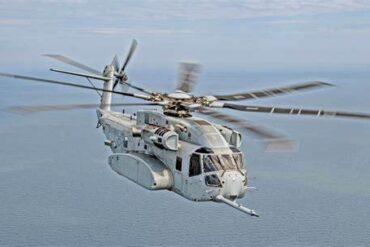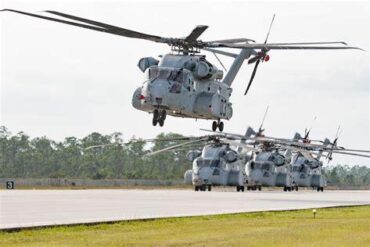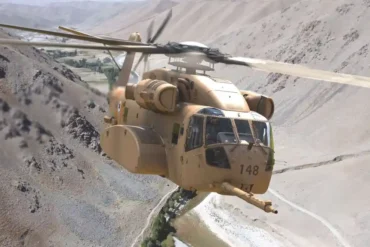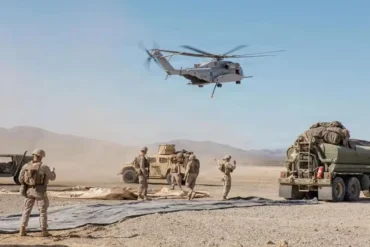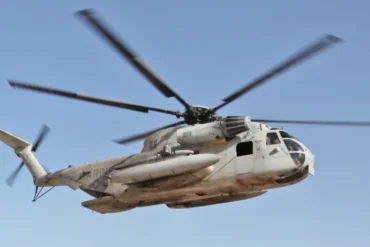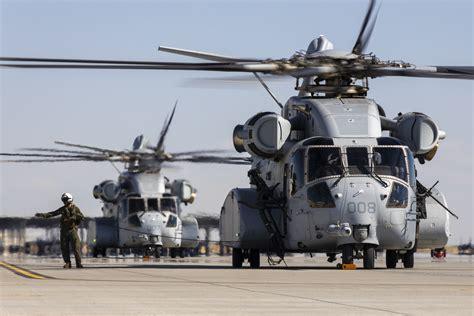
The U.S. Marine Corps has taken delivery of two more CH-53K King Stallion heavy-lift helicopters, marking another deliberate step in a long-term effort to modernize one of its most critical aviation capabilities. The aircraft were formally accepted following joint U.S. Navy and Marine Corps testing, underscoring a program that is steadily moving from early introduction toward mature, sustained operational service. Each delivery strengthens the Corps’ ability to move forces, equipment, and sustainment across increasingly demanding expeditionary environments.
Sikorsky, a Lockheed Martin company, confirmed the handover in late January 2026, noting that the helicopters completed the standard acceptance process applied to all CH-53K airframes produced at its U.S. manufacturing facilities. The procedure includes rigorous flight testing, system validation, and logistics verification by Navy and Marine Corps evaluation teams, ensuring the aircraft meet operational requirements before entering the fleet. This measured approach reflects lessons learned from earlier phases of the program, when incremental improvements were deliberately integrated to enhance reliability and maintainability.
The latest delivery also highlights the disciplined pace of the Marine Corps’ transition away from the aging CH-53E Super Stallion, a platform that has served for decades but now faces growing sustainment challenges. Rather than rushing the process, the service is aligning new aircraft arrivals with training capacity, shipboard integration, and logistics infrastructure, ensuring each CH-53K adds immediate and lasting value to operational readiness.
Program Momentum Under a Long-Term Production Contract
These two helicopters are part of the broader CH-53K production framework established under a major multi-year contract awarded in April 2023. Acting on behalf of the Marine Corps, the U.S. Navy structured the agreement to support a program of record for 200 aircraft, providing the industrial stability needed to move beyond low-rate production and into sustained manufacturing. Defense budget documents indicate the contract emphasizes cost control, predictable delivery schedules, and the systematic incorporation of improvements identified during operational testing.
By early 2026, program officials report that production processes have matured significantly compared to the program’s initial years. Unit cost growth has stabilized, supplier performance has improved, and aircraft availability rates continue to trend upward. For the Marine Corps, this steady progress is as important as headline performance figures, because heavy-lift helicopters are only decisive if they are consistently available, deployable, and maintainable across global commitments.
A Clean-Sheet Heavy-Lift Design for Modern Warfare
Although the CH-53K retains the familiar external profile of earlier CH-53 variants, it is fundamentally a new aircraft, designed from the ground up to meet contemporary expeditionary and maritime demands. The airframe incorporates extensive use of advanced composites, reducing weight while improving corrosion resistance in harsh shipboard environments. The cargo cabin is wider and more capable, allowing it to carry modern tactical vehicles and palletized loads that could not be accommodated by legacy helicopters without compromise.
At the heart of the King Stallion is a powerful propulsion system built around three GE T408-GE-400 engines, each producing 7,500 shaft horsepower. These engines feed a split-torque main gearbox specifically engineered to handle power levels unprecedented in a production rotary-wing aircraft. The result is a helicopter designed not just to lift heavy loads, but to do so reliably under conditions that reflect real-world combat operations rather than ideal test environments.
Performance Built for Hot, High, and Hostile Conditions
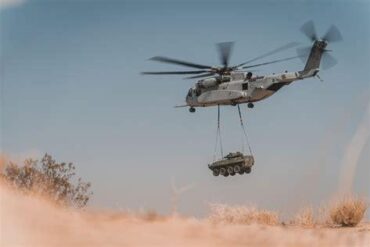
The defining metric for the CH-53K is its ability to lift more than 27,000 pounds externally in what the Marine Corps defines as hot-and-high conditions: 3,000 feet of pressure altitude at 91 degrees Fahrenheit. These parameters are not theoretical extremes; they mirror the environments Marines are likely to encounter in expeditionary operations across the Indo-Pacific, Middle East, and other regions where heat, altitude, and limited infrastructure converge.
Beyond raw lift, the helicopter offers substantial performance margins. Its service ceiling reaches approximately 16,000 feet under standard conditions and remains robust even at elevated temperatures. This power reserve enhances safety, reduces pilot workload, and provides commanders with flexibility when planning missions that involve complex terrain, degraded weather, or unexpected contingencies.
Central to Expeditionary and Maritime Operations
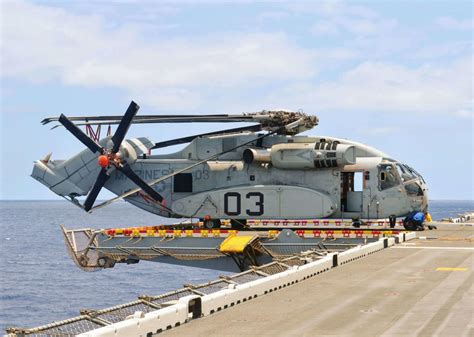
For the Marine Corps, the CH-53K is not a niche asset but a cornerstone of expeditionary warfare. Operating from amphibious assault ships and austere forward bases, Marines depend on heavy-lift helicopters to move combat power ashore, sustain distributed units, and rapidly reposition forces across dispersed operating areas. Without this capability, the tempo and reach of Marine Air-Ground Task Forces would be sharply constrained.
The King Stallion’s mission set spans troop transport, vehicle and artillery movement, logistics resupply, casualty evacuation, humanitarian assistance, and direct support to special operations forces. In future conflict scenarios, it is expected to enable expeditionary advanced base operations, delivering sensors, air defense systems, fuel, and ammunition to small, dispersed units operating inside contested zones. Its ability to fly day or night in degraded visual environments, including severe brownout conditions, is essential to these missions.
Survivability, Connectivity, and Digital Integration
Modern conflict environments demand more than lift capacity alone. The CH-53K was designed with survivability and networked operations as core requirements. Its glass cockpit integrates fused sensor displays, advanced navigation systems, and a full-authority digital fly-by-wire flight control system that enhances handling and reduces pilot fatigue during demanding missions.
The aircraft also incorporates an integrated health and usage monitoring system, enabling predictive maintenance and reducing unscheduled downtime. Provisions for defensive aids allow the helicopter to counter infrared and radar-guided threats, supporting operations in contested airspace. These features are intended to ensure interoperability with fifth-generation platforms such as the F-35B, allowing the CH-53K to operate as part of a connected, multi-domain force rather than as an isolated transport asset.
Transitioning From the CH-53E Super Stallion
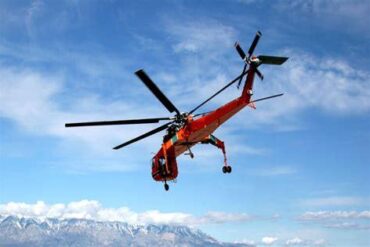
As of early 2026, the Marine Corps continues to operate a mixed heavy-lift fleet, with CH-53E Super Stallions sustaining deployments while CH-53K units expand training and readiness. Introduced in the early 1980s, the CH-53E has provided decades of service but now faces increasing maintenance demands and diminishing availability. Its maximum external lift of roughly 16,000 pounds under comparable conditions highlights the generational leap represented by the King Stallion.
The transition strategy reflects operational realism. Rather than retiring the CH-53E prematurely, the Marine Corps is balancing ongoing commitments with the gradual fielding of the CH-53K, ensuring no gap in heavy-lift capability. Because the Corps does not operate any other heavy-lift helicopter, the success of this transition is directly tied to its ability to execute global missions.
Industrial Base and Strategic Implications
Each CH-53K delivery reinforces the program’s importance within the U.S. defense industrial base. Sikorsky’s production line supports a supplier network spanning more than 40 states, with critical contributions from companies such as GE Aerospace, Collins Aerospace, and Northrop Grumman. This nationwide footprint not only sustains skilled jobs but also preserves specialized manufacturing capabilities essential for future rotorcraft development.
Officials involved in recent acceptance activities note that production maturity and aircraft availability continue to improve, supporting confidence in the program’s long-term trajectory. While the delivery of two helicopters may seem incremental, it represents steady momentum for a platform that the Marine Corps increasingly views as indispensable. In an era defined by contested logistics, long distances, and distributed operations, the CH-53K King Stallion is emerging not merely as a replacement for an aging aircraft, but as a decisive enabler of Marine Corps combat power for decades to come.