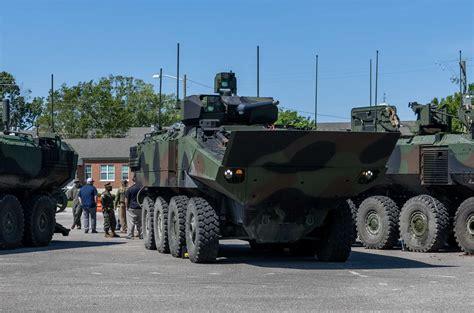
The U.S. Marine Corps has moved decisively to deepen its investment in next-generation amphibious warfare with a $195 million contract awarded to BAE Systems for additional ACV-30 Amphibious Combat Vehicles, pushing total procurement of turreted variants beyond 150 vehicles. Announced on February 3, 2026, the order confirms that the ACV-30 is no longer a supplemental capability but a core combat platform shaping how Marines expect to fight from ship to shore and beyond. The decision arrives at a moment when amphibious forces face increasingly hostile coastlines, layered defenses, and persistent surveillance, demanding vehicles that combine sea mobility, land survivability, and credible direct firepower.
This latest award reinforces the Marine Corps’ long-term transition away from legacy tracked systems toward a wheeled, networked, and survivable amphibious fleet capable of operating in both permissive and contested environments. Rather than slowing procurement to reassess requirements, the service has chosen to scale production while the line is active, a signal of institutional confidence in the ACV’s performance envelope and growth potential. For industry, it sustains a stable manufacturing rhythm; for operators, it accelerates the fielding of vehicles already aligned with evolving doctrine.
The ACV-30 sits at the intersection of expeditionary maneuver and mechanized combat, designed to land directly from the sea and remain in the fight as Marine units push inland. This contract underscores that the Marine Corps no longer views amphibious assault as a brief delivery phase but as a continuous, high-risk operation requiring armored vehicles that can fight, survive, and command under fire.
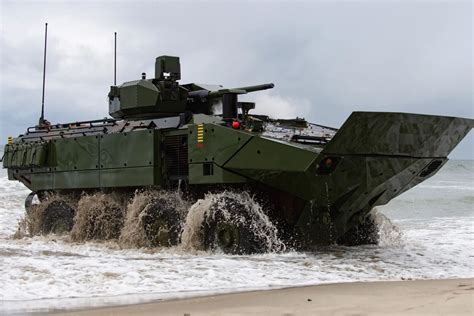
ACV-30: A Gun-Armed Variant Redefining Amphibious Combat Roles
At the heart of the new procurement is the ACV-30, the most heavily armed member of the Amphibious Combat Vehicle family. Built on an 8×8 amphibious chassis, the vehicle integrates Kongsberg’s Medium Caliber Turret (MCT-30), a remotely operated system mounting the 30 mm Mk 44 Stretch Bushmaster dual-feed cannon paired with a coaxial machine gun. The turret is operated from under armor, preserving crew protection while maintaining the delicate weight balance required for amphibious stability.
This configuration is more than an incremental upgrade. The 30 mm cannon gives Marine infantry a direct-fire capability far exceeding that of heavy machine guns, enabling engagement of light armored vehicles, fortified positions, and dispersed anti-armor teams threatening beach exits and inland routes. With modern electro-optical sensors and fire-control systems, the ACV-30 can detect and engage targets at ranges exceeding five kilometers, extending its influence well beyond the immediate landing zone.
Crucially, the turret’s remote design avoids the penalties traditionally associated with manned turrets on amphibious hulls. By keeping operators under armor and managing weight growth, the ACV-30 preserves sea performance without sacrificing lethality, a balance that has historically challenged amphibious vehicle designers.
From Transport to Fighting Platform: Why the Marine Corps Is Doubling Down
The Marine Corps’ decision to expand ACV-30 procurement reflects a broader doctrinal shift toward contested entry operations. In environments where enemy forces deploy precision fires, loitering munitions, and layered coastal defenses, amphibious vehicles must contribute immediately to suppressing threats rather than acting solely as armored taxis.
The ACV-30’s role is to create and exploit windows of opportunity during the most vulnerable phase of an assault. As vehicles transition from surf to shore, the ability to deliver accurate medium-caliber fire against concealed firing points, vehicle-borne threats, and hardened positions can determine whether an assault force maintains momentum or stalls under fire. This organic firepower reduces reliance on immediate close air support or naval gunfire, both of which may be constrained by weather, air defenses, or deconfliction in crowded littoral battlespaces.
Once inland, ACV-30s provide overwatch for dismounted infantry, escort reconnaissance elements, and secure key terrain such as ports, causeways, and coastal infrastructure. In this role, the vehicle functions as both shield and sword, pairing protected mobility with sustained fire support in environments where traditional armor may be too heavy or logistically burdensome.
A Family of Variants Built for Sustained Operations
The ACV program is deliberately structured as a family of mission-specific variants, allowing Marine amphibious units to deploy balanced, self-sustaining formations. Alongside the ACV-30, BAE Systems continues to deliver the ACV-Personnel (ACV-P) and ACV-Command (ACV-C) variants, each addressing distinct operational needs.
The ACV-P is designed to transport 13 combat-loaded Marines plus a three-person crew, minimizing squad fragmentation while providing blast protection and mobility across complex terrain. Its role is foundational, delivering infantry intact to decisive points without forcing excessive dismounts during movement.
The ACV-C, by contrast, focuses on command and control. Equipped with multiple workstations and communications systems, it enables Marine leaders to maintain situational awareness, coordination, and decision-making in dispersed operations. As Marine formations spread out to complicate enemy targeting, the ability to command from a protected, mobile platform becomes increasingly critical.
Less visible but equally vital is the ACV-Recovery (ACV-R) variant. BAE Systems has delivered three production representative test vehicles, with crane integration handled by the U.S. Government at Anniston Army Depot. In practical terms, recovery vehicles determine whether a fleet can sustain tempo under fire. Amphibious environments are unforgiving; vehicles bog down in surf zones, suffer mechanical failures, or take damage in predictable chokepoints. A dedicated recovery capability turns individual vehicles into a resilient system, capable of repair and extraction under forward conditions.
Industrial Momentum and Production Stability
The $195 million award also highlights the Marine Corps’ intent to avoid stop-start procurement cycles that historically erode industrial expertise and drive up long-term costs. By ordering additional vehicles while production remains active, the service preserves a skilled workforce and a stable supplier base, reducing risk and maintaining quality.
BAE Systems will conduct work in Johnstown and York, Pennsylvania, while Charleston, South Carolina supports government-led integration of the Kongsberg turret system. This distributed production model reflects a mature defense industrial approach, spreading risk across multiple facilities while anchoring the program within the U.S. manufacturing base. It also signals that the ACV line is treated as a sustained capability, not a short-term bridge solution.
Survivability by Design: Learning From Two Decades of Conflict
Compared to the legacy Assault Amphibious Vehicle (AAV) it replaces, the ACV family emphasizes blast protection, mobility, and reliability. Derived from the SuperAV 8×8 hull co-developed with Iveco, the platform is engineered to operate in rough surf before transitioning to high-speed maneuver on land. Its hull form and seating architecture are optimized to mitigate underbody blasts, a lesson learned through years of operating in mine- and IED-threatened environments.
This survivability focus is not theoretical. Amphibious vehicles are forced into predictable avenues of approach near beaches, ports, and road networks, making them prime targets for mines and indirect fire. By combining improved blast resistance with wheeled mobility, the ACV seeks to reduce attrition at the point of entry, preserving combat power for operations beyond the shoreline.
Strategic Signals Beyond the Contract
Beyond hardware, the expansion of the ACV-30 fleet sends a strategic message. It signals that armored amphibious maneuver remains relevant even as long-range precision strike, cyber operations, and unmanned systems dominate defense discourse. For the Marine Corps, it reflects a belief that future conflicts will still demand forces capable of seizing and holding terrain under fire, particularly in maritime theaters where access cannot be assumed.
For allies and partners, the ACV program provides a tangible reference for interoperability in combined littoral operations. As many nations reassess their own amphibious and expeditionary capabilities, the U.S. Marine Corps’ commitment to a gun-armed, survivable amphibious vehicle underscores the enduring value of platforms that bridge sea and land without pause.
In expanding its ACV-30 procurement, the Marine Corps is not merely buying vehicles. It is investing in a vision of amphibious warfare that accepts risk, confronts contested environments head-on, and equips Marines with the firepower, protection, and mobility needed to fight from the surf line to inland objectives. The $195 million contract is a clear affirmation that the ACV-30 is central to that future, not an accessory to it.