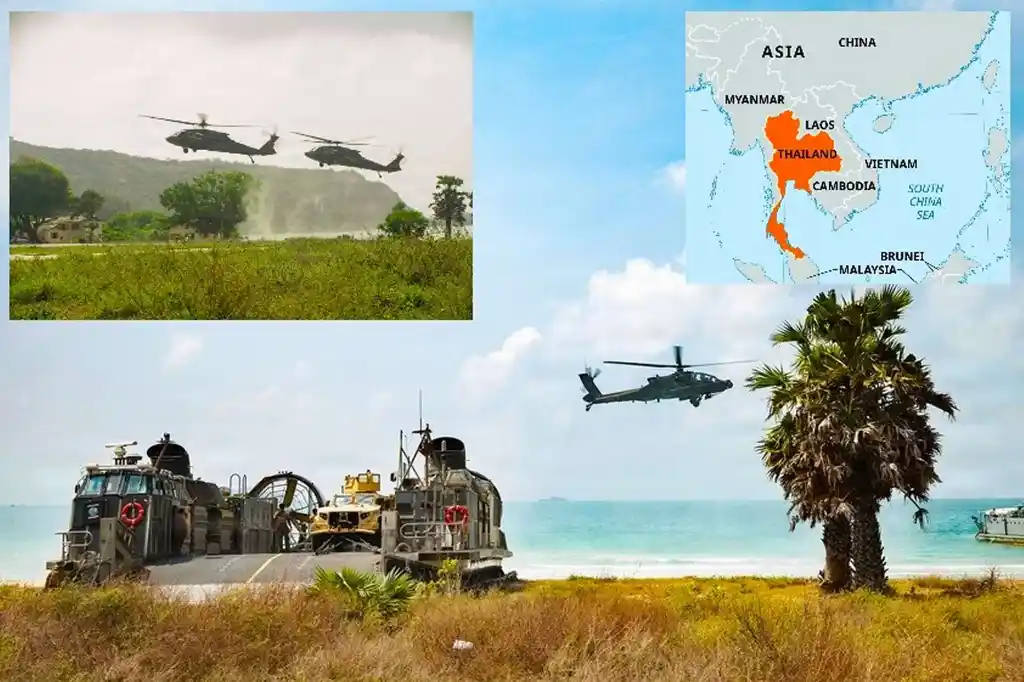
Cobra Gold 2026 has once again transformed Thailand’s eastern coastline into a proving ground for the future of Indo-Pacific security. Off Hat Yao Beach in Rayong Province, U.S. naval and Army aviation units executed a tightly synchronized amphibious and sea-based air operation designed to refine the United States’ ability to project combat power across contested littorals. The imagery released through the Defense Visual Information Distribution Service (DVIDS) captures more than a routine training serial; it reveals a deliberate recalibration of how American forces intend to fight, deter, and respond across the region’s coastal flashpoints.
The drills unfolded on 26 February 2026 as part of Cobra Gold, one of mainland Asia’s largest multinational military exercises, co-hosted annually by the United States and Thailand. While the exercise encompasses humanitarian assistance, command post coordination, and multinational ground maneuvers, the maritime phase this year placed particular emphasis on joint sea-based maneuver. The objective was precise: validate over-the-horizon ship-to-shore movement under simulated threat conditions while integrating rotary-wing fire support and air assault operations into a seamless operational picture.
At the center of the beach landing was U.S. Navy LCAC 81, assigned to Assault Craft Unit 5, delivering Marines and Sailors from Task Force Ashland, I Marine Expeditionary Force. The Landing Craft, Air Cushion (LCAC) is no ordinary transport. Riding on a cushion of air, it hovers above the water and shoreline, capable of speeds exceeding 40 knots and able to traverse terrain that would defeat traditional displacement landing craft. Mudflats, soft sand, and shallow surf zones become accessible corridors rather than obstacles. By deploying from amphibious shipping positioned beyond the visual horizon, LCAC 81 demonstrated how larger vessels can remain outside the effective range of coastal defense systems while still delivering combat power precisely where needed.
The over-the-horizon profile of the operation is not cosmetic. In a region characterized by dense missile inventories, mobile coastal batteries, and proliferating surveillance networks, proximity can equal vulnerability. Keeping high-value amphibious ships at standoff distance reduces risk while preserving operational tempo. The LCAC serves as a high-speed connector, bridging sea and land without presenting an easy target. In strategic terms, this is distributed lethality applied to logistics and maneuver: spreading capability across platforms so that no single node becomes a decisive weakness.
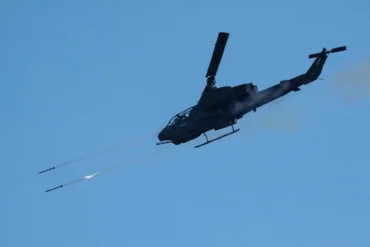
Providing overwatch above the landing force was a U.S. Army AH-64 Apache attack helicopter, simulating close air support during the beach insertion. The Apache’s sensor suite, including advanced targeting systems and night-vision capabilities, allows it to identify and engage armored vehicles, fortified positions, and small boat threats with precision-guided munitions or its 30mm chain gun. Its presence in a maritime-centric scenario reflects an increasingly joint approach to littoral warfare. Amphibious operations are no longer the exclusive domain of naval and Marine forces; they are multi-domain undertakings where Army aviation, naval air defense, and ground maneuver units converge into a single networked force.
The integration of an Army attack helicopter into the amphibious assault vignette underscores a doctrinal evolution. In previous eras, service lines often shaped operational boundaries. Today, operational necessity dissolves those boundaries. The Apache’s simulated support role over Hat Yao Beach illustrates layered protection: naval vessels provide air defense and command-and-control; rotary-wing assets offer immediate fire support; surface connectors move personnel and materiel; ground forces establish the beachhead. The architecture is modular and adaptable, designed to complicate adversary targeting cycles.
Parallel to the LCAC landing, UH-60 Black Hawk helicopters from Task Force Tigershark, 1st Battalion, 229th Aviation Regiment, 16th Combat Aviation Brigade, conducted sea-based maneuvers. Rather than launching from fixed land bases, these aircraft operated in coordination with maritime platforms, rehearsing air assault insertions, logistics resupply, and medical evacuation missions originating from the sea. The difference is not trivial. Operating from maritime environments demands proficiency in deck landings, maritime navigation, confined approaches over open water, and synchronization with naval air traffic control procedures.
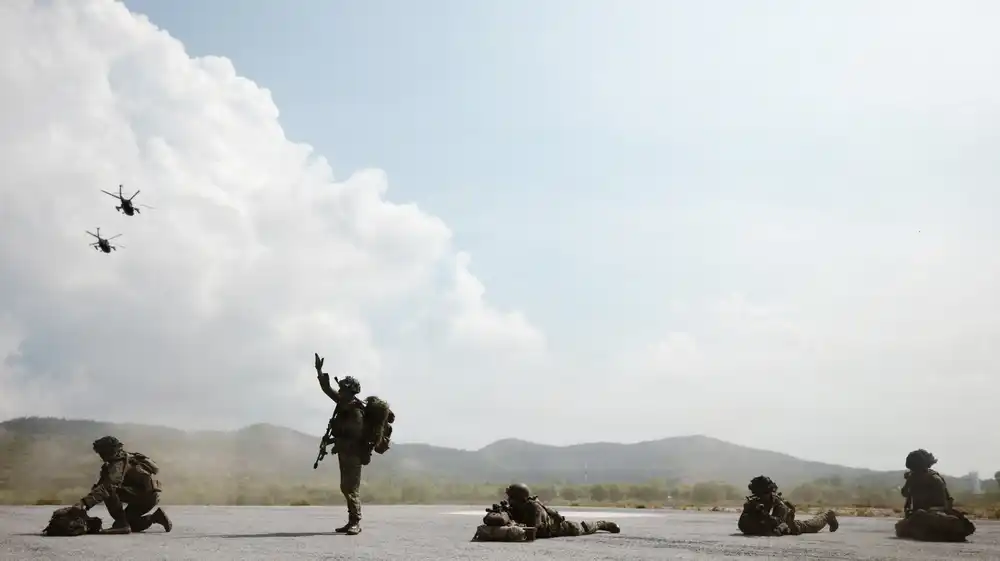
Sea-based vertical maneuver provides commanders with options that go beyond a single beach landing. Troops can be inserted inland, bypassing heavily defended coastal zones. Supplies can be delivered to dispersed units operating along fragmented shorelines. Casualties can be evacuated directly to ships equipped with surgical facilities. In the Indo-Pacific, where archipelagic geography dominates and infrastructure can be limited or contested, this flexibility becomes operational currency.
The Cobra Gold scenario reflects broader U.S. operational concepts shaping force development. Distributed Maritime Operations emphasize dispersing naval assets to reduce vulnerability while maintaining collective combat power. Joint All-Domain Operations seek to integrate land, sea, air, cyber, and space capabilities into a unified decision-making network. The Marine Corps’ evolving focus on expeditionary advanced base operations envisions small, mobile units operating within contested zones to provide sensing, fires, and logistical nodes. The drills off Rayong Province serve as a tangible rehearsal of these abstract concepts.
This is not merely about rehearsing large-scale amphibious assaults reminiscent of the 20th century. Instead, Cobra Gold 2026 showcased smaller, agile force packages capable of rapid insertion, sustainment, and repositioning. The combination of LCAC connectors, rotary-wing aviation, and ground elements allows for adaptive maneuver. In a crisis scenario—whether a contested island, a threatened chokepoint, or a destabilized coastal region—such agility can determine whether deterrence holds or escalation spirals.
Strategically, the Indo-Pacific’s geography defines its security calculus. Long coastlines, narrow straits, and densely populated littorals create a battlespace where control of coastal access equates to influence. By refining ship-to-shore maneuver and sea-based aviation integration, U.S. forces signal that they are preparing specifically for this environment. The training message is implicit but clear: access will be contested, logistics will be targeted, and mobility will be decisive.
Beyond combat readiness, the same capabilities demonstrated at Hat Yao Beach carry dual-use implications. Amphibious connectors and rotary-wing aircraft are indispensable during humanitarian assistance and disaster relief operations, a recurring requirement in a region prone to typhoons, tsunamis, and flooding. An LCAC delivering Marines under simulated fire can, with minimal reconfiguration, deliver relief supplies to devastated shorelines. A Black Hawk trained for maritime air assault can evacuate civilians or transport medical teams to isolated communities. The operational muscle memory developed in high-end warfighting scenarios directly enhances crisis response effectiveness.
Thailand’s role as co-host reinforces the exercise’s multinational dimension. Cobra Gold has long served as a platform for building interoperability among regional partners. Shared deck procedures, communications protocols, and command relationships foster trust and reduce friction in real-world contingencies. When aircraft from one service or nation land on another’s platform, the choreography represents more than technical coordination; it embodies strategic alignment.
The imagery from Cobra Gold 2026 encapsulates a broader strategic narrative. LCAC 81 surging toward shore, an Apache circling overhead, Black Hawks approaching from the sea—these are not isolated vignettes but components of a coherent doctrine tailored to the Indo-Pacific’s realities. The United States is investing in the ability to project power without concentrating vulnerability, to sustain forces without fixed infrastructure, and to operate jointly without seams.
In an era defined by rapid technological change and intensifying competition across maritime domains, adaptability is a form of deterrence. Cobra Gold 2026 demonstrates that amphibious warfare in the Indo-Pacific is evolving from massed formations toward distributed, integrated, and networked maneuver. The beaches of Rayong Province provided the stage, but the implications extend across the region’s coastlines and straits. Through disciplined rehearsal and joint integration, the United States continues to refine the tools required to ensure access, reassure partners, and respond decisively when stability is tested.