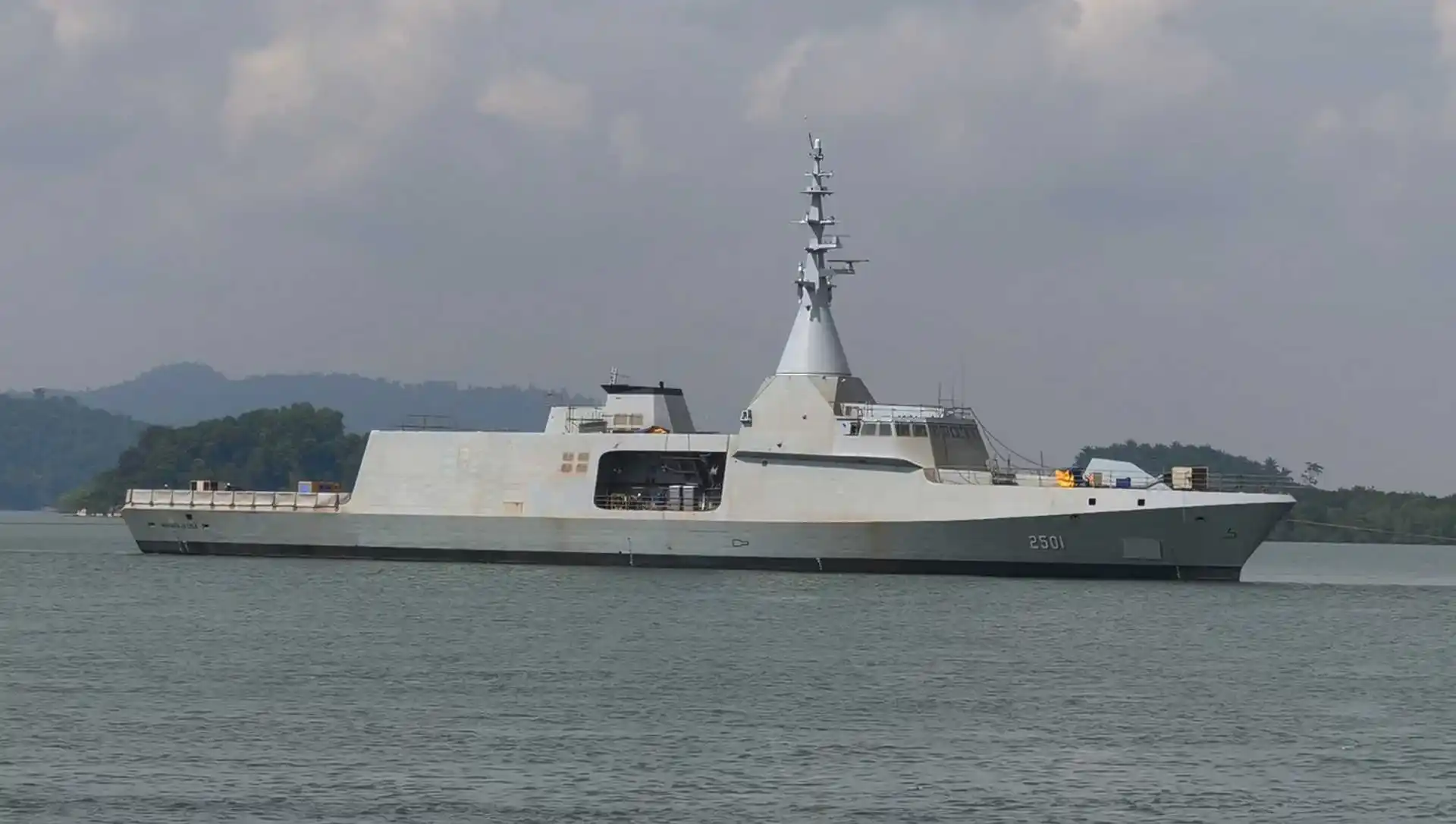
Malaysia’s long-delayed littoral combat ship program crossed a visible threshold in January 2026 when KD Maharaja Lela (2501), the first vessel of the Maharaja Lela-class, finally left the safety of the dock and entered open waters for initial sea trials. For the Royal Malaysian Navy, this was not a ceremonial milestone or a paper announcement. It was a physical, measurable movement of steel, systems, and expectations after years of public scrutiny, political debate, and stalled progress.
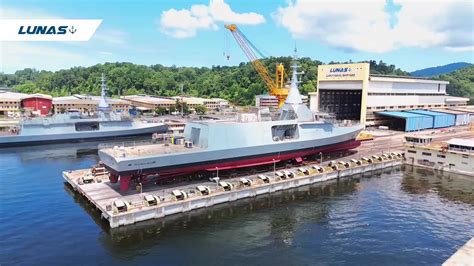
The ship departed Lumut Naval Shipyard on January 20, 2026, following the completion of dockside checks that validated core mechanical and electrical systems. Video footage captured the vessel being towed clear of the harbor, a cautious but necessary step for a first-of-class warship emerging from a prolonged construction pause. Within days, AIS tracking data and contemporaneous imagery confirmed KD Maharaja Lela operating off Pangkor Island, accompanied by tugboats, signaling the start of sustained at-sea testing rather than a brief symbolic sortie.
This transition from static outfitting to dynamic trials marks the most concrete advancement yet for Malaysia’s LCS program, a project that has come to symbolize both the ambition and the administrative fragility of major defense procurement efforts in the region.
By the time the ship reached open water, the broader program context had already shifted. Lumut Naval Shipyard released materials showing parallel progress across other hulls, underscoring that KD Maharaja Lela’s departure was not an isolated act but part of a staggered recovery plan. The moment carried weight precisely because it suggested momentum rather than rescue.
A Program Moving Forward on Uneven Keels
The sea trials of KD Maharaja Lela unfolded alongside visible developments across the rest of the class. A time-lapse sequence released by the shipyard documented structural completion on KD Sharif Masahor (2503), the third ship in the series. The footage showed the finished upper structure, installation of major external fittings, and the application of the pennant number, formally assigning the vessel its place in the Royal Malaysian Navy’s order of battle.
In contrast, KD Raja Muda Nala (2502), the second hull, remained alongside at Lumut, still undergoing outfitting rather than transitioning to trials. This uneven progression highlights the program’s revised execution model: multiple ships advancing simultaneously, but at different speeds and levels of readiness. One vessel at sea, one nearing structural completion, and one deep in systems integration paints a picture of cautious concurrency rather than the linear production originally envisioned.
This approach reflects lessons learned from earlier disruptions. The program is no longer chasing aggressive delivery targets; it is prioritizing demonstrable progress and technical validation, one hull at a time.
Years of Delay, Scrutiny, and Reset
The Maharaja Lela-class program has been under a microscope for most of its life. Originally launched in 2011, the project was intended to deliver six modern littoral combat ships to replace aging surface combatants and strengthen Malaysia’s maritime posture. Construction moved forward until financial, contractual, and governance issues brought work to a near standstill several years later.
The resulting delays triggered government investigations, parliamentary inquiries, and a temporary suspension of the program. Only in 2020 did construction resume under revised terms, accompanied by stricter oversight and a restructured delivery plan. By early 2026, lawmakers were again preparing visits to Lumut Naval Shipyard to assess whether the revived schedule was being honored and whether the revised scope could realistically be completed.
Under the current plan, Malaysia will field five Maharaja Lela-class ships, not six, with the first unit expected to be commissioned in 2026 and the class serving well into the 2030s. The reduction reflects hard constraints rather than shifting ambition, a recalibration designed to salvage operational capability from a troubled procurement cycle.
Design Origins and Platform Characteristics
KD Maharaja Lela is derived from an enlarged variant of the Gowind 2500 design proposed by France’s Naval Group, formerly known as DCNS. The Malaysian configuration diverges from the baseline corvette by increasing displacement and internal volume, effectively pushing the ship into the light frigate category by regional standards.
Laid down on March 8, 2016, and launched on August 24, 2017, the ship then spent years in a state of partial completion as the program stalled. In its finalized form, the vessel displaces approximately 3,100 tons at full load, measures 111 meters in length, and has a beam of 16 meters with a draft of 3.85 meters. Crew complement is typically cited at 138 personnel, with accommodation flexibility depending on mission configuration.
These dimensions are not cosmetic. The expanded hull supports longer endurance, greater fuel capacity, and a denser concentration of combat systems, enabling sustained operations in both congested littoral waters and near-open-sea environments.
Propulsion, Endurance, and Seakeeping
The ship’s propulsion architecture uses a combined diesel and diesel (CODAD) arrangement, powered by four MTU 20V 1163 M94 diesel engines. Each engine produces roughly 7,400 kW, delivering a combined output of about 29,600 kW. This configuration allows a top speed of 28 knots, sufficient for both interception and escort roles.
At a cruising speed of 15 knots, KD Maharaja Lela is designed to achieve a range of approximately 5,000 nautical miles, with an endurance of around 21 days. Survivability standards extend up to Sea State 9, reflecting expectations for operations in challenging weather conditions common to the region.
A stern flight deck and enclosed hangar support sustained aviation operations, accommodating helicopters such as the Super Lynx 300, Fennec AS555, AW139, and EC725, as well as unmanned aerial systems. The facilities are rated for aircraft weighing up to 10 tons, expanding the ship’s reach in surveillance, anti-submarine warfare, and maritime security missions.
Sensors, Combat Systems, and Electronic Warfare
The combat system architecture centers on the SETIS combat management system, integrating sensors and weapons into a unified operational picture. Surveillance and targeting are supported by the SMART-S Mk2 radar, paired with Rheinmetall TMEO Mk2 and TMX/EO Mk2 electro-optical fire control systems.
For undersea warfare, the ship combines a Kingklip Mk1 hull-mounted sonar with a CAPTAS-2 towed array, enabling detection and tracking of submarines across varying depths and acoustic conditions. Electronic warfare capabilities include the Thales Vigile electronic support measures suite and the Wallop Super Barricade decoy launcher, providing layered defenses against radar-guided and infrared threats.
This integrated sensor and countermeasure ecosystem is tailored for the dense traffic, complex acoustics, and short reaction times typical of Southeast Asian littoral environments.
Weapons Fit and Operational Role
KD Maharaja Lela’s armament reflects a balanced, multi-role design. The main gun is a Bofors 57 mm, supported by two MSI DS30M 30 mm cannons for close-in defense. Anti-submarine warfare is handled by two triple J+S torpedo launchers.
Missile armament is built around 16 Sylver vertical launch cells intended for VL MICA short-range surface-to-air missiles, providing point and local area air defense. Anti-ship capability is planned around eight Naval Strike Missiles, replacing older systems associated with earlier Gowind variants and significantly extending the ship’s strike reach.
Together, these systems position the Maharaja Lela-class as a flexible surface combatant capable of patrol, escort, deterrence, and limited power projection.
Cost, Accountability, and the Meaning of Sea Trials
Financially, the program has evolved as much as the ship itself. Initial estimates placed the cost at RM9 billion for six ships. Revised agreements raised the figure to RM11.2 billion for five ships, with per-unit costs cited at approximately RM2.24 billion, including technology transfer components.
Against this backdrop, the sea trials of KD Maharaja Lela carry significance beyond engineering validation. They represent a tangible checkpoint in restoring credibility to a program long defined by delay. Every mile logged off Pangkor Island is data, evidence, and momentum.
If trials proceed as planned, KD Maharaja Lela will become more than a symbol of recovery. It will be the operational foundation upon which Malaysia rebuilds confidence in one of its most ambitious naval modernization efforts.