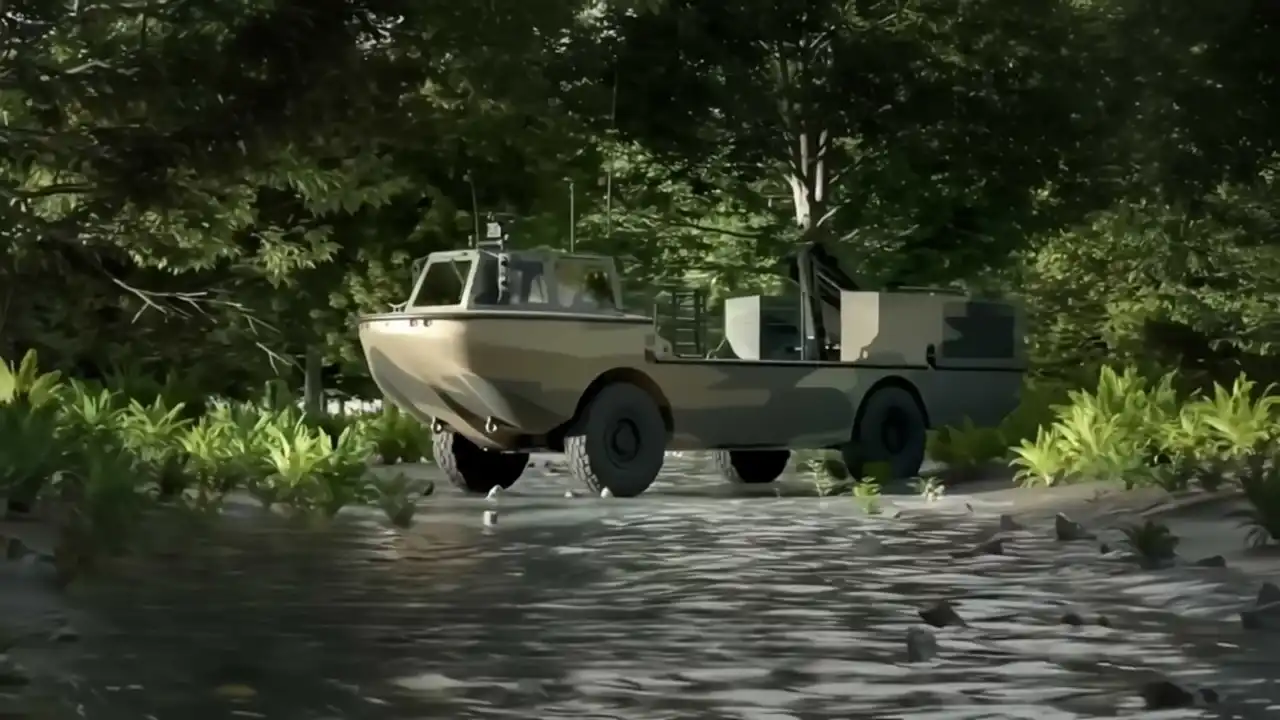
Australia has taken a decisive step in reshaping its amphibious and littoral warfare capabilities by ordering 16 new Amphibious Vehicle – Logistics (AV-L) platforms for the Australian Army. The decision reflects a broader strategic recalibration toward coastal, riverine, and archipelagic operations, where logistics mobility across the land–sea interface is no longer a niche requirement but a core operational necessity. Announced in mid-January 2026, the acquisition reinforces Canberra’s intent to ensure that sustainment forces can keep pace with manoeuvre units operating far from established ports and fixed infrastructure.
The contract, signed on January 13, 2026, awards AU$125 million to Australian defence engineering firm Birdon, covering the design and construction of one prototype followed by 15 production vehicles. Equivalent to roughly US$84 million, the deal forms a key element of the Australian Army’s Land 8710 Littoral Manoeuvre program, which is focused on delivering an integrated suite of platforms capable of moving forces and supplies seamlessly from ship to shore and onward inland. The AV-L is specifically designed to bridge this sustainment gap, ensuring continuous over-the-shore resupply even where ports are damaged, absent, or contested.
At its core, the AV-L program addresses a long-standing capability challenge faced by the Australian Army: how to sustain dispersed forces operating along vast coastlines and island chains under harsh environmental conditions. Unlike conventional trucks or landing craft, the AV-L is engineered to operate as a single, self-contained logistics link, transitioning directly from road to surf to open water without reconfiguration. This design philosophy reflects lessons learned from decades of expeditionary and disaster-response operations, where logistics bottlenecks often dictate operational tempo more than combat power.
The strategic significance of the acquisition becomes clearer when viewed against Australia’s evolving defence posture. The Indo-Pacific region’s geography, defined by narrow straits, shallow littorals, and extended coastlines, places a premium on amphibious sustainment. For the Australian Army, the ability to resupply forces independently of major ports supports not only combat operations but also humanitarian assistance, disaster relief, and regional engagement missions. The AV-L is therefore not a niche asset but a foundational enabler for modern Australian land forces.
Land 8710 and the Shift Toward Littoral Manoeuvre
The Land 8710 Littoral Manoeuvre program represents the Australian Army’s most comprehensive effort to modernise its maritime mobility since the Cold War. Structured across multiple phases, the program integrates new landing craft, amphibious logistics vehicles, and enabling infrastructure to support sustained operations in coastal and archipelagic environments. Rather than relying on a small number of large amphibious ships and ports, Land 8710 emphasises distributed lift, redundancy, and adaptability.
Within this framework, the AV-L serves as the connective tissue between naval platforms, beaches, and inland supply routes. It complements medium and heavy landing craft that transport vehicles, artillery, and bulk supplies, ensuring that once ashore, sustainment can continue without interruption. This approach aligns closely with emerging Army concepts centred on littoral manoeuvre and long-range strike, where forces are expected to operate in small, mobile elements across wide areas.
The program also supports organisational change. Dedicated Littoral Lift Groups are being developed, along with specialised maritime skills within the Army. These units are designed to operate alongside Royal Australian Navy assets while retaining the flexibility to act independently in shallow waters and confined coastal zones. The AV-L is integral to this vision, providing a purpose-built logistics platform tailored to the unique demands of the littoral battlespace.
Replacing the LARC-V Legacy Fleet
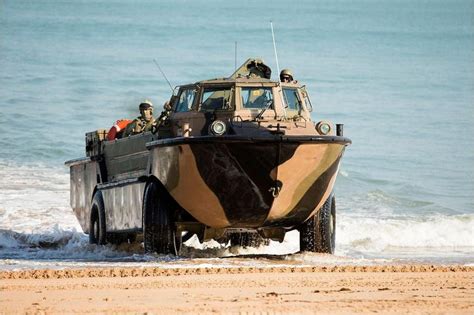
A critical driver behind the AV-L acquisition is the planned retirement of the Army’s ageing LARC-V (Lighter Amphibious Resupply Cargo Vehicle) fleet. Originally developed in the United States during the 1950s and introduced into Australian service in the early 1960s, the LARC-V has delivered decades of reliable service in over-the-shore resupply, coastal transport, and domestic disaster response. However, its age has increasingly constrained availability, safety, and performance.
While the LARC-V proved remarkably adaptable for its era, modern operational demands exceed its design limits. Payload capacity, endurance, crew protection, and maintainability all fall short of contemporary requirements. As Australia’s strategic focus shifts northward and outward into the Indo-Pacific, the need for a more robust, reliable, and environmentally resilient amphibious logistics vehicle has become unavoidable. The AV-L is intended not merely as a replacement but as a generational leap in capability.
Engineering for Harsh Littoral Environments
The Amphibious Vehicle – Logistics platform has been engineered from the outset to withstand the extreme environmental conditions typical of northern Australia and the wider Indo-Pacific. High ambient temperatures, extreme humidity, corrosive saltwater, and debris-filled surf zones are treated as baseline operating conditions rather than edge cases. This environmental tolerance is essential for a vehicle expected to conduct repeated transitions between land, surf, and open water over extended periods.
The AV-L’s design combines characteristics traditionally associated with deep-sea vessels and heavy road vehicles, while remaining compliant with Australian safety and regulatory standards. This dual-domain approach allows the vehicle to move directly from inland road networks into the surf without external support or modification. Such flexibility significantly reduces logistical friction and enhances responsiveness during both military and civil operations.
Mobility across this complex operating envelope is achieved through an integrated propulsion and traction architecture. The vehicle employs waterjet propulsion rather than exposed propellers, improving safety and reducing vulnerability to debris during surf operations. On land, a dynamic drivetrain and advanced traction management system automatically detect wheel slip or bogging, adjusting power distribution to regain grip when exiting soft sand or wave zones.
Mobility, Control, and Performance Parameters
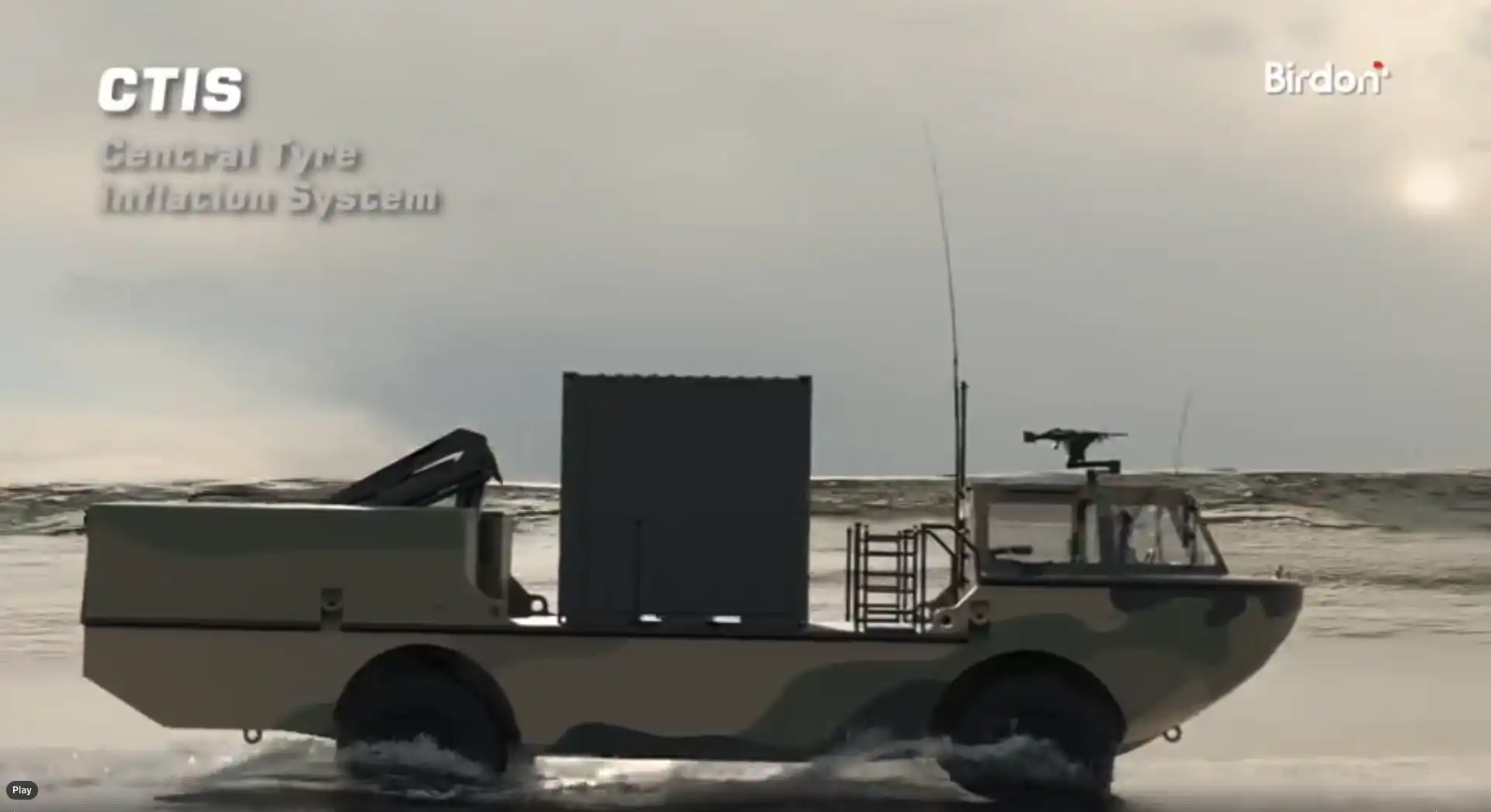
From a performance perspective, the AV-L strikes a deliberate balance between road mobility and maritime endurance. Measuring approximately 11.7 metres in length, the vehicle is rated to carry a payload of 5.2 short tons (4.7 metric tonnes), sufficient for pallets, containers, vehicles, or mission-specific equipment. Its modular deck arrangement, supported by an onboard crane, allows rapid reconfiguration for varied resupply tasks.
On land, the AV-L is expected to achieve a range of 500 miles (800 kilometres), enabling extended road movements between dispersed operating areas. Maximum land speed is listed at 34 mph (55 km/h), adequate for convoy operations while prioritising durability over outright speed. In the water, the vehicle offers an operational range of 80 nautical miles at up to 9.5 knots, even in Sea State 4, underscoring its role as a true amphibious logistics asset rather than a sheltered-water craft.
Key to maintaining control during high-risk amphibious transitions is a suite of stability-enhancing features. Independent suspension, front and rear steering, automatic tyre inflation, and a self-levelling system with ride-height control work together to maintain balance in uneven terrain and turbulent surf. These systems are designed to reduce crew workload and minimise the risk of rollovers or groundings during beaching operations.
Survivability, Safety, and Sustainment by Design
Beyond mobility, significant attention has been paid to survivability and safety. Guarded waterjets eliminate exposed rotating components, reducing the risk of injury to personnel and damage from floating debris. Dual Namjet waterjet units enhance redundancy and manoeuvrability, particularly when operating close to shore or in confined waterways. A reverse-flush system allows crews to clear debris from jet intakes without leaving the vehicle.
Fire safety and fuel system integrity are addressed through isolated fuel tanks and integrated suppression measures, reflecting the heightened risk profile of amphibious logistics operations. The vehicle’s structure incorporates single-point lift and tie-down provisions, ensuring compatibility with strategic airlift assets such as the C-17, as well as shipboard handling systems. These features collectively support rapid deployment and redeployment across the theatre.
Maintainability has also been prioritised, recognising that amphibious vehicles operate in some of the most punishing conditions faced by military equipment. Corrosion resistance, accessible systems, and modular components are intended to reduce downtime and sustain high availability rates over the vehicle’s service life. This focus aligns with the Army’s requirement for consistent performance rather than peak capability that cannot be sustained.
Sovereign Manufacturing and Industrial Impact
All 16 AV-L vehicles will be designed and built in Australia at Birdon’s Port Macquarie shipyard on the New South Wales Mid North Coast. This decision reinforces the government’s emphasis on sovereign defence manufacturing and supply chain resilience. By retaining design authority and production capability domestically, Australia reduces reliance on overseas suppliers for critical amphibious platforms.
Birdon, founded in Port Macquarie in 1977, brings decades of experience supporting Defence and other government agencies, having first contracted with the Department of Defence in 1992. The company reports a workforce exceeding 700 employees, a domestic supply chain of more than 1,300 Australian partners, and contracted work valued at approximately AU$3 billion. The AV-L program is expected to sustain skilled employment while advancing national expertise in amphibious and maritime vehicle engineering.
A Foundation for Future Littoral Operations
The AV-L acquisition under Land 8710 is more than a fleet replacement; it is a foundational investment in Australia’s ability to operate effectively in the littoral domain. By delivering a purpose-built, modern amphibious logistics vehicle, the Australian Army gains the flexibility to sustain forces across dispersed coastal environments without dependence on vulnerable infrastructure. In an era defined by strategic competition and environmental uncertainty, the AV-L provides a practical, resilient answer to one of the most enduring challenges of military operations: getting the right supplies to the right place at the right time.