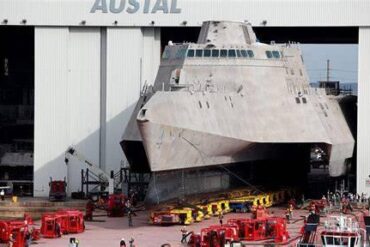
Australia has committed approximately AUD 4 billion to Austal Defence Shipbuilding Australia Pty Ltd for the construction of eight Landing Craft Heavy (LCH) vessels, marking one of the most consequential naval procurement decisions in Western Australia in recent years. Announced on February 20, 2026, the agreement forms part of the Commonwealth’s Strategic Shipbuilding Agreement and cements Henderson as a long-term center of gravity for Australia’s amphibious and sealift capability.
The scale of the investment underscores Canberra’s sharpened maritime focus amid a shifting Indo-Pacific security environment. The LCH program is not merely a fleet renewal initiative; it is a structural reinforcement of Australia’s ability to project and sustain land forces across vast maritime distances. With construction scheduled to begin in 2026 and final delivery targeted for 2038, the twelve-year build timeline signals continuity rather than episodic procurement, ensuring sustained industrial momentum in Western Australia.
The contract was announced by Deputy Prime Minister and Minister for Defence Richard Marles alongside Minister for Defence Industry Pat Conroy, positioning the project as both a military modernization effort and a national industrial strategy. Formal execution is expected at Austal’s Henderson shipyard, where infrastructure investments and workforce expansion will align with the demands of continuous naval construction.
A Damen LST100-Derived Design Adapted for Australian Requirements
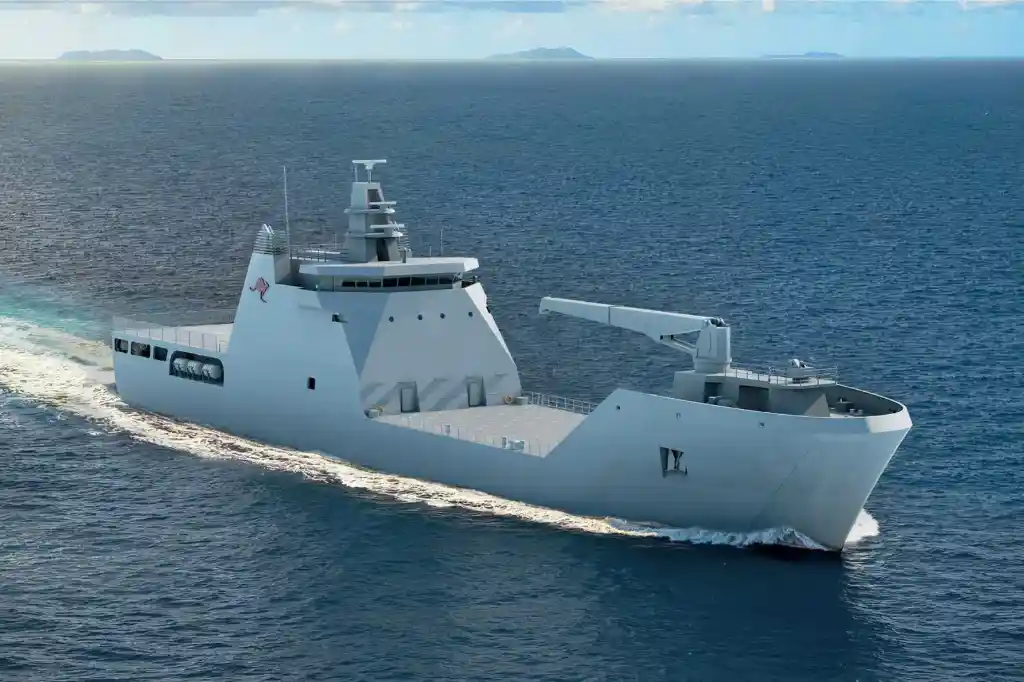
The new Landing Craft Heavy vessels will be based on the proven Damen LST100 design, extensively adapted to meet Australian Defence Force (ADF) specifications. Each ship will measure approximately 100 meters in length, with a 16-meter beam and a displacement between 3,900 and 4,000 tonnes. This hull configuration reflects a deliberate balance between payload capacity, range, and shallow-water accessibility.
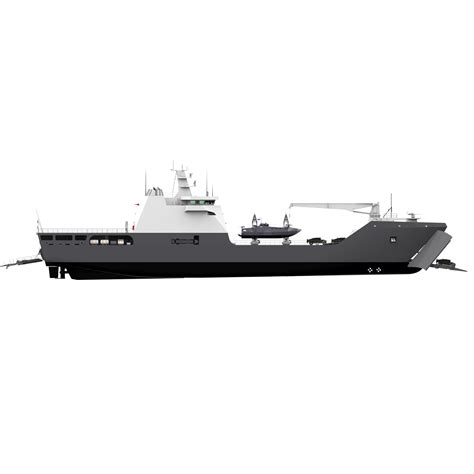
The LST—Landing Ship Tank—heritage is central to the vessel’s operational identity. Unlike larger amphibious assault ships that depend on well decks or aviation assets for offloading, the LCH platform is optimized for direct beaching operations. Its shallow draft and reinforced bow ramp allow roll-on/roll-off discharge onto austere shorelines or undeveloped ports. In contested littoral environments where fixed infrastructure may be compromised or absent, this ability becomes tactically decisive.
Adaptation to ADF requirements is expected to include enhanced communications suites, secure navigation systems, and survivability measures suited to high-threat operating zones. While detailed combat system specifications remain undisclosed, integration of defensive aids and secure data networks will ensure interoperability with joint and allied forces.
Transforming Amphibious Lift and Armored Mobility
From an operational standpoint, the LCH fleet dramatically expands Australia’s amphibious lift capacity. Each vessel will be capable of embarking more than 200 personnel alongside significant heavy equipment loads. Notably, the platform can transport up to six M1A2 SEP v3 Abrams main battle tanks or nine Redback infantry fighting vehicles, providing armored mobility previously constrained by limited sealift assets.
This capability reshapes the calculus of force movement across northern Australia and into the broader Pacific region. The ability to reposition mechanized units between Darwin, Townsville, and remote northern bases without reliance on large commercial ports enhances both responsiveness and survivability. In scenarios ranging from deterrence patrols to stabilization missions, the LCH provides a hardened logistics backbone capable of sustained shuttle operations.
The vessels are designed to complement the Royal Australian Navy’s Canberra-class Landing Helicopter Dock (LHD) ships. While the LHDs deliver aviation lift, command-and-control infrastructure, and joint integration capacity, the LCH fleet will provide concentrated heavy cargo throughput closer to shore. This layered approach distributes risk and reduces dependence on a limited number of high-value platforms.
Strategic Imperatives Under the Defence Strategic Review
Australia’s Defence Strategic Review emphasized the necessity of credible maritime maneuver and logistics in the Indo-Pacific. The LCH program directly reflects those priorities. Recent regional developments and observations from high-intensity conflicts abroad have reinforced the vulnerability of concentrated supply nodes to precision-strike systems. Distributed maritime logistics—enabled by multiple medium-sized sealift vessels—offers redundancy and resilience.
In practical terms, the LCH fleet will support amphibious assault operations, sustain forward-deployed land forces, conduct regional engagement missions, and deliver rapid Humanitarian Assistance and Disaster Relief (HADR) responses. The Indo-Pacific’s geographic realities—archipelagic terrain, dispersed populations, and cyclone-prone coastlines—make such flexibility indispensable.
By expanding sovereign sealift, Australia strengthens its ability to act independently or within allied frameworks. The vessels’ endurance and payload profile allow sustained operations across Australia’s primary area of military interest without overextending high-end combatants.
Industrial Expansion at Henderson Shipyard
The contract represents a generational commitment to Western Australia’s naval industrial base. Construction will take place at Austal’s Henderson facility, utilizing both company-owned infrastructure and the adjacent Common User Facility. This integration supports scalability and workforce continuity.
Thousands of direct and indirect jobs are expected to be created or sustained across steel fabrication, propulsion integration, electrical systems installation, and platform outfitting. Beyond immediate employment, the long build schedule fosters skills retention and apprenticeship pipelines, embedding advanced shipbuilding expertise within the domestic workforce.
Austal leadership has characterized the award as a stabilizing force for its order book and a rebalancing of revenue streams toward domestic production. In recent years, Austal USA has accounted for a significant share of defense income through programs such as the U.S. Navy’s Landing Craft Utility vessels under construction in Mobile, Alabama. The Australian LCH program diversifies that footprint and reinforces sovereign capability.
Continuous Naval Construction and Program Synergy
The LCH contract follows closely on the AUD 1.029 billion Landing Craft Medium (LCM) program awarded in December 2025. Together, the LCM and LCH initiatives form the backbone of Australia’s continuous naval construction framework. This sequencing reduces the cyclical boom-and-bust patterns that have historically challenged shipbuilding industries.
Parallel production streams also create opportunities for modular construction techniques, digital ship design integration, and supply chain optimization. Cross-learning between Austal’s Australian and U.S. operations may yield efficiencies in survivability features, production scheduling, and component sourcing while preserving national autonomy in final assembly.
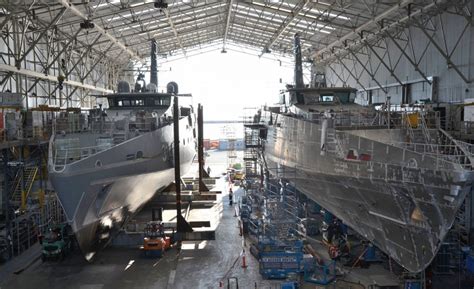
The industrial strategy extends beyond hull assembly. It encompasses digital engineering capabilities, cybersecurity integration within ship systems, and supply chain resilience amid global disruptions. As maritime platforms become increasingly network-centric, industrial sophistication becomes inseparable from operational effectiveness.
Long-Term Impact on Australia’s Maritime Posture
By the time the eighth Landing Craft Heavy is delivered in 2038, Australia’s amphibious architecture will look markedly different. The combination of Canberra-class LHDs, Landing Craft Medium vessels, and the new LCH fleet will provide layered lift options spanning aviation, medium cargo, and heavy armored throughput.
The program signals confidence in maritime maneuver as a cornerstone of national defense strategy. It reflects an understanding that geography remains Australia’s defining strategic constant. Vast distances demand ships that can carry weight—both literally and strategically.
For the Australian Defence Force, the LCH fleet represents a hardened, adaptable logistics instrument tailored to the realities of the Indo-Pacific. For Western Australia, it represents sustained industrial vitality anchored in advanced naval construction. And for the broader regional balance, it marks a deliberate investment in credible, sovereign maritime mobility—an asset that shapes deterrence as much as it enables response.