Australia has formally shifted the AUKUS submarine program from strategic design to industrial execution, committing $3.9 billion to establish a full-scale nuclear-powered submarine construction yard at Osborne, South Australia. Announced on February 15, 2026, the investment marks the most tangible step yet in transforming the Royal Australian Navy from a diesel-electric force into an operator of conventionally armed, nuclear-powered attack submarines (SSNs).
The funding does more than finance infrastructure. It anchors a sovereign industrial capability that will ultimately position Australia among the very few nations capable of domestically constructing nuclear-powered submarines. In strategic terms, this is not an incremental upgrade. It is a generational leap in maritime power projection, endurance, and deterrence across the Indo-Pacific.
The decision locks Osborne into the center of Australia’s long-term naval future. Australian Naval Infrastructure estimates total investment in the submarine construction yard and surrounding precinct could reach approximately $30 billion over the coming decades, reflecting both the technical complexity of nuclear submarine construction and the commitment to sustain a continuous production cycle.
AUKUS and the Strategic Pivot to Nuclear Propulsion
The AUKUS partnership, unveiled in September 2021 by Australia, the United Kingdom, and the United States, rests on two core pillars. Pillar I delivers nuclear-powered submarines to Australia. Pillar II expands cooperation in advanced military technologies, including artificial intelligence, cyber capabilities, quantum systems, undersea warfare technologies, and hypersonics.
For Canberra, Pillar I represents the defining transformation. Nuclear propulsion grants submarines the ability to remain submerged for months, limited primarily by crew endurance and food supply rather than battery life. Unlike diesel-electric submarines, which must snorkel periodically and expose themselves to detection, nuclear-powered SSNs operate with sustained stealth and range, enabling persistent presence across vast maritime theaters.
In the Indo-Pacific—where distances stretch across thousands of nautical miles—endurance is strategy. The shift from the Collins-class fleet to a future SSN force reshapes Australia’s deterrent posture from regional denial to sustained forward reach.
The Three-Phase Transition to an SSN Fleet
Australia’s 2023 submarine roadmap outlines a phased transition. Beginning as early as 2027, the Submarine Rotational Force–West initiative will bring increased rotational deployments of U.S. Navy Virginia-class and Royal Navy Astute-class submarines to Western Australia. This phase accelerates Australian crew certification, nuclear regulatory readiness, and port infrastructure adaptation.
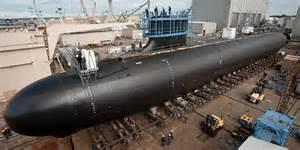
In the early 2030s, Australia is expected to acquire at least three U.S. Virginia-class submarines, with the possibility of two additional boats depending on U.S. industrial output and legislative approval. These submarines provide an interim capability while domestic production ramps up.
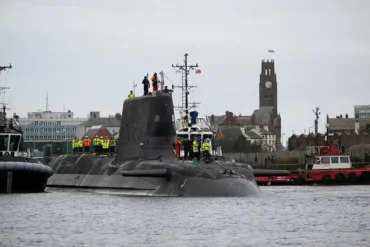
The long-term centerpiece is the SSN-AUKUS, a next-generation nuclear attack submarine design derived primarily from the United Kingdom’s future SSN concept, integrating American propulsion technology and combat systems. The first UK-built SSN-AUKUS is scheduled to begin construction in the late 2020s. In Australia, assembly of the first domestically built SSN-AUKUS is expected in the early 2030s, with delivery projected for the early 2040s.
Australia ultimately intends to operate a fleet of approximately eight nuclear-powered attack submarines, with at least five constructed at Osborne.
Inside the SSN-AUKUS: Capability and Design Expectations
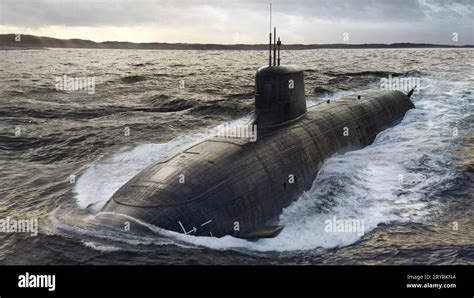
While final specifications remain subject to detailed engineering refinement, the SSN-AUKUS is expected to displace more than 8,000 tonnes submerged, placing it within the category of modern Western SSNs. These submarines will remain conventionally armed but powered by sealed nuclear reactors supplied under AUKUS arrangements.
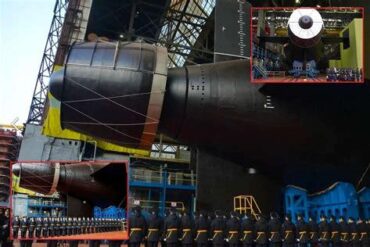
The operational advantages are profound. Nuclear propulsion enables sustained high-speed transit without the need for snorkeling. Pump-jet propulsion systems are expected to reduce acoustic signature, enhancing survivability in contested anti-submarine warfare environments. Advanced sonar arrays, electronic warfare suites, and integrated combat systems will provide situational awareness across complex undersea battlespaces.
The submarines are also expected to feature vertical launch systems capable of deploying long-range cruise missiles, alongside heavyweight torpedoes. This combination supports sea denial, intelligence collection, and precision strike roles, extending the Royal Australian Navy’s reach far beyond its previous operating envelope.
In practical terms, endurance translates into unpredictability. An SSN operating silently beneath the surface for months complicates adversary planning and shifts the strategic calculus across the maritime domain.
Osborne: Building a Sovereign Nuclear Shipyard
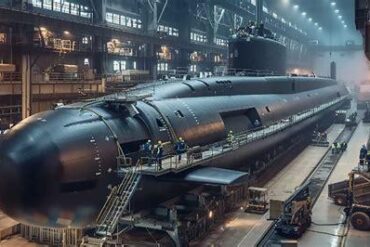
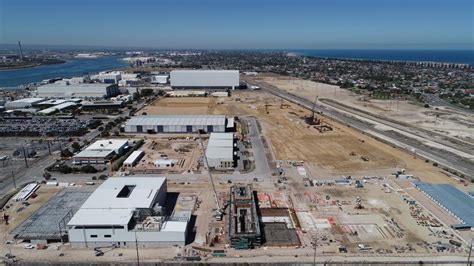
The $3.9 billion commitment initiates full-scale construction of the AUKUS Submarine Construction Yard at Osborne. The facility will be structured around three primary operational zones designed to replicate best practices from U.S. and UK nuclear submarine shipyards.
Area 1 will house a 420-meter-long Fabrication Hall, approximately 2.5 times the length of Adelaide Oval. Here, modular block construction techniques will allow pressure hull sections, reactor compartments, and mission modules to be fabricated simultaneously before integration. Modular construction reduces production timelines while maintaining stringent quality standards.
Area 2 will focus on outfitting. This stage integrates propulsion systems, combat systems, sensors, and weapons within tightly controlled environments. Nuclear submarine assembly demands extreme precision in welding, alignment, and acoustic isolation. Even minor imperfections can compromise survivability in high-threat environments.
Area 3 will manage consolidation, testing, launch, and commissioning. Heavy-lift infrastructure, safety protocols, and certification processes tailored to nuclear-powered vessels will define this phase.
The scale is staggering. The new yard’s floor area is projected to be ten times larger than the existing Osborne South development. Construction will require an estimated 66 million person-hours and approximately 126,000 tonnes of structural steel, equivalent to the mass of 17 Eiffel Towers.
Workforce and Skills: Engineering a Nuclear Industrial Base
Infrastructure alone does not build submarines. Nuclear-powered vessel construction demands a workforce trained to operate within extraordinarily tight tolerances. Australia plans to invest more than $500 million in a dedicated Skills and Training Academy, with the first intake scheduled for 2028.
The academy is designed to support up to 1,000 learners annually. Training will focus on high-integrity welding, reactor safety culture, systems integration, shock resistance, and acoustic management. Establishing these competencies domestically is essential to sustaining sovereign production rather than relying indefinitely on foreign shipyards.
At peak activity, around 4,000 workers are expected to be involved in constructing the yard itself. Once operational at maximum output, approximately 5,500 personnel will support nuclear submarine production. This scale transforms South Australia into one of the most concentrated naval industrial hubs in the Southern Hemisphere.
The Osborne precinct already supports Collins-class sustainment and Hunter-class frigate construction. Infrastructure upgrades, including the Eurimbla Way link road connecting Pelican Point Road directly to the shipyard, enhance secure logistical flow for heavy modules and sensitive components.
Bridging the Capability Gap
Maintaining operational readiness during the transition remains critical. The Collins-class submarines will undergo life-of-type extensions into the 2030s to ensure no capability gap emerges before Virginia-class acquisitions and SSN-AUKUS deliveries.
This bridging strategy reflects a disciplined approach to force continuity. Nuclear submarines require years of industrial preparation, regulatory compliance, and workforce development. By overlapping sustainment, acquisition, and domestic construction, Australia reduces strategic risk during one of the most complex defense transformations in its history.
Strategic Significance in the Indo-Pacific
The Indo-Pacific security environment is defined by maritime competition, expanding naval capabilities, and contested sea lines of communication. Nuclear-powered submarines alter deterrence equations precisely because of their stealth, endurance, and strike potential.
An eight-boat SSN fleet provides Australia with persistent undersea presence across chokepoints, sea lanes, and strategic approaches. It also deepens interoperability with the United States and United Kingdom, embedding Australia within a tightly integrated undersea warfare ecosystem.
The $3.9 billion investment is therefore not merely an industrial announcement. It represents the opening chapter of a multi-decade transformation that aligns industrial capacity, workforce development, and strategic ambition. As fabrication halls rise at Osborne and Australian crews integrate with allied SSN operations, the foundations of a sovereign nuclear submarine enterprise are taking shape.
By the early 2040s, when the first Australian-built SSN-AUKUS enters service, the decision announced in February 2026 will be recognized as the moment planning became steel—and strategy became structure beneath the waves.