Heavy lift helicopters remain critical to modern infrastructure, defense, and disaster response. In 2025, these airborne titans continue to push the boundaries of aerial logistics, offering unmatched versatility in lifting, transporting, and delivering heavy payloads to the most inaccessible corners of the globe. From military hardware relocation to precision delivery in urban construction zones, heavy lift helicopters are engineered to perform where other aircraft cannot operate.
The Strategic Value of Heavy Lift Helicopters
We recognize the irreplaceable role of heavy lift helicopters in high-stakes operations. These machines are specifically designed to carry substantial loads both internally and externally. The combination of powerful rotors, advanced avionics, and durable airframes allows these helicopters to operate under extreme environmental conditions, making them essential for:
-
Combat and military logistics
-
Disaster relief and emergency response
-
Oil and gas platform support
-
Remote construction and infrastructure deployment
-
Aerial firefighting and search-and-rescue missions
Each mission profile demands a blend of payload capacity, range, stability, and maneuverability, which only a select few helicopters worldwide can deliver reliably.
Mil Mi-26: The World’s Largest Helicopter
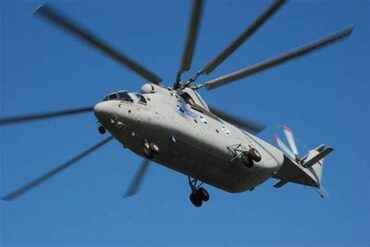
The Mil Mi-26 remains the global benchmark for raw lifting capability. Developed by the Mil Moscow Helicopter Plant, it holds the record as the largest and most powerful helicopter in active service. Capable of externally lifting up to 20,000 kg (44,000 lb), it thrives in environments as diverse as the Siberian tundra and Middle Eastern deserts.
Its massive eight-blade main rotor and twin D-136 turboshaft engines deliver exceptional performance. With a maximum takeoff weight of 56,000 kg (123,000 lb), the Mi-26 plays a vital role in transporting tanks, construction equipment, and even downed aircraft in humanitarian missions and military logistics.
Sikorsky CH-53K King Stallion: The Future of Military Lift
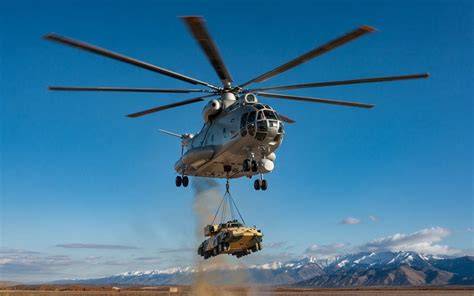
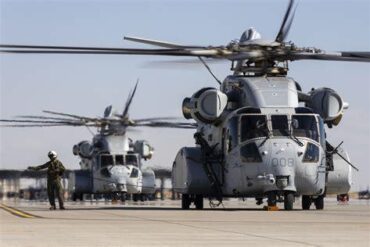
The Sikorsky CH-53K King Stallion is a marvel of modern helicopter engineering. Designed with expeditionary warfare and distributed logistics in mind, it has an external payload capacity of 16,329 kg (36,000 lb)—over three times more than its predecessor, the CH-53E.
With three GE T408 engines, it operates efficiently in high-temperature and high-altitude (high/hot) conditions, capable of flying a 12,200-pound load over 110 nautical miles. Its wider cargo bay accommodates larger vehicles internally, enhancing mission safety and reducing exposure.
Mil Mi-10: The Original Aerial Crane
Though retired, the Mil Mi-10 carved a niche as a pioneer in aerial crane operations. With a distinct high landing gear design, it could lift 12,000 kg (26,460 lb) externally. It revolutionized how oil rigs, communication towers, and prefabricated structures were erected in remote terrains without ground support equipment.
The Mi-10’s legacy persists in today’s rotorcraft design philosophy, influencing the layout and mission profile of modern lifting helicopters.
Boeing CH-47F Chinook: Timeless Twin-Rotor Workhorse
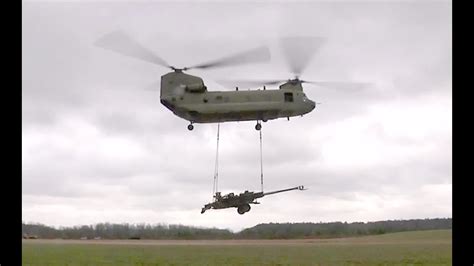
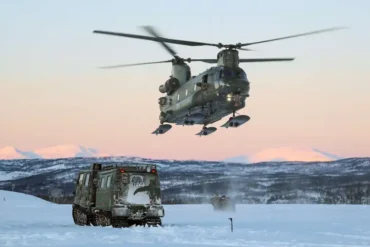
The Boeing CH-47F Chinook stands as one of the most versatile heavy-lift helicopters globally. Recognized by its twin rotors and rear-loading ramp, it lifts up to 9,000 kg (20,000 lb) externally and continues to evolve with upgrades in avionics, communication, and survivability systems.
Serving over 20 nations, its tactical use spans from combat troop transport to disaster relief. It remains a vital element in humanitarian operations and rapid-deployment scenarios.
Kamov Ka-32: Precision in Compact Spaces
The Kamov Ka-32 is uniquely designed with coaxial rotors, eliminating the need for a tail rotor. This enables it to operate in tight, urban, or forested environments. With an external lift capacity of 7,000 kg (15,400 lb), the Ka-32 excels in firefighting, logging, and aerial rescue missions, particularly in Europe and Asia.
Its precise hovering capabilities and reduced vibration profile make it indispensable for aerial construction in metropolitan areas and mountainous regions.
Sikorsky S-64 Skycrane: Modular Efficiency
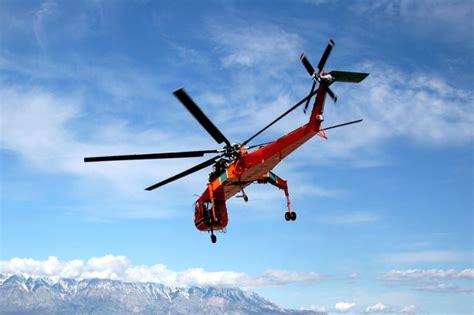
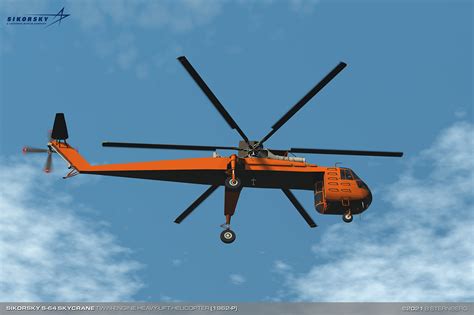
The skeletal Sikorsky S-64 Skycrane, operated primarily by Erickson Inc., is designed for modular lifting. With a lift capacity of 9,071 kg (20,000 lb), it can move HVAC systems, large generators, or building modules to hard-to-reach areas.
Its precision hover system and onboard fire suppression capabilities make it a preferred choice for wildfire management and urban high-rise construction.
Mil Mi-6: The Cold War Giant
A Cold War icon, the Mil Mi-6 was one of the first turbine-powered heavy-lift helicopters. With a max takeoff weight of 42,000 kg (92,594 lb) and a lifting capability of 12,000 kg (26,460 lb), it pioneered Soviet strategies in remote Arctic supply, military logistics, and nuclear disaster response.
Though retired, its legacy endures through its innovations in payload design and lift strategy, influencing subsequent generations of heavy helicopters.
Airbus AS332 Super Puma: Offshore Reliability
The AS332 Super Puma, from Airbus Helicopters, is a robust medium-heavy lifter with a focus on offshore oil and gas, search and rescue, and medevac operations. It lifts 4,800 kg (10,582 lb) externally and incorporates crash-absorbing seating, modern autopilot systems, and redundant twin engines, ensuring reliability during long overwater flights.
It continues to serve as a preferred platform for offshore logistics, especially in the North Sea, Gulf of Mexico, and Asia-Pacific regions.
Boeing Vertol 234: Civilian Chinook Utility
The Boeing Vertol 234 Chinook brings the CH-47’s military-grade performance to the civilian sector. It’s a lifeline in Alaskan and Canadian remote cargo missions, able to lift 11,340 kg (25,000 lb) externally while ensuring operational stability through tandem rotor balance.
Its services include forestry operations, construction logistics, and emergency supply runs, often to areas where no fixed-wing aircraft can land.
Sikorsky S-92: Civilian and Military Blend
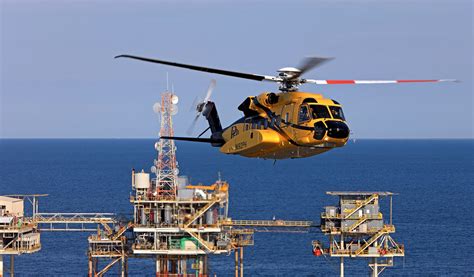
The Sikorsky S-92 is a modern heavy-lift solution designed for VIP transport, offshore platforms, and search-and-rescue. It lifts 4,500 kg (9,920 lb) externally and is equipped with advanced avionics, weather radar, and multiple redundancy systems.
With certification for both civil and military operations, the S-92 is a premier platform for high-value missions demanding safety, comfort, and performance.
Engineering Trends Shaping 2025
Heavy lift helicopters in 2025 are embracing technologies that redefine their potential:
-
Hybrid-electric propulsion systems for fuel efficiency
-
Autonomous cargo delivery modules for low-risk zones
-
Composite materials to reduce weight while increasing structural integrity
-
Fly-by-wire controls and smart avionics to reduce pilot fatigue and error
These innovations are shaping the next generation of aerial logistics, where sustainability, cost-efficiency, and precision delivery are paramount.
Heavy Lift Helicopter Performance Summary (2025)
| Helicopter | Max Takeoff Weight (kg) | External Lift (kg) | Primary Use | Status |
|---|---|---|---|---|
| Mil Mi-26 | 56,000 | 20,000 | Military, Humanitarian | Active |
| CH-53K King Stallion | 38,600 | 16,329 | Military Transport | Active |
| Mil Mi-10 | 28,200 | 12,000 | Construction | Retired |
| CH-47F Chinook | 22,680 | 9,000 | Multi-role | Active |
| Kamov Ka-32 | 11,000 | 7,000 | SAR, Firefighting | Active |
| S-64 Skycrane | 21,772 | 9,071 | Urban Construction | Active |
| Mil Mi-6 | 42,000 | 12,000 | Cold Climate Transport | Retired |
| AS332 Super Puma | 9,800 | 4,800 | Offshore, Rescue | Active |
| Vertol 234 Chinook | 31,750 | 11,340 | Logging, Civilian Cargo | Active |
| Sikorsky S-92 | 12,500 | 4,500 | Offshore, VIP | Active |
FAQs
What is the most powerful heavy lift helicopter in 2025?
The Mil Mi-26 is the most powerful, with an external lifting capacity of 20,000 kg (44,000 lb) and a maximum takeoff weight of 56,000 kg (123,000 lb). It is still in active service and remains unmatched in raw lifting power.
Are there civilian heavy lift helicopters available for commercial use?
Yes, helicopters like the Sikorsky S-64 Skycrane, Boeing Vertol 234, and Airbus AS332 Super Puma are used in construction, logging, offshore operations, and disaster relief by private and government operators globally.
How are modern helicopters improving environmental performance?
Modern heavy lift helicopters integrate hybrid propulsion, lightweight composite materials, and more efficient engines, which collectively reduce fuel consumption, noise levels, and overall emissions—key goals for next-gen rotorcraft sustainability.

![Big Drones & Heavy Lift Drones: A Comprehensive Guide for Drone Pilots [New for 2025]](https://boltflight.com/wp-content/uploads/2025/05/big-drones-heavy-lift-drones-comprehensive-guide-drone-pilots-new-2025-370x247.jpg "Big Drones & Heavy Lift Drones: A Comprehensive Guide for Drone Pilots [New for 2025]")