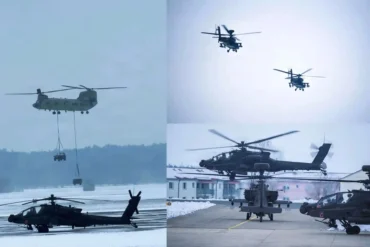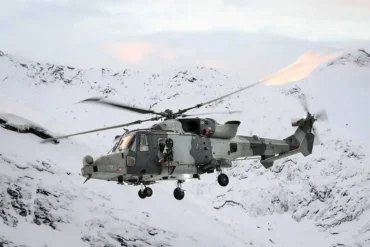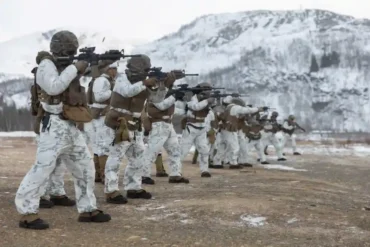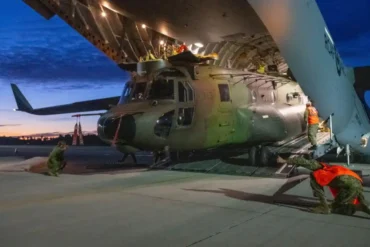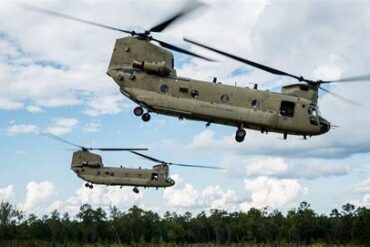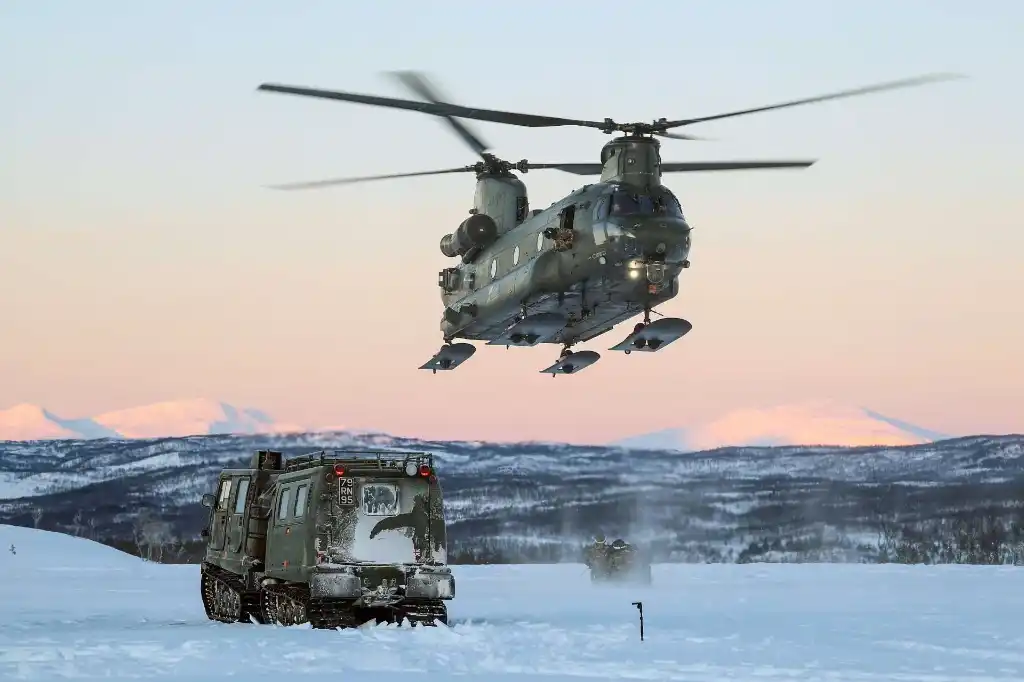
The Royal Air Force has deployed Chinook heavy-lift helicopters to northern Norway, pushing one of Britain’s most capable rotary-wing assets deep into the Arctic as NATO sharpens its focus on the High North. Operating from Bardufoss Air Station, more than 200 nautical miles above the Arctic Circle, the deployment places British aircrews and support teams in an environment where cold, distance, and terrain are not theoretical challenges but daily operational realities. This forward posture reflects a broader alliance shift from occasional reinforcement drills to persistent, routine activity across Europe’s northern flank.
The Chinooks, drawn from RAF Odiham, are operating under Operation CLOCKWORK, the UK’s long-running cold-weather tasking in Norway. While described as an annual deployment, CLOCKWORK has evolved into a continuous test of readiness for forces expected to deploy early in a northern contingency. Northern Norway’s Inner Troms region, with its narrow valleys, fjord systems, and sparse road network, exposes aviation units to the same constraints they would face in crisis: limited infrastructure, unpredictable weather, and extended distances between dispersed forces.
This year’s Chinook presence arrives as NATO increasingly treats the High North as a baseline planning area rather than a peripheral theatre. The Norwegian Sea, long central to allied maritime calculations, remains a gateway between the North Atlantic and the Arctic. To the northeast, the Barents Sea and proximity to Russia’s Kola Peninsula continue to shape regional deterrence dynamics. In this context, heavy-lift aviation is not a niche capability but a core enabler, allowing allied ground forces to move, resupply, and survive where surface logistics alone would be slow, exposed, or simply impossible.
The RAF’s CH-47 Chinook HC6 and HC6A variants bring a blend of payload, range, and resilience that few other helicopters can match in extreme cold. Capable of carrying up to 55 fully equipped troops or lifting payloads approaching 10 tonnes, the Chinook provides commanders with a rare degree of freedom in austere terrain. In northern Norway, that capacity translates directly into operational effect. A single sortie can move personnel, ammunition, fuel, or engineering equipment across valleys and mountain passes that would otherwise tie units to predictable road routes and choke points.
Bardufoss itself is a strategic hinge. More than a cold-weather airfield, it sits astride NATO’s northern reinforcement pathways, linking reception areas in southern Norway with forward operating zones closer to the Arctic approaches. From here, Chinook crews can support Norwegian and allied units spread across a wide area, sustaining dispersed formations while retaining the option to concentrate combat power when conditions permit. This balance between dispersion for survivability and rapid concentration for effect lies at the heart of modern NATO land doctrine in the High North.
Operating heavy-lift helicopters inside the Arctic Circle reshapes every aspect of aviation. Sub-zero temperatures affect hydraulics, lubrication, and avionics, while cold-soaked components shorten maintenance windows and demand meticulous planning. Ice accretion, gusting winds, and rapidly changing visibility impose constant performance penalties, reducing margins for error. Even routine ground handling becomes slower and more hazardous as crews work in bulky protective clothing around turning rotors. In this environment, success is measured less by speed than by discipline, timing, and endurance.
For the RAF Chinook Force, these conditions are not an abstraction but a proving ground. Crews must exploit narrow weather windows without pushing beyond safe limits, often flying long legs with few diversion options. Navigation in snow-covered terrain challenges depth perception and situational awareness, while limited daylight during winter months compresses operating schedules. The result is a form of training that cannot be replicated elsewhere: real-world exposure to the cumulative stresses that define Arctic operations.
A critical enabler of this deployment lies not in the cockpit but beneath the aircraft. The Joint Helicopter Support Squadron plays a central role during CLOCKWORK, particularly through underslung load operations. This capability effectively turns the Chinook into a flying crane, allowing generators, vehicles, fuel bladders, and other bulky equipment to be delivered directly to forward locations with no prepared landing sites. In the Arctic, where frozen ground, deep snow, and limited infrastructure restrict wheeled movement, underslung lift becomes a decisive advantage.
Executing these lifts in extreme cold adds another layer of complexity. Crews must hook, carry, and release loads in blowing snow and limited visibility while maintaining precise control and avoiding damage to aircraft or cargo. Repetition matters. The value of the capability lies not in a single successful lift but in the ability to sustain the cycle over days and weeks, supporting dispersed units without degradation in safety or tempo. This is the unglamorous backbone of northern operations, where logistics quietly determine outcomes.
Beyond the tactical level, the Chinook deployment carries clear strategic weight. Visible allied aviation activity in northern Norway reinforces deterrence through presence, demonstrating that NATO can operate credibly in the High North without resorting to escalatory gestures. It reassures regional partners, validates reception and support arrangements, and confirms that British forces can integrate seamlessly into Norway’s operating environment. While the United Kingdom is not an Arctic state, its sustained participation in CLOCKWORK builds credibility through consistency rather than spectacle.
Operation CLOCKWORK itself has been conducted for decades, but its meaning has sharpened as the alliance refocuses on territorial defence. What began as seasonal cold-weather familiarisation now functions as a standing rehearsal for how NATO would sustain forces in Europe’s northernmost operating areas under real pressure. The Chinook detachment from RAF Odiham embodies that shift. Heavy-lift aviation, once seen primarily as a support asset, is increasingly recognised as a decisive enabler that shapes operational design from the outset.
Recent conflicts have underscored a hard truth: logistics are often the first systems targeted and the hardest to regenerate. In the High North, where the logistics footprint is inherently narrow, reliance on roads alone creates vulnerabilities. Heavy-lift helicopters complicate an adversary’s targeting calculus by moving sustainment into the vertical domain, reducing predictability and expanding options for commanders on the ground. In practical terms, that means fuel and ammunition can reach units even when weather, damage, or enemy action disrupt surface routes.
The Chinook’s endurance further amplifies its value. With the range to cover vast distances and the power margins to operate safely in cold, dense air, it allows allied forces to think beyond fixed hubs. Forward refuelling points, temporary operating sites, and ad-hoc logistics nodes become viable, increasing resilience and flexibility. In a region defined by space and climate, these attributes are not luxuries but necessities.
As NATO’s High North posture continues to mature, deployments like this one signal a clear intent: the Arctic is no longer a seasonal concern. By positioning heavy-lift helicopters at Bardufoss and exercising them under authentic conditions, the UK contributes directly to an alliance posture built on readiness, interoperability, and endurance. The Chinooks may not grab headlines in the way fighter jets or submarines do, but in the frozen valleys of northern Norway, they represent something more enduring: the ability to move, sustain, and adapt when the environment itself becomes an adversary.
In that sense, the current deployment is less about showcasing capability and more about proving it, day after day, in conditions that allow no shortcuts. For NATO’s High North ambitions, and for the RAF crews flying from Bardufoss, that quiet persistence may be the most credible signal of all.