The United Kingdom has intensified its focus on Arctic warfare readiness by deploying Royal Navy Wildcat helicopters to Northern Norway, reinforcing NATO’s ability to operate in one of Europe’s most strategically sensitive regions. The deployment, conducted under Operation Clockwork, places frontline aviation units into extreme cold-weather conditions that mirror the realities of a potential High North conflict, where geography, climate, and distance amplify every operational challenge.
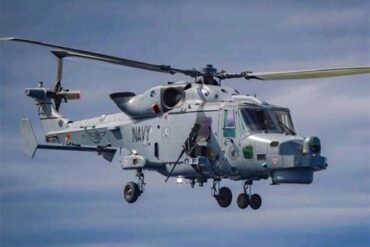
Operating above the Arctic Circle, Wildcat helicopters from 847 Naval Air Squadron are embedded in a demanding training environment designed to stretch aircrew, engineers, and commanders alike. This annual deployment is not symbolic. It is a deliberate, methodical effort to ensure that British rotary-wing forces can survive, fight, and sustain operations where temperatures plunge well below freezing and infrastructure is sparse.
The High North has re-emerged as a focal point of strategic competition, driven by Russia’s Arctic militarization, growing NATO concerns over northern sea lines of communication, and the region’s role as a gateway between the North Atlantic and the Arctic Ocean. Against this backdrop, Operation Clockwork is as much about deterrence as it is about training.
Based at Royal Norwegian Air Force Base Bardufoss, a critical NATO hub north of the Arctic Circle, 847 Naval Air Squadron operates at the edge of the alliance’s northern frontier. Bardufoss provides direct access to fjords, steep valleys, and mountainous interiors that replicate the terrain Royal Navy crews could face during expeditionary operations in Norway or other Arctic-aligned theaters. The location also allows close integration with Norwegian forces that have decades of experience operating in extreme cold.
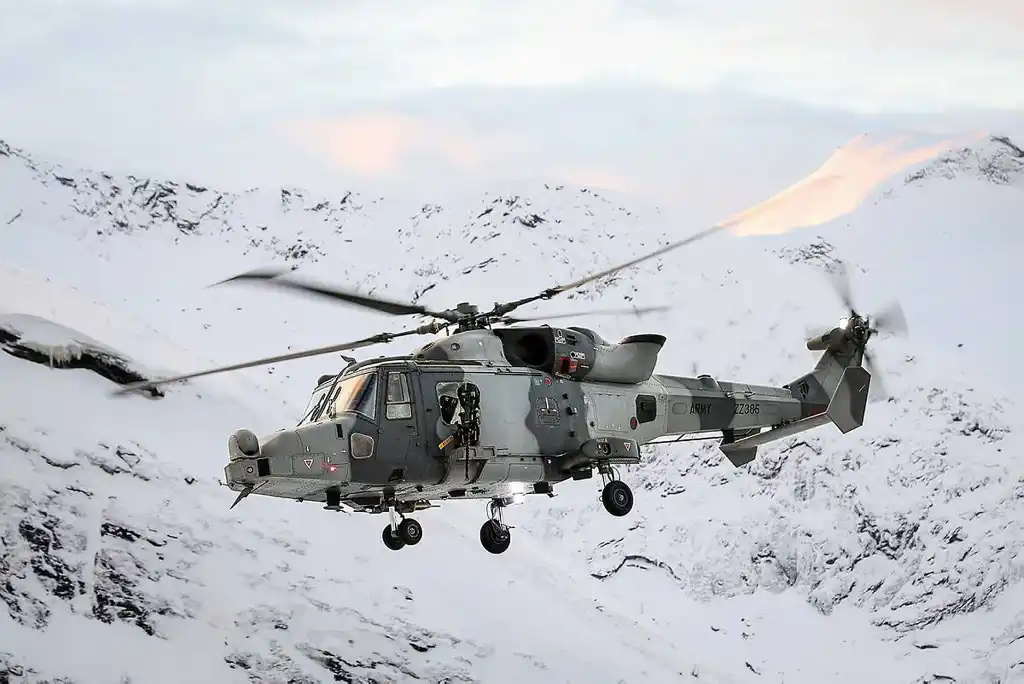
From this base, Wildcat crews conduct intensive mountain flying sorties through confined valleys and across snow-covered ridgelines, where rapidly shifting weather patterns create unpredictable turbulence, icing, and visibility challenges. Arctic mountain flying demands precise power management and flawless crew coordination, particularly at low altitude, where a sudden downdraft or whiteout can escalate into a critical situation within seconds. The environment leaves no margin for complacency.
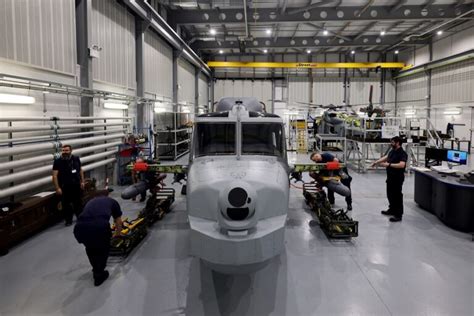
At the center of the deployment is the Wildcat HMA2, a compact but highly capable maritime and battlefield helicopter optimized for operations in austere environments. Powered by twin LHTEC CTS800 engines, the aircraft offers strong performance in cold and high-altitude conditions, maintaining agility and responsiveness where heavier platforms may struggle. Its advanced glass cockpit and integrated mission system allow crews to fuse sensor data, navigation inputs, and communications into a coherent operational picture even in degraded conditions.
The Wildcat’s combat relevance is a core focus of the training. Armed with Martlet lightweight multirole missiles, the helicopter provides precision strike capability against fast attack craft, lightly armored vehicles, and fortified positions, a vital asset in littoral and Arctic land warfare. Door-mounted 12.7 mm or 7.62 mm machine guns offer close support for Royal Marines, while the electro-optical and infrared sensor turret enables persistent surveillance and target acquisition in snow-dominated terrain where visual contrast is minimal.
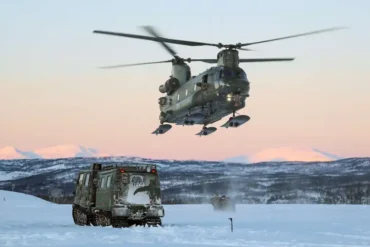
Operating alongside the Wildcats, Commando Merlin Mk4 helicopters expand the training’s scope, allowing the Commando Helicopter Force to rehearse fully integrated air assault operations. In realistic mission profiles, Merlins deliver troops, vehicles, and supplies, while Wildcats provide reconnaissance, armed escort, and command and control. This layered approach reflects how British forces would operate during real-world contingency missions, where speed, coordination, and adaptability are decisive.
Equally critical is the role of ground crews and engineers, whose work underpins every sortie. Maintaining frontline helicopters in sustained sub-zero temperatures exposes vulnerabilities in hydraulics, avionics, and structural components. Engineers supporting 847 Naval Air Squadron gain essential experience managing cold-soaked systems, frozen seals, and rapid maintenance cycles in remote conditions, ensuring aircraft availability remains high even when the environment actively works against it.
Before flying begins in earnest, personnel undergo Arctic survival training, an integral component of Operation Clockwork. Crews learn ski mobility, shelter construction, navigation, and survival techniques necessary for operating far from immediate rescue support. In the High North, survival skills are not ancillary; they are inseparable from combat effectiveness, where a forced landing can rapidly become a life-threatening scenario.
The deployment also strengthens UK–Norway defense cooperation, deepening interoperability between the Royal Navy and the Royal Norwegian Air Force. Norwegian expertise in snow and ice operations, dispersed basing, and rapid weather adaptation provides invaluable lessons for British crews. Shared procedures and combined training enhance NATO’s collective ability to operate seamlessly across national boundaries in the Arctic domain.
Operation Clockwork feeds directly into preparations for Exercise Cold Response 2026, expected to be the largest military exercise ever conducted in Norway. For 847 Naval Air Squadron and the wider Commando Helicopter Force, the Arctic deployment ensures that reconnaissance, firepower, and command capabilities remain credible in one of the world’s harshest operational environments, reinforcing NATO’s northern deterrence with proven, practiced capability.