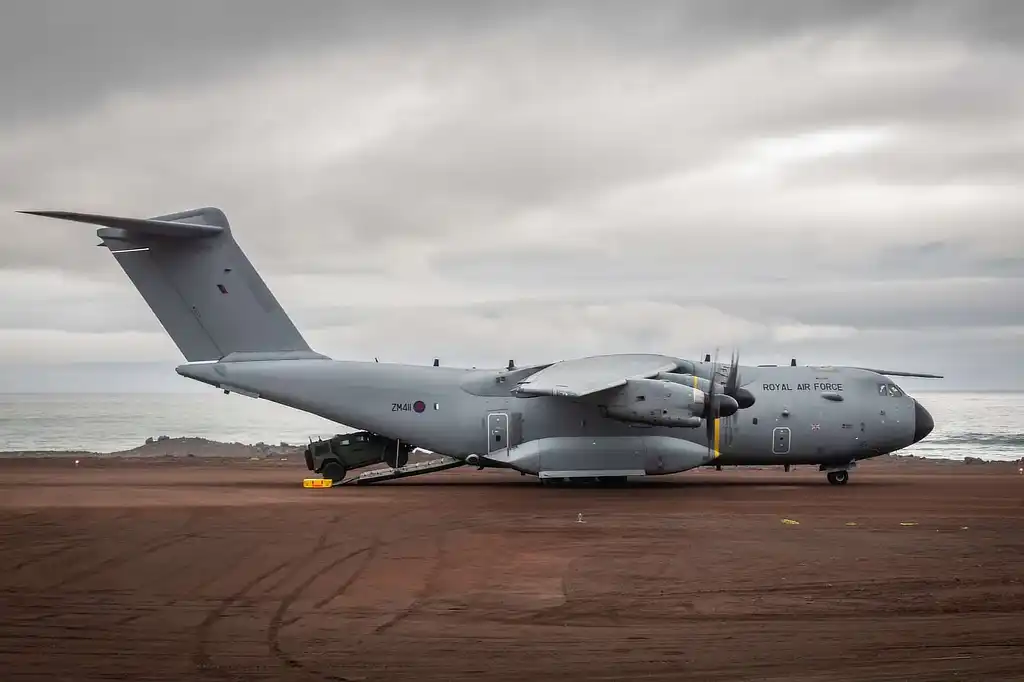
On 9 October 2025, the UK Royal Air Force (RAF) achieved a landmark feat that underscored both technological prowess and strategic foresight. An A400M Atlas airlifter from the RAF executed the first-ever landing on Norway’s remote Jan Mayen island, a volcanic outpost known for its extreme weather and geographical isolation. The aircraft delivered a U.S. Marine Corps Joint Light Tactical Vehicle (JLTV) for a trilateral Arctic deployment involving Norwegian Armed Forces, UK Royal Marines, and U.S. Marines.
This was no ordinary logistical operation—it was a test of NATO’s ability to project and sustain power in one of the harshest environments on Earth, a validation of multi-domain mobility, and a visible demonstration of operational access across the Arctic frontier.
A Milestone in Arctic Airlift Operations
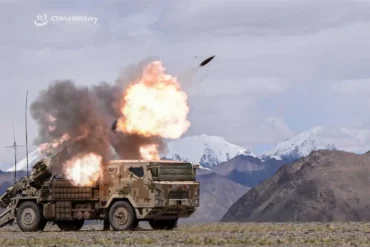
The RAF described the sortie as a pioneering Arctic operation, a mission designed to prove logistics, access, and mobility under extreme conditions. The JLTV carried aboard the A400M served as a surrogate for the Navy/Marine Expeditionary Ship Interdiction System (NMESIS)—a cutting-edge coastal anti-ship missile launcher based on the JLTV platform. This simulation allowed NATO planners to validate procedures for deploying mobile coastal defense assets into isolated Arctic regions, reinforcing both deterrence and rapid response capability.
The A400M’s landing was made on a minimally prepared airstrip carved into Jan Mayen’s volcanic terrain, buffeted by polar winds and rapidly shifting weather. Yet despite these conditions, the mission proved the aircraft’s ability to deliver heavy armored vehicles directly into contested or infrastructure-poor zones. The result was a powerful message to allies and adversaries alike: NATO’s logistical reach now extends even into the Arctic’s most forbidding outposts.
The Aircraft That Made It Possible: RAF’s A400M Atlas
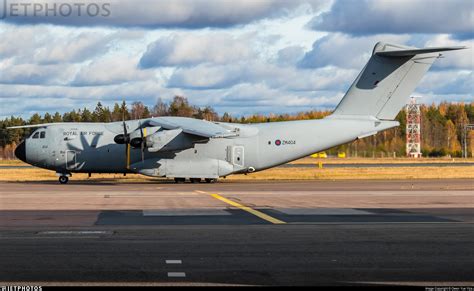
The Airbus A400M Atlas has emerged as Europe’s answer to the challenge of balancing tactical agility with strategic lift. Since entering service in 2013, the A400M has matured into one of the most versatile airlifters in existence, bridging the gap between the C-130J Hercules and the C-17 Globemaster III.
With a payload capacity of approximately 37 tonnes, the A400M can transport armored vehicles, helicopters, humanitarian supplies, or troops over intercontinental ranges while still operating from short or semi-prepared airstrips—a capability critical in the Arctic. Its four Europrop TP400-D6 turboprop engines allow for exceptional power-to-weight efficiency, giving it the agility to handle rugged terrain and unpredictable Arctic runways.
The RAF’s A400M Atlas C.1 variant has already proven its adaptability during disaster relief operations in the Caribbean, Middle East, and Eastern Europe. Yet Jan Mayen marks a new frontier: the Arctic, where logistical endurance, navigation precision, and aircrew resilience are tested to the limit.
Tactical Significance of the JLTV and NMESIS Simulation
While the aircraft drew headlines, the cargo it carried was equally symbolic. The U.S. Marine Corps JLTV on board wasn’t just a vehicle—it was configured to simulate the NMESIS coastal missile system, a capability that has become central to modern littoral defense strategies.
The NMESIS (Navy/Marine Expeditionary Ship Interdiction System) integrates the Kongsberg Naval Strike Missile (NSM) onto a remotely operated JLTV chassis, creating a fast-deploying, networked coastal anti-ship platform. This system allows Marines to deliver precision strike capability against hostile naval assets from unexpected positions, such as remote islands or fjords.
By demonstrating the ability to deliver such systems to Jan Mayen, NATO validated a core element of its deterrence posture: the ability to deploy distributed, mobile firepower to locations previously considered unreachable. This transforms the Arctic theater from a logistical liability into an operational opportunity, complicating adversary naval planning and expanding NATO’s maritime control options.
Jan Mayen: The Strategic Outpost in the High North
Jan Mayen island, located roughly halfway between Iceland and the Norwegian mainland, may appear remote and desolate, but its geopolitical significance is immense. The island lies astride key North Atlantic sea lanes—routes that connect North America to Europe and form the backbone of NATO’s transatlantic reinforcement strategy.

Its proximity to the Greenland and Norwegian Seas, both of which are critical maritime corridors, makes Jan Mayen an ideal staging ground for surveillance, maritime strike, and communication relay operations. The successful landing on the island is thus more than symbolic—it’s a proof-of-access to a location that could serve as a forward logistics or sensor node in any future Arctic contingency.
As the Arctic warms and new sea routes open, competition for influence in the region has intensified. Russia’s Northern Fleet, based on the Kola Peninsula, views the Arctic as a strategic bastion—a sanctuary for its ballistic missile submarines and a buffer zone against NATO incursion. NATO’s demonstration of operational access to Jan Mayen signals that no region, however remote, lies beyond the alliance’s reach.
NATO’s Arctic Strategy and Deterrence Messaging
The Arctic has reemerged as a focal point of NATO’s strategic planning, driven by a combination of climate change, resource competition, and military modernization in Russia’s northwestern territories.
NATO’s Arctic strategy emphasizes freedom of navigation, situational awareness, and rapid reinforcement. Exercises like the Jan Mayen sortie are designed not merely to test logistics but to send calibrated signals of deterrence and unity. The ability to land heavy aircraft on remote ice-covered islands demonstrates credible access—a prerequisite for deterrence that’s both practical and psychological.
Vice Admiral Rune Andersen, Chief of the Norwegian Joint Headquarters, summed it up succinctly:
“NATO remains a defensive alliance, but it must demonstrate readiness and resolve in all environments. The Arctic is no exception.”
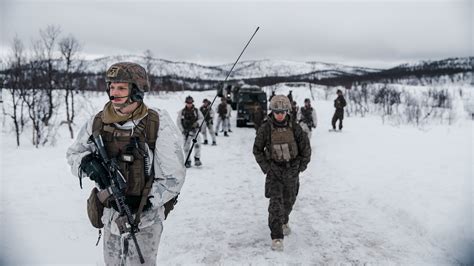
By aligning with Norway’s emphasis on year-round joint exercises, the RAF’s operation reaffirmed collective defense principles. It also underscored how Arctic interoperability among allied forces—particularly the UK, Norway, and the U.S.—strengthens the alliance’s ability to respond swiftly to emerging threats across the High North.
Technical and Logistical Insights from the Operation
Executing a first-ever Arctic landing required meticulous preparation. RAF planners had to model wind shear, surface friction, and approach gradients on Jan Mayen’s limited airstrip—conditions far more demanding than standard operations.
Key technical takeaways include:
- Runway Preparation: Engineers assessed the volcanic soil composition and used portable matting systems to stabilize the landing zone.
- Autonomous Navigation: The A400M’s advanced terrain-following radar and GPS-aided flight management systems allowed precision approach despite degraded visibility.
- Self-Sustainment: Crews carried fuel, food, and shelter systems, ensuring zero reliance on local infrastructure—a crucial benchmark for Arctic autonomy.
- Joint Integration: The operation tested communications interoperability between RAF and U.S. Marine Corps systems, verifying data link compatibility for future Arctic missions.
Each step reinforced that mobility and sustainability are now attainable in the Arctic, transforming what was once viewed as an operational dead zone into an accessible extension of NATO’s defense perimeter.
Broader Strategic Implications
The Jan Mayen sortie represents more than a feat of engineering—it’s a strategic rehearsal for a future where the Arctic is central to global defense and logistics. As ice coverage recedes, the High North is expected to become an arena of both opportunity and tension, with nations vying for shipping routes, natural resources, and strategic positioning.
For NATO, maintaining credible access is about ensuring freedom of movement and denying potential adversaries uncontested control. By mastering logistics in the Arctic, the alliance effectively reduces geographical constraints that once favored isolationist defense strategies.
This operation also reaffirms interoperability goals outlined in NATO’s 2025 modernization roadmap, which emphasizes:
- Multi-domain integration—linking air, land, sea, space, and cyber capabilities in contested environments.
- Expeditionary logistics—rapid deployment of combat and sustainment units without established bases.
- Resilient infrastructure access—ensuring that critical nodes like Jan Mayen can be activated even during crises.
A Testbed for Future Arctic Warfare Concepts
In many ways, Jan Mayen served as a laboratory for future Arctic operations. The lessons drawn here will feed directly into the design of next-generation Arctic warfare doctrines, particularly regarding distributed maritime operations, anti-access/area denial (A2/AD) countermeasures, and remote base establishment.
The demonstration proved that air mobility assets like the A400M can act as both strategic enablers and force multipliers. They can bridge the gap between distant bases and forward units, supporting missions ranging from missile deployment to search-and-rescue and ISR (intelligence, surveillance, reconnaissance) operations.
For allied forces, this means that the Arctic theater is no longer a seasonal or symbolic zone—it’s an active operational domain capable of supporting sustained joint operations.
Arctic Access as a Measure of Credibility
The UK’s A400M Arctic sortie to Jan Mayen was more than a technical success—it was a strategic signal. It conveyed that NATO possesses both the will and the means to operate in environments previously deemed inaccessible. The mission demonstrated logistical agility, interoperability, and strategic foresight, validating the alliance’s commitment to defend its northern flank.
For defense analysts, it’s a tangible manifestation of a broader transformation: the Arctic as an operational continuum—where deterrence, logistics, and mobility intersect.
As the global balance of power subtly shifts northward, one truth becomes clear: those who master Arctic access will shape the future of transatlantic security.