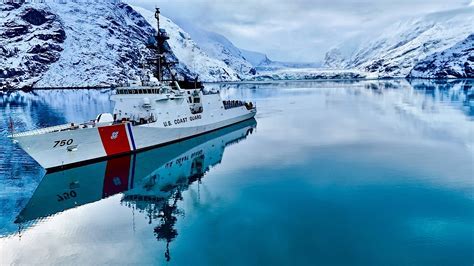
The return of the U.S. Coast Guard Cutter Kimball to Honolulu after a four-month deployment across the Arctic and sub-Arctic marks a decisive evolution in how the United States approaches security, governance, and deterrence in the High North. Covering more than 16,500 nautical miles across the Bering Sea and Gulf of Alaska, the patrol demonstrated that the Arctic is no longer treated as a distant frontier of seasonal activity, but as an operational theater where presence directly shapes strategic outcomes.
Announced by the U.S. Coast Guard on January 9, 2026, the mission underscored how climate change, geopolitical rivalry, and accelerating maritime traffic are converging to elevate the Arctic’s importance to U.S. national security. The waters Kimball traversed are increasingly described by defense planners as America’s “northern front porch,” a phrase that captures both their proximity to the homeland and their growing exposure to strategic competition.
At its core, the deployment reflected a fundamental shift in posture. What once centered on fisheries enforcement and search-and-rescue has expanded into a broader concept of integrated homeland defense, blending civil authorities, military readiness, and real-time operational integration. In the High North, presence is no longer symbolic; it is a tangible instrument of policy.
From Maritime Governance to Strategic Signaling
Kimball’s patrol illustrated how traditional Coast Guard missions now operate alongside deterrence objectives. The cutter conducted 13 fishing vessel inspections in coordination with NOAA enforcement teams, issuing citations for violations including illegally retained catch. These actions, though routine in appearance, carry strategic weight in a region where illegal or coercive fishing can be used to normalize foreign presence and test maritime boundaries.
The mission also involved emergency response operations following Typhoon Halong, reinforcing the Coast Guard’s unique role as a first responder capable of operating where military forces alone cannot. This dual-use capability, enforcing law while delivering humanitarian support, strengthens U.S. legitimacy in contested waters and reassures coastal communities and allies alike.
Behind these activities lies a deliberate message: the United States intends to uphold order and sovereignty in the Arctic through persistent, credible presence rather than episodic patrols.
A Cutter Designed for the High North
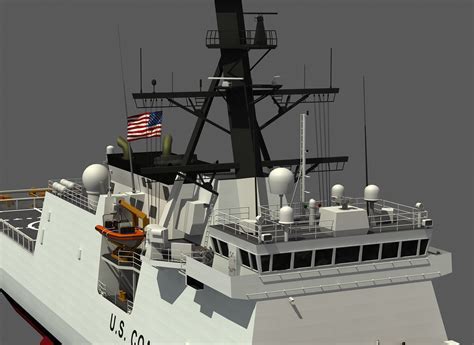
The Legend-class National Security Cutter is purpose-built for missions like Kimball’s Arctic deployment. Measuring 418 feet and displacing approximately 4,500 long tons, the vessel combines endurance, speed, and command-and-control capacity in a single platform. With a range exceeding 12,000 nautical miles and patrol cycles extending up to 90 days, Kimball can remain on station in regions where logistics support is scarce and weather windows are unforgiving.
Its propulsion system, pairing MTU diesel engines with a General Electric LM2500 gas turbine, allows the cutter to sustain long-range patrols while retaining the sprint speed needed to close contacts rapidly. In Arctic operations, where distance itself functions as a defensive barrier, this blend of endurance and agility is strategically decisive.
Sensors, Networks, and Maritime Awareness
Kimball’s influence extends well beyond its hull. The cutter’s SeaCommander combat system integrates surface and air search radars, electro-optical sensors, electronic warfare systems, and tactical data links into a single operational picture. This architecture transforms the ship into a mobile node of maritime domain awareness, capable of fusing sensor data and distributing it across joint and interagency networks.
In practical terms, this means Kimball can track vessels, aircraft, and electronic emissions across vast stretches of ocean, sharing information with partners ashore and in the air. In the Arctic, where gaps in coverage remain a persistent vulnerability, such distributed awareness is essential for early warning and rapid response.
Credible Force in a Gray-Zone Environment
While the Coast Guard is not a traditional naval combat force, Kimball’s weapons and defensive systems provide credible protection and deterrence. The cutter is equipped with a 57 mm naval gun, a Phalanx close-in weapon system, decoys, chaff launchers, and crew-served weapons, supported by a collective protection system against chemical or radiological threats.
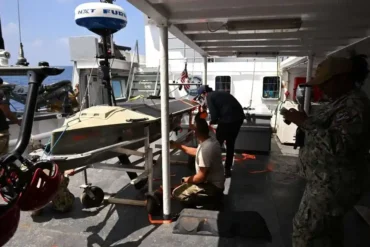
Equally important is the ship’s ability to project authority at close range. Kimball deploys Long Range Interceptor II pursuit boats capable of operating at high speed in rough seas, enabling rapid boardings and enforcement actions. In gray-zone competition, where ambiguity is often exploited, the ability to intercept, board, and inspect vessels decisively is a strategic asset.
Expanding Reach Through Aviation and Unmanned Systems
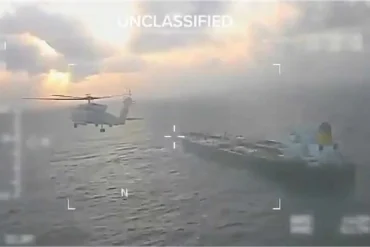
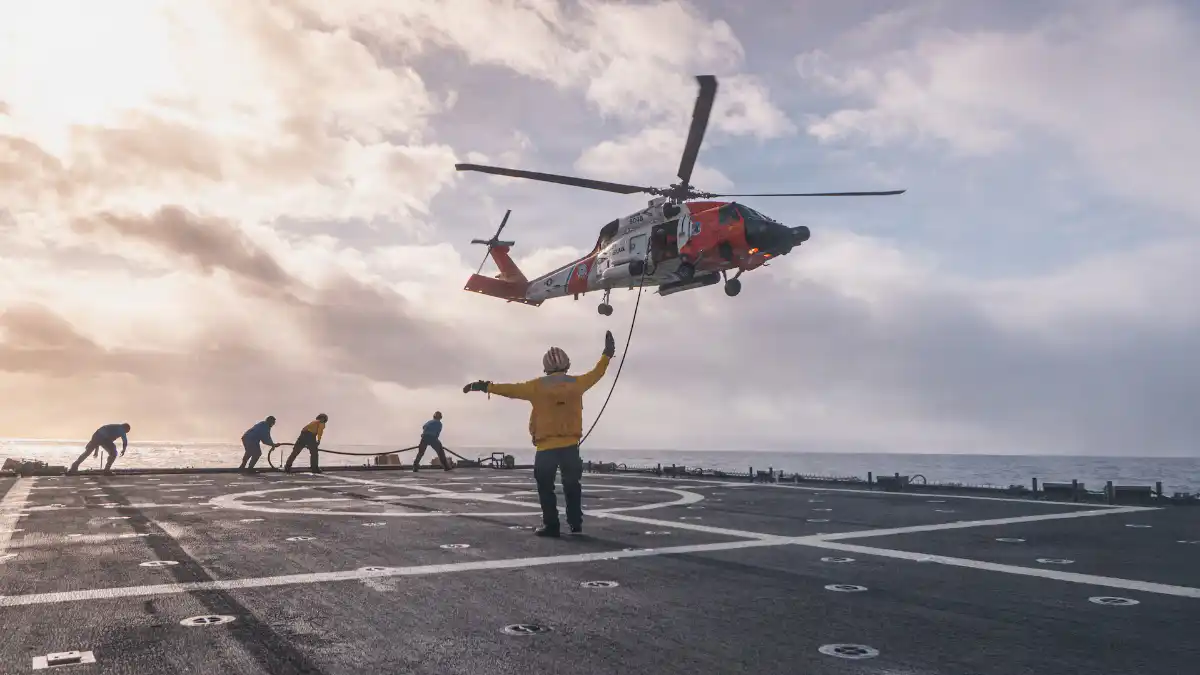
A defining feature of the patrol was Kimball’s integration with MH-60 helicopters from Air Station Kodiak, including training in helicopter in-flight refueling. Extending rotary-wing endurance dramatically expands the cutter’s surveillance and response radius, compressing timelines across a region measured in thousands of miles.
The deployment also tested a vertical takeoff and landing unmanned aerial system, evaluating how ship-launched drones can extend surveillance beyond the radar horizon. In Arctic conditions, where weather limits flight operations and maintenance support is minimal, a reliable VTOL drone provides persistent eyes over the sea with lower risk and cost than manned sorties.
Operation TUNDRA MERLIN and Joint Deterrence
The most strategically revealing element of Kimball’s patrol occurred during Operation TUNDRA MERLIN. On December 9, 2025, the cutter participated in simulated joint maritime strike operations alongside U.S. Air Force B-52 Stratofortress bombers in the Gulf of Alaska. Kimball contributed targeting data that enabled standoff strike simulations, linking a Coast Guard asset directly into a combatant command’s operational framework.
This integration illustrates a critical concept in modern deterrence: Arctic defense is a system, not a collection of isolated missions. A cutter operating under peacetime authorities can seamlessly transition into a role supporting high-end military operations, reinforcing deterrence without escalating tensions prematurely.
Strategic Context in a Contested Arctic
The patrol aligns closely with the Pentagon’s Arctic Strategy and the National Strategy for the Arctic Region, both of which describe the North American Arctic as a critical approach to the homeland and a northern flank connected to Indo-Pacific security. As melting ice expands access, competition intensifies. Russia’s entrenched Arctic infrastructure and China’s expanding polar ambitions challenge earlier assumptions that cooperation would dominate the region.
Against this backdrop, Kimball’s 120-day mission represents more than operational success. It signals that the United States is prepared to defend its interests through sustained presence, credible capability, and integrated action. In the High North, deterrence is not declared; it is demonstrated, mile by mile, patrol by patrol.