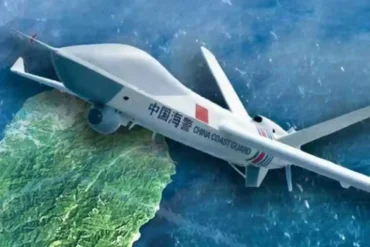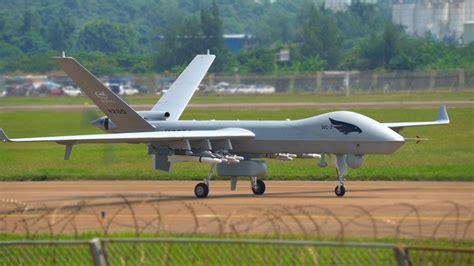
China has formally confirmed the operational deployment of Wing Loong II (WL-2) unmanned aerial vehicles with the Chinese Coast Guard, marking a notable evolution in how Beijing enforces maritime presence and sovereignty claims around Taiwan and adjacent contested waters. This development places a military-grade long-endurance drone under a paramilitary law-enforcement framework, significantly altering the balance between surveillance, deterrence, and escalation management in the Taiwan Strait.
The disclosure, first revealed on January 27, 2026, follows months of visual and satellite evidence suggesting that the Chinese Coast Guard (CCG) had begun integrating large unmanned platforms into its patrol architecture. The confirmation aligns with the drone’s observed participation during the “Justice Mission 2025” exercises conducted in December, where multiple Chinese security elements coordinated operations around Taiwan. Unlike previous Coast Guard aviation assets, the Wing Loong II introduces persistent, high-altitude intelligence coverage that was previously the exclusive domain of the People’s Liberation Army (PLA).
This shift underscores a broader strategy in which China leverages paramilitary platforms to project state authority while maintaining plausible deniability and avoiding overt military confrontation. The presence of a MALE-class drone flying Coast Guard missions signals a new operational threshold for regional maritime security.
From Military Showcase to Coast Guard Asset
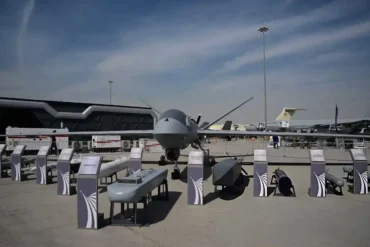
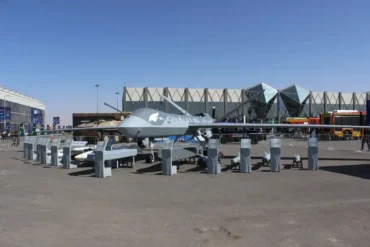
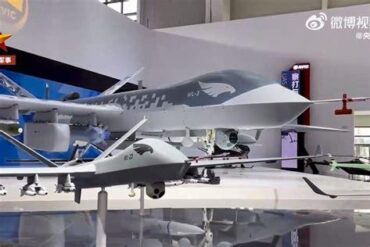
Originally developed by the Aviation Industry Corporation of China (AVIC), the Wing Loong II was designed as a medium-altitude, long-endurance UAV optimized for intelligence, surveillance, reconnaissance, and precision strike missions. It first gained international attention as an export platform and a visible competitor to Western systems such as the MQ-9 Reaper. Its transition into Coast Guard service represents an intentional blurring of institutional boundaries.
Unlike smaller tactical UAVs typically used for fisheries monitoring or search-and-rescue, the WL-2 is a strategic surveillance platform. With an operational ceiling of approximately 9,000 meters, endurance exceeding 32 hours, and a payload capacity of 400 kilograms, the drone enables uninterrupted monitoring of wide maritime zones. For the Chinese Coast Guard, this means sustained coverage of the Taiwan Strait, Bashi Channel, and Luzon Strait without reliance on crewed aircraft.
By assigning such a platform to the Coast Guard rather than the PLA Air Force, Beijing reframes high-end surveillance as a law-enforcement activity, reducing the political friction that would accompany uniformed military flights over sensitive waters.
Technical Capabilities That Reshape Maritime Surveillance
The Wing Loong II’s onboard systems significantly enhance the Coast Guard’s situational awareness. Its electro-optical and infrared sensors provide continuous day-night visual tracking, while synthetic aperture radar (SAR) allows high-resolution imaging regardless of weather or cloud cover. These sensors are coupled with real-time data links, enabling direct transmission to shore-based command centers and maritime patrol vessels.
This sensor suite enables persistent tracking of foreign naval task groups, commercial shipping lanes, and air-sea interactions across international waters. The drone’s estimated 4,000-kilometer operational range allows coverage well beyond China’s immediate coastline, extending ISR reach past the first island chain. For a coast guard entity, this level of surveillance depth is unprecedented.
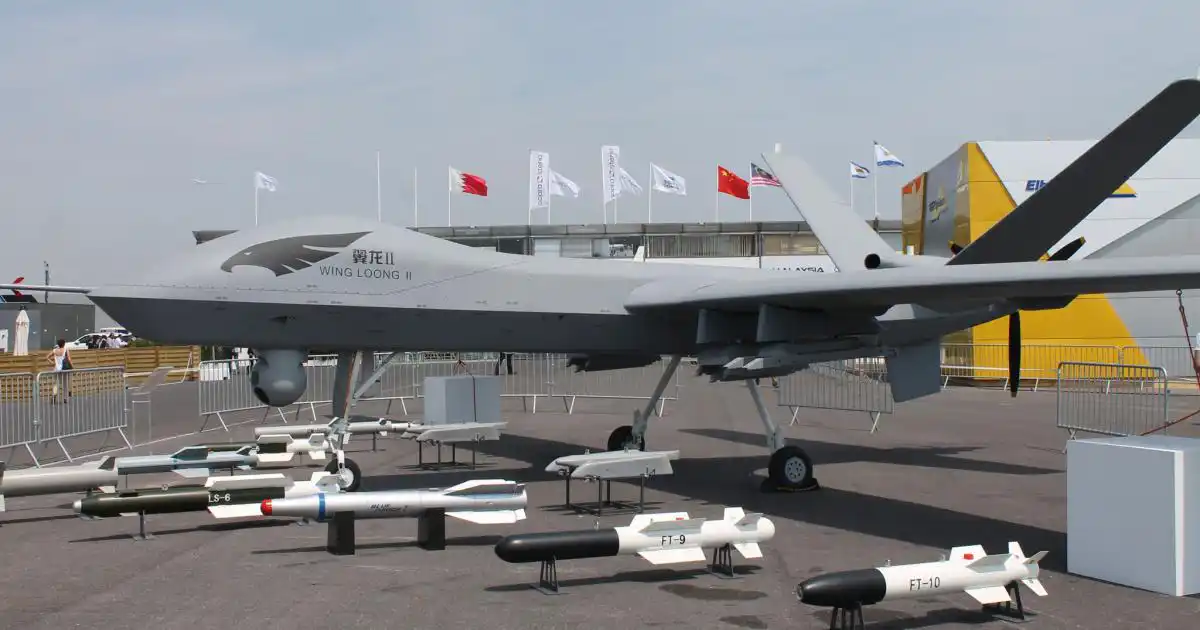
Although officially described as unarmed in Coast Guard service, the WL-2’s architecture remains fully compatible with Chinese precision munitions, including AR-1 laser-guided missiles and FT-series guided bombs. This inherent dual-use design fuels regional concern, as the platform can be rapidly reconfigured if political or operational thresholds shift.
Justice Mission 2025 and Integrated Maritime Command
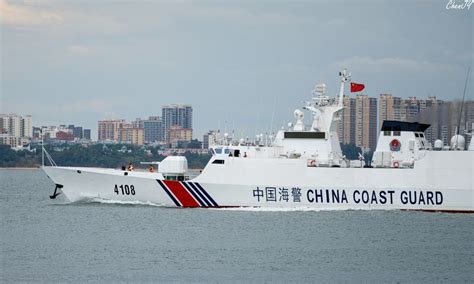
During the Justice Mission 2025 exercises, Wing Loong II drones operated alongside Hai Jing Coast Guard cutters and Y-8 maritime patrol aircraft, forming an integrated sensor and command network. This multi-layered structure reflects a mature approach to joint maritime-domain awareness, where unmanned systems cue surface vessels and manned aircraft in near real time.
The exercises demonstrated how UAV-derived intelligence can guide intercepts, shadowing operations, and maritime signaling without direct confrontation. By embedding the Wing Loong II into Coast Guard routines, China normalizes this operational pattern and conditions regional actors to accept persistent aerial surveillance as a baseline reality.
This integration also shortens decision cycles. Real-time ISR allows commanders to escalate or de-escalate encounters quickly, applying calibrated pressure through presence rather than force. It is a textbook example of gray-zone operations, where control is asserted incrementally below the threshold of armed conflict.
Civil-Military Fusion at Sea
The deployment of Wing Loong II drones reflects China’s broader civil-military fusion (CMF) strategy, in which civilian and paramilitary institutions absorb advanced military technologies. Under this model, the Coast Guard becomes a frontline instrument for enforcing territorial claims while the PLA remains positioned as a strategic backstop.
This structure complicates response options for neighboring states. Intercepting or challenging a Coast Guard UAV risks being framed as interference with law enforcement, even though the platform itself possesses military-grade performance. The ambiguity is deliberate and strategically valuable.
Satellite imagery showing expanded UAV infrastructure on Hainan Island further supports the conclusion that unmanned operations under Coast Guard command are not experimental but institutionalized. Hardened hangars, extended runways, and dedicated control facilities point to sustained investment in long-endurance drone patrols.
Implications for Taiwan and Regional Stability
For Taiwan, the operational presence of Wing Loong II drones under Coast Guard authority represents a persistent surveillance challenge. These UAVs can loiter beyond visual range, monitor naval movements, and collect electronic signatures without crossing clear red lines. Over time, this erodes operational surprise and increases pressure on Taiwanese air and maritime defenses.
Regionally, the move raises questions about precedent. If coast guards begin operating platforms traditionally reserved for air forces, the boundary between civilian maritime governance and military power projection becomes increasingly porous. Other regional actors may feel compelled to follow suit, accelerating an unmanned surveillance competition across the Western Pacific.
At the strategic level, Beijing’s approach remains consistent: assert control, gather intelligence, and shape the operational environment while keeping escalation manageable and deniable. The Wing Loong II, flying Coast Guard patrols, is ideally suited to that mission.
A New Phase in Maritime Power Projection
China’s deployment of Wing Loong II UAVs with its Coast Guard marks a decisive step in the evolution of maritime statecraft. By pairing long-endurance aerial surveillance with a law-enforcement mandate, Beijing strengthens its ability to monitor, signal, and influence events around Taiwan without triggering immediate military response.
This is not merely an equipment upgrade. It is a structural change in how maritime power is exercised—one that blends technology, doctrine, and political messaging into a single platform circling quietly above contested seas.