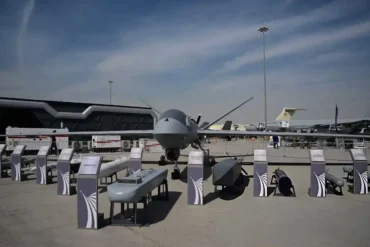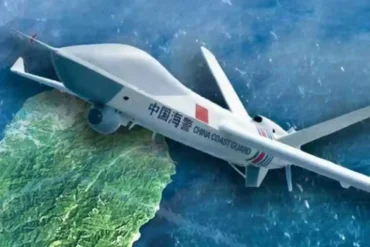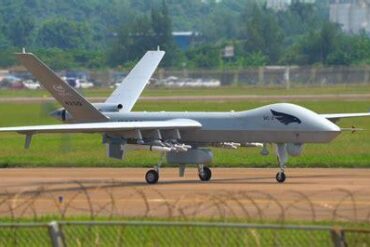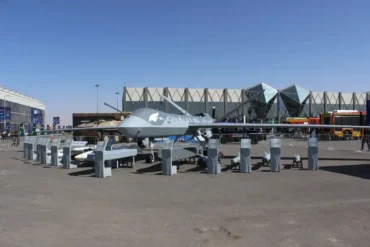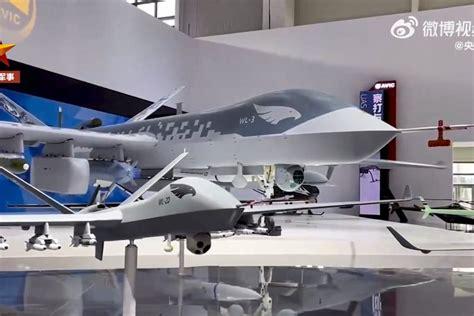
The Wing Loong-3 represents a defining moment in the evolution of China’s unmanned aerial vehicle (UAV) capabilities, embodying a technological and strategic leap in global drone warfare. Developed by the Aviation Industry Corporation of China (AVIC), this next-generation UAV integrates long-endurance flight, heavy payload capacity, and multi-domain operational versatility, creating a highly adaptable platform that straddles both military and civilian applications. As geopolitical tensions escalate and precision warfare grows increasingly reliant on unmanned systems, Wing Loong-3’s capabilities push China to the forefront of this competitive domain.
Exceptional Performance Specifications that Redefine Reach and Stamina
Wing Loong-3 is engineered to outperform existing platforms, particularly in mission duration, payload delivery, and altitude adaptability. At 12.2 meters in length, 24 meters in wingspan, and a maximum takeoff weight of 6.2 tons, the UAV stands among the largest drones in its category. Its intercontinental range exceeding 10,000 kilometers and continuous airborne endurance of up to 40 hours make it a formidable tool for sustained surveillance and combat support.
The aircraft is powered by the domestically produced AEP-80 turboprop engine, capable of delivering 800 kilowatts, ensuring operational reliability in high-altitude, long-duration missions. These specifications allow Wing Loong-3 to patrol vast oceanic expanses, penetrate deep into contested airspace, and operate with minimal logistical support.
Heavy Payload and Advanced Weapon Integration
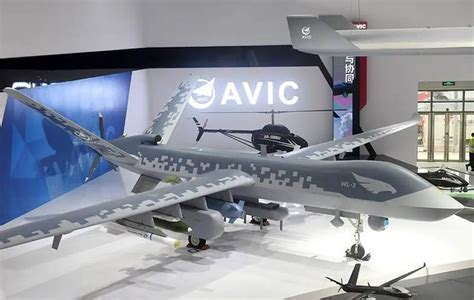
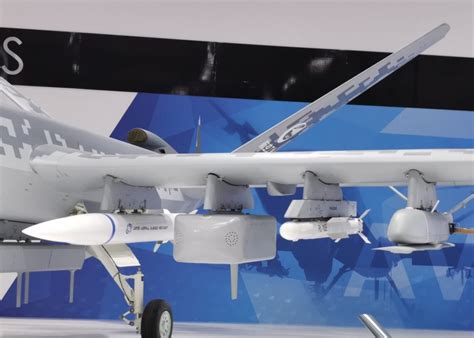
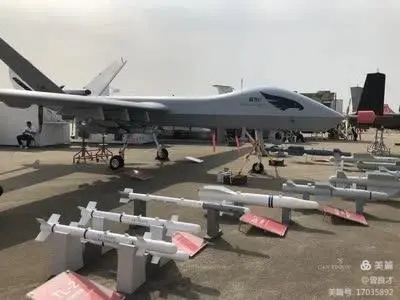
The Wing Loong-3 delivers a breakthrough in payload diversity and volume. Outfitted with nine hardpoints — eight beneath its expansive wings and one on the fuselage — the drone can carry up to 2.3 tons of armament, including 2 tons of external munitions and 300 kilograms of internal payload. Utilizing composite mounting systems, it can carry up to 16 missiles or guided bombs simultaneously.
The UAV supports a wide spectrum of advanced weaponry:
- Blue Arrow-21AR: anti-radiation missile for targeting enemy radar and electronic systems.
- LS-6 glide bombs: GPS/INS guided for high-precision strikes.
- PL-10E air-to-air missiles: enabling limited dogfighting and aerial self-defense.
- Sonobuoy pods: for maritime anti-submarine warfare (ASW).
- Cloud Shadow-160 loitering munitions: acting as miniature kamikaze drones for battlefield saturation.
This comprehensive armament suite allows Wing Loong-3 to dominate multiple theaters — from deserts and coastlines to dense urban battlefields.
Aerodynamic Engineering for Efficiency and Altitude Control
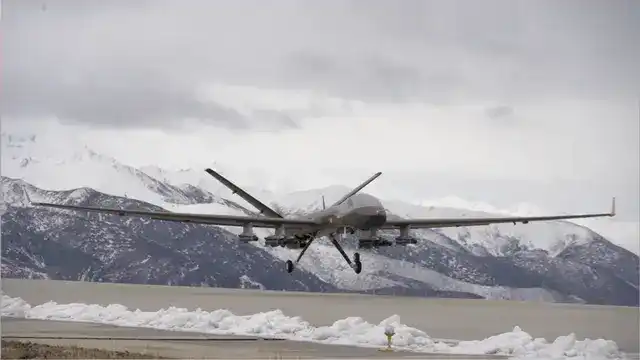
Wing Loong-3 adopts an optimized high-aspect-ratio straight-wing and V-tail configuration, providing excellent lift-to-drag performance. This aerodynamic structure ensures stability in thin upper atmospheric layers and enhances fuel efficiency during prolonged missions. The UAV is designed to operate effectively at altitudes of up to 12,000 meters, offering a strategic advantage in surveillance and engagement beyond the reach of many adversary defense systems.
Incorporating lessons from both manned aircraft and previous UAV iterations, the airframe is resilient under complex meteorological conditions, maintaining structural integrity in high wind, precipitation, and icing environments.
Modular Intelligence and Sensor Fusion Capabilities
The true strength of Wing Loong-3 lies in its sensor suite and modular architecture, allowing for rapid role-switching between missions. It comes equipped with:
- Synthetic Aperture Radar (SAR) for day-and-night, all-weather ground imaging.
- Electronic Warfare (EW) pods for jamming and signal disruption.
- Signals intelligence (SIGINT) systems for intercepting enemy communications.
- Multiband datalinks for real-time telemetry and targeting updates.
This sensor fusion enables Wing Loong-3 to conduct cross-domain reconnaissance, simultaneously identifying ground, air, and maritime threats. Operators can reconfigure payload bays within hours — swapping sonar systems for wildfire monitoring equipment or replacing weapon bays with communication relay stations. This flexibility extends its usability into non-combat humanitarian missions, a hallmark of emerging drone doctrines.
Electronic Countermeasures and Survivability in Hostile Environments
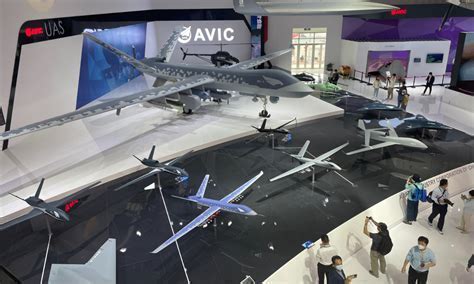
Wing Loong-3 is equipped to survive and function within highly contested electromagnetic environments. It integrates a next-generation electronic countermeasures (ECM) system, capable of neutralizing radar tracking and maintaining communications integrity despite adversary jamming. Additionally, its capacity to carry self-defense weapons like the PL-10E ensures it can respond to threats from hostile aircraft or drones.
This emphasis on defensive survivability, combined with strategic redundancy in onboard avionics, marks a significant evolution in UAV design — from expendable reconnaissance platforms to semi-autonomous combat assets.
Combat Roles Across Land, Sea, and Air
Persistent Reconnaissance and Precision Strike
Wing Loong-3’s core doctrine aligns with “Intelligence-Surveillance-Strike” (ISR-Strike) operations. Capable of lingering over targets for extended periods, it uses high-fidelity optics and SAR imagery to maintain battlefield awareness and direct pinpoint attacks using precision munitions. This integration reduces kill chain timelines and enhances target acquisition efficiency.
Anti-Submarine and Maritime Patrol Missions
Its long endurance and payload configuration make Wing Loong-3 ideal for blue-water naval operations. By deploying sonobuoys and magnetic anomaly detection (MAD) sensors, it can detect, track, and engage submarines in regions beyond the range of conventional patrol aircraft. This fills a critical gap in China’s naval surveillance network, especially in disputed maritime zones.
Electronic Warfare and Command Disruption
With onboard electronic warfare pods, the UAV can jam communication nodes, spoof radar signatures, and degrade enemy sensor capabilities. This allows supporting units to operate under reduced threat and contributes to multi-layered electronic attack strategies, further integrating the UAV into joint-force operations.
Humanitarian Aid and Civil Support
Wing Loong-3’s capability as an airborne communication relay is invaluable during natural disasters where infrastructure is compromised. Covering up to 50 square kilometers, it can restore connectivity, assist in coordination, and transmit live video feeds to ground teams. In environmental science, the UAV supports hyperspectral imaging and meteorological monitoring, useful for wildfire detection, mineral exploration, and atmospheric analysis.
Strategic Implications and Global Market Competitiveness
Outclassing the MQ-9 Reaper in Key Metrics
Wing Loong-3 challenges the dominance of Western UAVs, particularly the General Atomics MQ-9 Reaper. While the MQ-9 boasts a range of 11,000 km and payload of 1.8 tons, Wing Loong-3 not only matches its range but exceeds its payload capacity by over 25%. Moreover, China’s advanced manufacturing capabilities allow for cost-effective production, making Wing Loong-3 more attractive to budget-conscious militaries seeking advanced capabilities without Western restrictions.
Expanding Influence in Global Drone Exports
Several nations in the Middle East, North Africa, and Central Asia have expressed strong interest in Wing Loong-3. Its adaptability to local mission requirements — from border patrol to counter-insurgency — enhances China’s defense diplomacy and expands its footprint in the global arms market. As export variants emerge with tailored configurations, Wing Loong-3 is set to become a cornerstone offering in Chinese drone exports.
Civil-Military Integration and Technological Spillover
The modular design of Wing Loong-3 enables the same core platform to perform both military and civilian missions, accelerating dual-use innovation. Technologies developed for autonomous combat can be reapplied to autonomous cargo delivery, disaster management, and environmental surveillance. This aligns with China’s broader policy of civil-military fusion, ensuring rapid transition of defense technologies into national infrastructure and commercial ventures.
Future Trajectory: From Drone to Loyal Wingman
Currently in the advanced testing phase, the Wing Loong-3 program is already anticipating further iterations. Possible variants include:
- Dedicated electronic warfare versions with enhanced ECM payloads.
- Improved anti-submarine warfare (ASW) models with larger sonobuoy capacity and AI-driven sonar analysis.
- AI-enhanced autonomous decision-making systems, advancing toward a true “loyal wingman” capability alongside manned aircraft.
As artificial intelligence becomes more deeply integrated into aerial platforms, Wing Loong-3 is poised to evolve into a semi-autonomous partner in formation flying, target prioritization, and even swarm coordination — signaling a new era in aerial warfare.
Conclusion
Wing Loong-3 stands as a pivotal achievement in China’s UAV development, reflecting a maturing defense technology ecosystem capable of challenging global leaders in both performance and affordability. Designed for precision, endurance, and versatility, it breaks the mold of traditional drone roles and positions itself as a multi-domain, strategic force multiplier. As international demand grows and new variants emerge, Wing Loong-3 will not only shape future battlefields but also influence the trajectory of global drone warfare and surveillance doctrine.