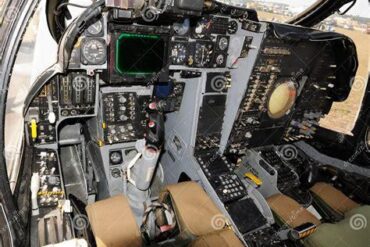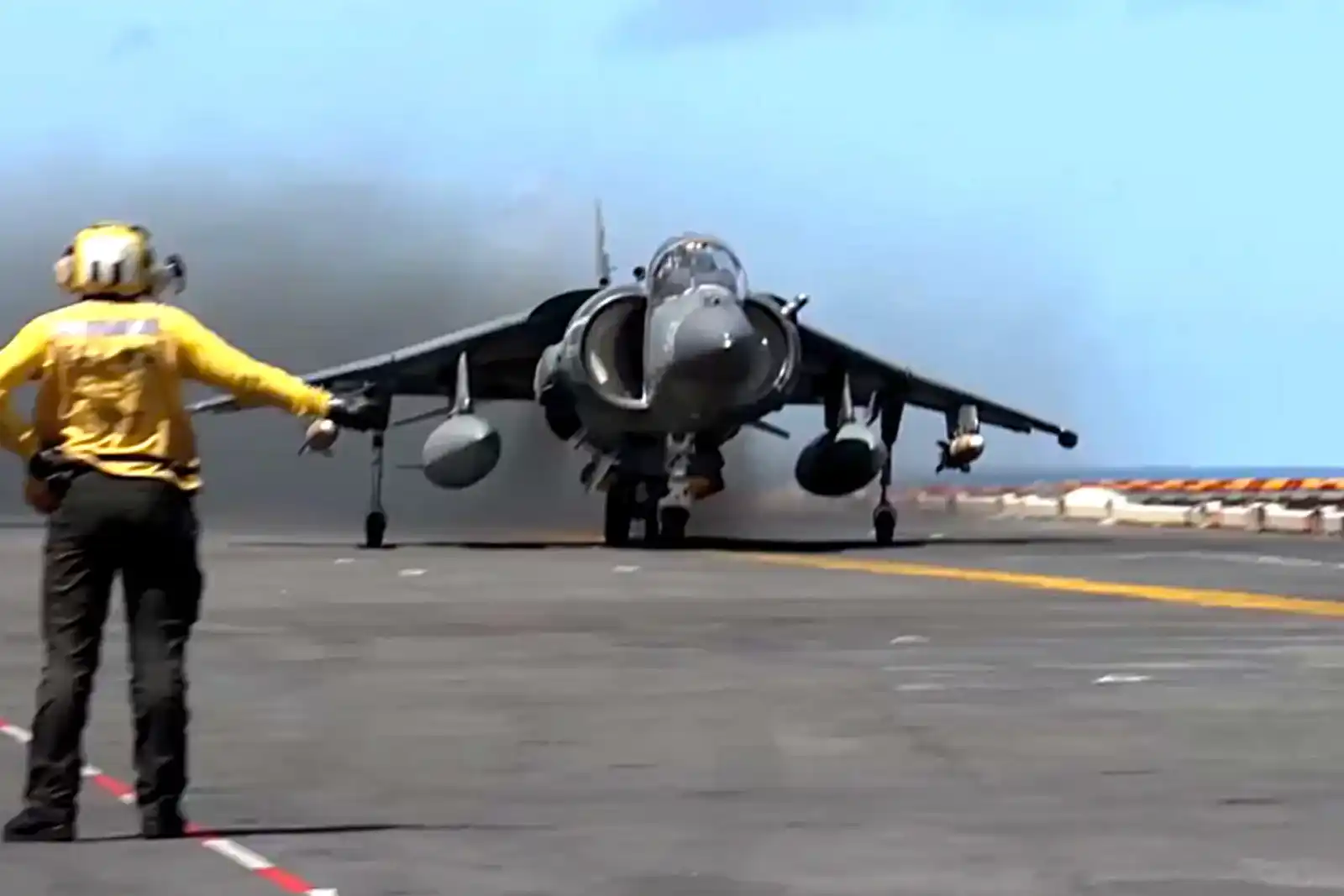
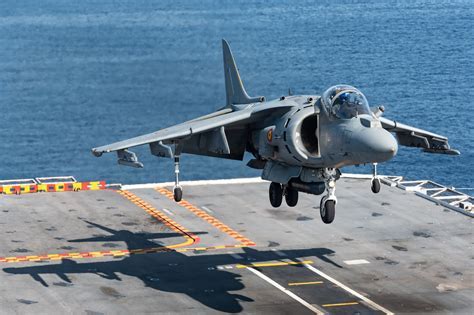
On November 18, 2025, U.S. Marine Corps AV-8B Harrier II jets from the 22nd Marine Expeditionary Unit (Special Operations Capable) soared from the deck of the USS Iwo Jima, thundering into the Caribbean skies as part of Operation Southern Spear. This striking demonstration, released by U.S. Southern Command, highlighted the operational synergy between manned strike platforms and the growing network of robotic and unmanned maritime systems now defining modern hybrid warfare.
AV-8B Harrier II: A Legacy Warhorse in a Transitional Era
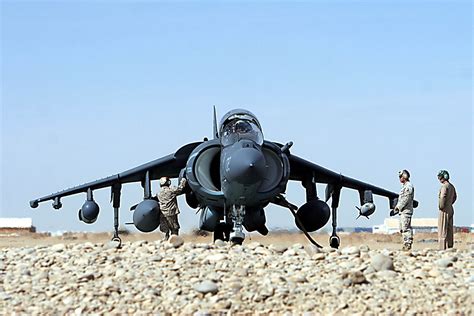
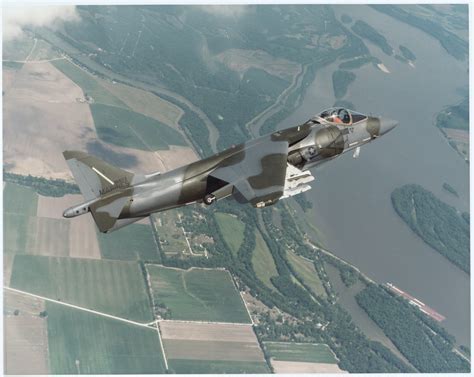
The AV-8B Harrier II, renowned for its Short Take-Off and Vertical Landing (STOVL) capability, has been a cornerstone of Marine aviation since the 1980s. Powered by a Rolls-Royce Pegasus turbofan, the Harrier’s unique vectored-thrust design allows it to operate in environments where traditional aircraft cannot, including from the decks of amphibious assault ships like the Iwo Jima and makeshift forward operating bases.
Armed with a 25 mm GAU-12/U Equalizer cannon, multiple wing hardpoints, and the ability to carry guided bombs, air-to-surface missiles, and precision rockets, the Harrier provides a flexible, fast-response strike platform. Despite nearing retirement, its integration with amphibious forces ensures it remains tactically relevant in complex operations like Southern Spear.
USS Iwo Jima: Amphibious Power Projection at Sea
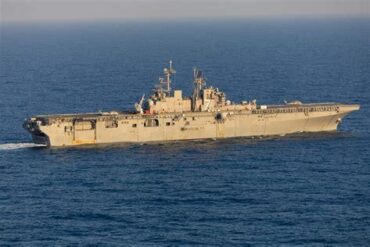
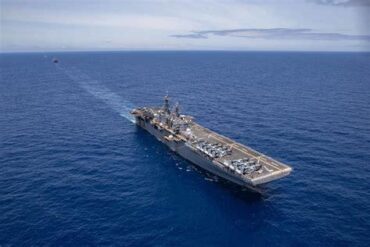
The USS Iwo Jima (LHD-7) serves as a floating fortress, designed to deploy a full Marine Expeditionary Unit (MEU) with an array of platforms—from rotary-wing helicopters and MV-22 Ospreys to landing craft and combat vehicles. These elements enable rapid troop insertion, shore bombardment, and direct air support, forming the backbone of U.S. expeditionary capability.
With the Harriers onboard, the Iwo Jima becomes a self-sustained strike platform, extending combat reach across maritime theaters. The ship’s deployment in Operation Southern Spear enhances the U.S. presence in the Caribbean, ensuring mobility and lethality even without reliance on land-based infrastructure.
Operation Southern Spear: Beyond Counter-Narcotics
Publicly framed as a counter-narcotics and maritime security campaign, Operation Southern Spear represents far more than interdiction. The Caribbean Sea, traditionally viewed as a transit zone for illicit trafficking, is increasingly becoming a strategic flashpoint. Cartels are expanding capabilities, using semi-submersibles, drones, and encrypted comms—tactics that blur the lines between organized crime and irregular warfare.
By integrating platforms like the AV-8B Harrier with uncrewed aerial systems (UAS), uncrewed surface vessels (USV), and intelligence networks, the U.S. creates a multi-domain shield and sword. While robotic platforms conduct persistent surveillance, track movement patterns, and relay actionable intel, the Harriers are tasked with surgical strikes on high-value targets at sea or in remote coastal zones.
Tactical Role of the Harrier in Hybrid Warfare
Unlike the stealthy, network-centric F-35B Lightning II—which is slowly assuming the STOVL mantle—the Harrier II remains fully embedded in traditional amphibious doctrine. It thrives in expeditionary contexts where reliability, simplicity, and battle-tested protocols matter more than cutting-edge stealth or full-spectrum ISR fusion.
While it lacks radar-absorbing design and advanced networking, the Harrier’s deck-cycle readiness, ability to take off from short or cluttered runways, and ease of maintenance make it an ideal asset for rapid deployments in high-heat operational zones. It is these qualities that shine in the Caribbean theater, where interdiction operations demand quick-turnaround sorties and flexible target engagement.
Strategic Signaling: Power Projection with Political Implications
Beyond tactical effectiveness, the presence of AV-8B Harrier sorties from the Iwo Jima in Caribbean waters sends a clear geopolitical message. This deployment—highly visible, publicly documented, and amplified across digital platforms—is designed to reinforce U.S. commitment to allies, deter non-state actors, and put pressure on regimes seen as complicit or indifferent to cartel activities.
For countries in the region, joint port visits and coordinated exercises serve to deepen interoperability, while simultaneously anchoring U.S. forces in strategic proximity. Yet, this intensified posture raises concerns. The frequent application of live-fire strikes, particularly in international waters or near sovereign zones, elicits debates over proportionality, civilian risk, and regional sovereignty.
A Transitioning Force: Harriers in the Age of Robotics
The participation of the AV-8B Harrier in Southern Spear illustrates the balancing act the Marine Corps now faces. The service is pivoting toward a future shaped by distributed operations, manned-unmanned teaming, and Littoral Operations in a Contested Environment (LOCE) doctrine. Yet, this evolution still relies on legacy platforms that offer proven performance in complex, gray-zone engagements.
As the Harrier winds down its storied career, continued upgrades ensure it remains lethal and responsive. Enhancements to targeting pods, electronic warfare suites, and weapon compatibility keep it mission-relevant in hybrid battlefields where state and non-state threats converge. It serves as a bridging platform—linking traditional amphibious warfare to a future dominated by AI, autonomy, and swarm dynamics.
Regional Dynamics: Reactions, Risks, and Realignment
U.S. efforts to assert control over Caribbean maritime domains are not occurring in a vacuum. Regional governments, though welcoming of U.S. support against trafficking, tread cautiously. The visible application of military force—especially from amphibious ships and vertical lift platforms—can be interpreted as a coercive projection that brushes against national sensitivities.
There’s also a diplomatic undertone to the Harrier operations. These drills illustrate how the U.S. Navy-Marine Corps team blends hard military power with strategic signaling. Washington seeks to establish dominance without occupation, using forward-deployed assets to shape adversary behavior and reassure partners, all while avoiding direct entanglement.
Looking Ahead: The Future of Amphibious Aviation
As the F-35B increasingly takes center stage in U.S. Marine aviation, the role of the AV-8B Harrier will gradually diminish. Yet, its continued deployment underscores that even as fifth-generation capabilities mature, fourth-generation platforms still provide unique value—particularly in politically sensitive, high-tempo maritime environments.
The USS Iwo Jima–Harrier duo represents a strategic hedge: dependable, combat-proven, and interoperable across coalitions. Its presence in Operation Southern Spear embodies a doctrine that combines mobility, lethality, and message projection. Even in the twilight of its service, the Harrier proves indispensable in shaping the battlespace—physically and psychologically.
Conclusion: Thunder in the Caribbean Skies
The roaring departure of AV-8B Harriers from the USS Iwo Jima is not simply a spectacle of military might. It is a signal, a strategy, and a synergy. It underscores a pivotal moment in U.S. military posture—where the old and the new converge in contested waters to enforce rules, secure lanes, and deny sanctuary to those who exploit maritime freedom for illicit gain.
In the Caribbean, where geostrategic calculations meet narco-violence, the Harrier continues to fly as a sentinel of order and an executor of American will. Its echo across the sea is not just the sound of jet turbines—it is the pulse of a force adapting to the future without forgetting the lessons of its past.