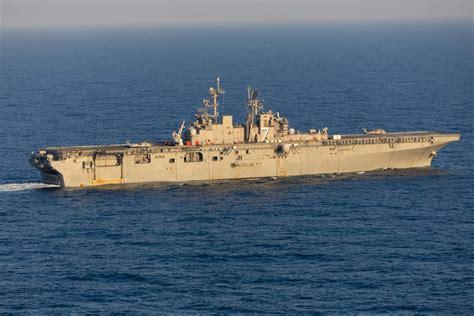
In a bold and high-stakes maneuver that has shaken international headlines, former Venezuelan leader Nicolas Maduro has been extracted and is now en route to New York City aboard the USS Iwo Jima, a formidable warship of the U.S. Navy. This operation marks a turning point in the years-long standoff between Maduro’s regime and the United States, and it casts the spotlight on one of America’s most powerful amphibious assault vessels.
USS Iwo Jima: A Legacy Forged in Battle
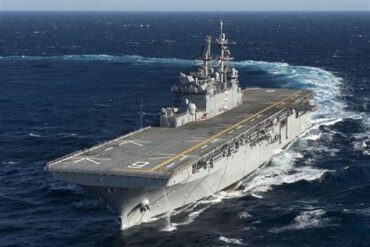
Named after one of the most iconic battles in World War II, the USS Iwo Jima (LHD-7) serves not just as a warship, but as a symbol of military might and American resolve. The Battle of Iwo Jima in 1945—immortalized by the photograph of U.S. Marines raising the flag atop Mount Suribachi—is reflected in every line and mission of this Wasp-class amphibious assault ship.
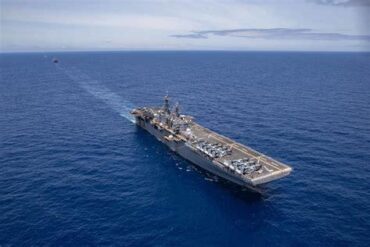
Commissioned in June 2001, the current Iwo Jima is the second U.S. Navy vessel to bear the name. At 844 feet long and displacing nearly 40,000 tons, she is a floating fortress designed to deploy Marines and launch full-scale air and sea operations with minimal notice. This makes her the perfect vessel for critical missions like the extraction of international fugitives such as Nicolas Maduro, who now faces federal charges in the United States.
A Floating Arsenal: The Ship’s Advanced Capabilities
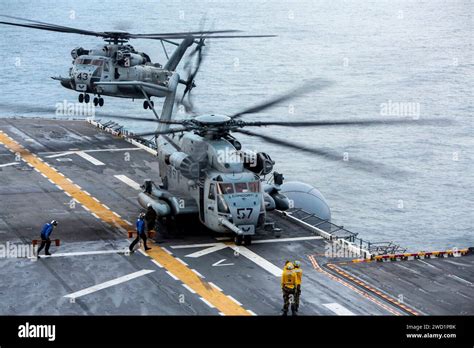
The USS Iwo Jima is far more than a transport ship. As a Wasp-class Landing Helicopter Dock (LHD), she carries a powerful blend of aviation assets and amphibious warfare technology. Her wide flight deck supports aircraft such as:
- MV-22B Ospreys – Tiltrotors that enable rapid troop deployment.
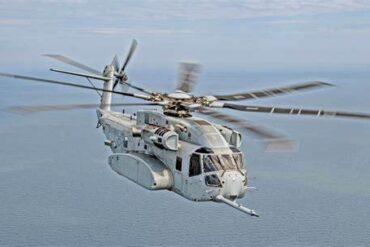
- CH-53E Super Stallion helicopters – For heavy-lift missions.
- AH-1Z Viper attack helicopters – Providing aerial firepower.
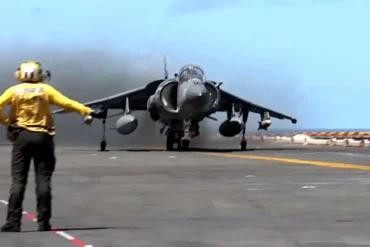
- AV-8B Harrier II+ jets – Equipped with AIM-120C-7 AMRAAM missiles, offering precision air-to-air capability.
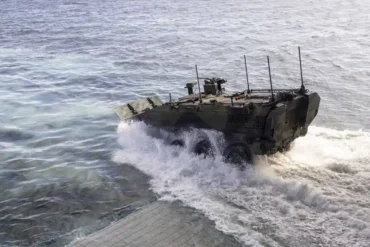
Her well deck below the flight deck can launch Landing Craft Air Cushion (LCAC) hovercraft and traditional landing boats to ferry Marines, armored vehicles, and critical supplies onto hostile shores. The embarked 22nd Marine Expeditionary Unit (MEU), consisting of around 2,000 Marines, ensures a flexible strike force for global operations.
The Strategic Deployment Near Venezuela
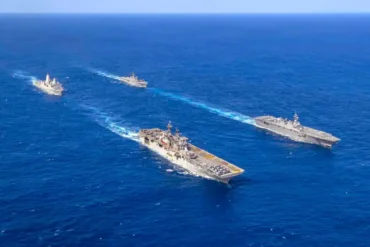
Since late summer 2025, the USS Iwo Jima has been participating in live-fire exercises, maritime patrols, and amphibious readiness drills in the Caribbean Sea. Satellite imagery and Navy reports confirm the ship’s proximity to Venezuelan waters in the months leading up to Maduro’s extraction.
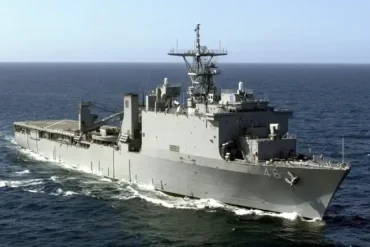
This isn’t a coincidental deployment. The positioning of the Iwo Jima and its Amphibious Ready Group (ARG)—including the USS San Antonio and USS Fort Lauderdale—reflects deliberate strategic planning. It also sends an unambiguous message about U.S. power projection in the Western Hemisphere.
Trump’s Statement and U.S. Intentions
In a revealing phone interview with Fox News, President Donald Trump confirmed Maduro’s capture. “They’re on a ship, but they’ll be heading into New York. The helicopters took them out,” Trump said, referring to the extraction process that placed Maduro and his wife aboard the Iwo Jima. Trump emphasized that Maduro had caused immense suffering: “They’ve killed a lot of people, remember that.”
He further clarified that Maduro was given several off-ramps to surrender, all of which he ignored. “You have to give up. You have to surrender,” Trump stated plainly. A photo posted on Trump’s Truth Social account showed Maduro handcuffed and blindfolded aboard the warship—an image symbolic of an authoritarian regime finally brought to heel.
Vice President Vance: ‘Justice Knows No Palace Walls’
U.S. Vice President JD Vance took a firm stance on the operation, noting that Maduro had refused all diplomatic solutions. “The president offered multiple off-ramps, but was very clear throughout this process: the drug trafficking must stop, and the stolen oil must be returned to the United States.”
Reiterating the legal basis of the mission, Vance declared, “You don’t get to avoid justice for drug trafficking in the United States because you live in a palace in Caracas.” This rhetoric underscores the administration’s zero-tolerance approach to international crimes and signals broader implications for other regimes under scrutiny.
Opposition Voices and the Winds of Political Change
The dramatic capture of Maduro also invigorated the Venezuelan opposition. Maria Corina Machado, Nobel Peace Prize laureate and a prominent voice against the Maduro regime, posted an emotionally charged message: “Venezuelans, the HOUR OF FREEDOM has arrived!”
Barred from the 2024 elections, Machado has remained a symbol of resistance and democratic aspirations. She called for national unity and the recognition of Gonzalez Urrutia as the new Commander-in-Chief of the National Armed Forces, urging the Venezuelan military to abandon the old regime.
Urrutia himself responded with equal urgency, stating, “These are decisive hours. Know that we are ready for the great operation of the reconstruction of our nation.” The implication is clear: Maduro’s arrest is not just a legal event but a transformative moment in Venezuela’s political evolution.
The Iwo Jima as a Symbol of Justice and Projection
The choice of the USS Iwo Jima as the vessel transporting Maduro to the U.S. is rich with symbolism. Built for war, humanitarian aid, and global intervention, the Iwo Jima embodies the flexibility of American naval power. It is equally capable of conducting large-scale military landings as it is in housing and transporting high-value detainees under maximum security.
In recent years, the ship has served in a range of missions—from aiding hurricane-struck Caribbean nations to counter-terror operations. Now, by ferrying Maduro into the U.S. judicial system, the Iwo Jima’s mission bridges the gap between military might and legal enforcement.
What Comes Next?
As the USS Iwo Jima sails northward with its high-profile detainee, a complex sequence of events is expected. Upon arrival, Maduro will be handed over to federal law enforcement in New York, where he faces drug trafficking, money laundering, and human rights abuse charges.
Political analysts anticipate renewed diplomatic tension across Latin America, while opposition leaders in Venezuela rally their base to initiate a democratic transition. The United States, for its part, appears committed to seeing this process through, leveraging both soft power and hard enforcement to reshape a region that has endured years of authoritarian rule.
Conclusion: A Turning Point at Sea
The transfer of Nicolas Maduro aboard the USS Iwo Jima is not just the story of a captured leader—it is a watershed moment in modern geopolitics. It brings together the legacies of historical battles, the might of contemporary U.S. military infrastructure, and the fragile aspirations of a nation yearning for freedom.
From the Caribbean waters to New York courtrooms, this operation is set to echo through history. The USS Iwo Jima once symbolized valor in war. Today, she stands as a vessel of justice, transition, and the resilience of democratic ideals.