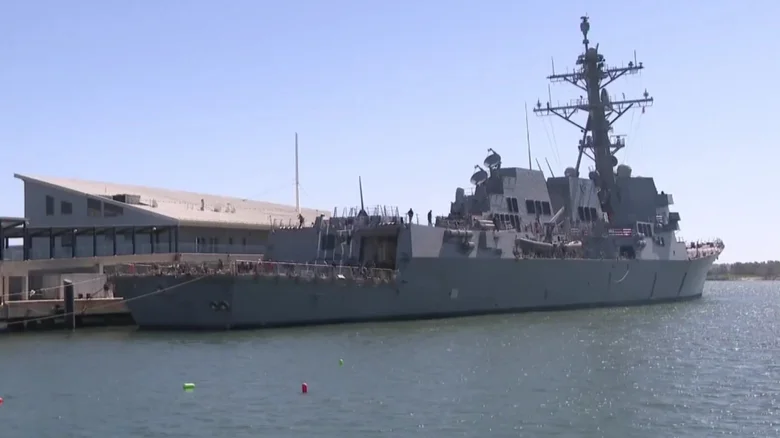
The USS Patrick Gallagher, the newest addition to the legendary Arleigh Burke-class destroyers, has entered a critical phase of sea trials, marking a decisive step toward operational deployment. Built by General Dynamics Bath Iron Works, this advanced warship embodies decades of naval engineering refinement, combining raw propulsion power with cutting-edge combat systems designed to dominate across surface, air, and subsurface domains.
As the vessel transitioned from construction to open water, it navigated the Kennebec River toward Portland Harbor, a symbolic passage from shipyard precision to real-world performance testing. There, a fresh crew boarded to initiate rigorous evaluations, ensuring every system performs flawlessly under operational stress. These trials are not ceremonial—they are unforgiving examinations where even minor inefficiencies are exposed.
At the heart of the destroyer lies a formidable propulsion system: four General Electric LM2500 gas turbines, collectively delivering an astonishing 100,000 horsepower. Supported by Rolls-Royce generators, this setup provides both speed and endurance, enabling rapid deployment across vast maritime theaters. The engineering challenge is not just power generation, but sustaining it reliably under combat conditions, where failure is not an option.
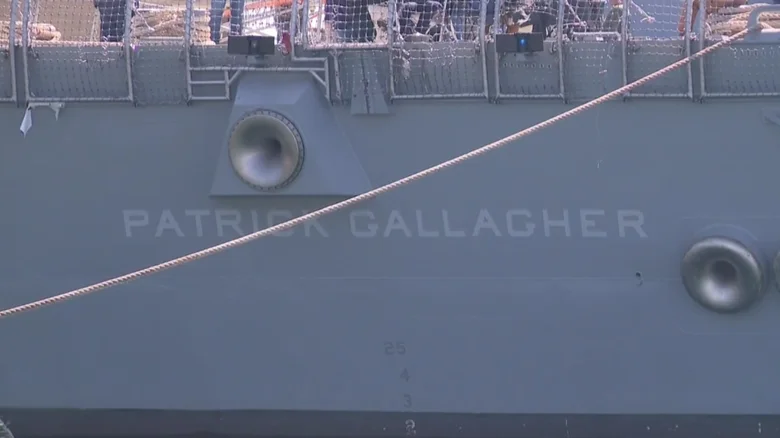
Builder’s Trials and Acceptance Trials: Proving Combat Readiness
Sea trials unfold in meticulously structured phases, beginning with Builder’s Trials, conducted by the shipbuilder. These tests focus on individual systems—propulsion, navigation, communications—and their integration under operational conditions. Engineers monitor everything from vibration tolerances to fuel efficiency, ensuring the destroyer meets its design benchmarks.
Following this comes the far more stringent Acceptance Trials, overseen by the U.S. Navy’s Board of Inspection and Survey (INSURV). This stage determines whether the vessel is fit for active service. The destroyer must demonstrate not only technical competence but also tactical responsiveness—maneuvering under simulated threat scenarios, executing precision navigation, and maintaining system stability under stress.
Even after commissioning, the process may extend into Final Contract Trials, underscoring the Navy’s uncompromising standards. This layered evaluation ensures that the USS Patrick Gallagher is not merely operational, but mission-ready in the most demanding environments.
A Weapons Platform Built for Multi-Domain Supremacy
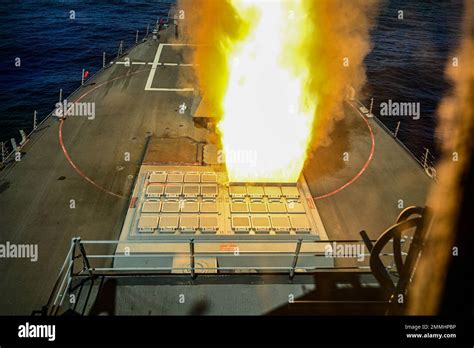
Beyond propulsion, the destroyer’s combat capabilities define its strategic value. Equipped with MK-46 torpedoes, Evolved Sea Sparrow Missiles (ESSM), and the Vertical Launch ASROC system, the vessel is engineered to neutralize threats across multiple vectors. Whether engaging hostile submarines, intercepting incoming missiles, or projecting force against surface targets, the ship operates as a versatile and lethal platform.
Central to its effectiveness is its integration within the broader Aegis Combat System, enabling real-time data sharing and coordinated defense operations. This networked capability transforms the destroyer from a standalone asset into a critical node within the Navy’s global strike architecture.
The Legacy Behind the Name: Honoring Patrick Gallagher
The destroyer carries a name steeped in valor. Corporal Patrick Gallagher, a U.S. Marine who served during the Vietnam War, was awarded the Navy Cross for extraordinary heroism. In a moment of selfless courage, he sacrificed his life by shielding fellow Marines from a grenade blast during an ambush near Cam Lo.
The ship’s christening on July 27, 2024, conducted by his sisters, infused the vessel with a deeply personal legacy. This connection between past sacrifice and present strength reinforces the Navy’s tradition of honoring გმ courage through its most powerful assets.
A Strategic Bridge: The Final Flight IIA Destroyer
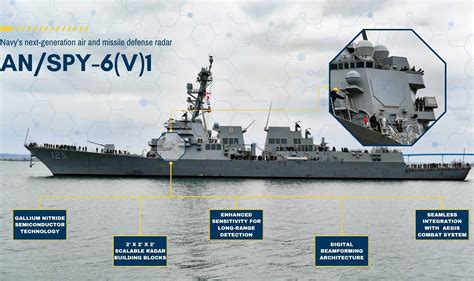
The USS Patrick Gallagher occupies a unique position in naval evolution as the final Flight IIA variant of the Arleigh Burke class. While the newer Flight III destroyers introduce the advanced AN/SPY-6(V)1 Air and Missile Defense Radar, the Navy continues to rely on upgraded Flight IIA ships to maintain fleet numbers and operational flexibility.
This hybrid approach reflects strategic pragmatism. The Patrick Gallagher incorporates select technological enhancements inspired by Flight III while retaining the proven reliability of the Flight IIA design. The result is a transitional warship—not obsolete, but optimized to bridge capability gaps during a period of rapid modernization.
Engineering Power Meets Strategic Necessity
The deployment of the USS Patrick Gallagher underscores a broader shift in naval warfare. Modern destroyers have effectively replaced battleships, not through sheer size, but through precision, adaptability, and networked power. With its 100,000 horsepower engines and integrated combat systems, this vessel exemplifies that transformation.
As sea trials continue, the destroyer is being pushed to its limits—testing not just machinery, but the very doctrine it represents. When it officially joins the fleet, it will do so not as an experiment, but as a fully realized instrument of maritime dominance, engineered for the complexities of modern conflict.