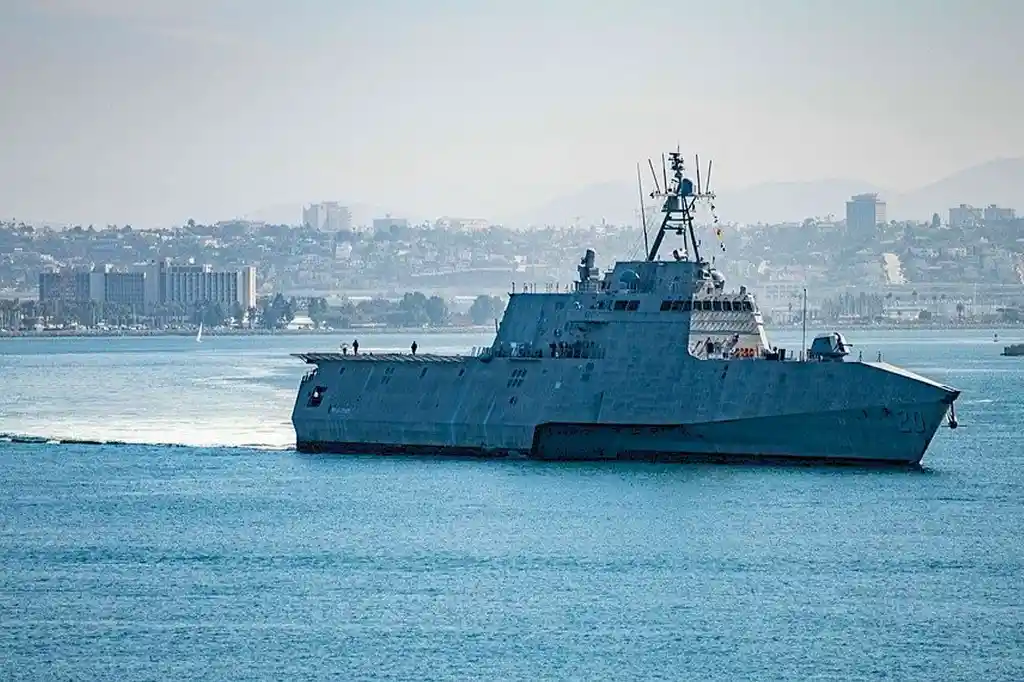
The U.S. Navy has quietly executed a move with outsized strategic implications by sending the Independence-class Littoral Combat Ship USS Cincinnati (LCS 20) to Cambodia’s Ream Naval Base on January 25, 2026. Officially described as a routine port visit by U.S. Indo-Pacific Command, the stop carries deeper meaning in a region where naval access, infrastructure investment, and symbolic presence increasingly define geopolitical alignment. At a time when Southeast Asia is navigating intensifying competition between Washington and Beijing, this visit signals a calculated naval recalibration rather than a simple diplomatic courtesy.
The arrival of USS Cincinnati marks the first time a U.S. Navy warship has docked at Ream, a facility that has drawn sustained international attention due to its Chinese-funded expansion. For years, analysts and regional observers have viewed Ream as a potential outpost of Beijing’s growing maritime influence, raising concerns about exclusive access arrangements and long-term strategic intent. Against that backdrop, a U.S. naval presence at the base disrupts prevailing assumptions and introduces a new layer of complexity into Cambodia’s external defense relationships.
Washington’s decision to send a Littoral Combat Ship rather than a larger surface combatant reflects both strategic intent and operational pragmatism. LCS platforms are designed for forward presence, rapid engagement, and access to shallow or constrained ports that are often off-limits to heavier warships. This makes them particularly well suited for diplomacy-by-presence in politically sensitive environments, where visibility matters but escalation does not.
Ream Naval Base and the Question of Strategic Access
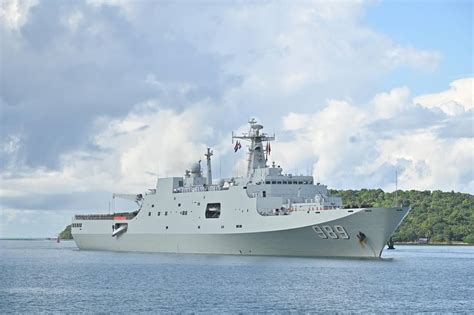
Ream Naval Base sits along Cambodia’s southern coastline on the Gulf of Thailand, offering direct maritime access to the South China Sea, one of the world’s most contested waterways. Over the past decade, the base has undergone significant upgrades, many of them supported by Chinese financing and construction expertise. These developments have fueled speculation that Ream could evolve into a quasi-permanent hub for the People’s Liberation Army Navy, despite repeated denials by Phnom Penh that any foreign military would receive exclusive rights.
The USS Cincinnati’s port call does not negate those concerns, but it complicates the narrative. A U.S. warship docking at Ream demonstrates that access to the facility is not, at least for now, singularly aligned with Beijing. For regional observers, this moment suggests that Cambodia is maintaining a degree of strategic flexibility, even as it deepens economic and political ties with China.
Why the Littoral Combat Ship Matters
The Independence-class Littoral Combat Ship represents a specific vision of modern naval warfare: fast, modular, and optimized for coastal operations. USS Cincinnati features an aluminum trimaran hull that delivers exceptional stability and maneuverability, particularly in near-shore environments common across Southeast Asia. With a top speed exceeding 40 knots, the ship can rapidly reposition across chokepoints, straits, and archipelagic waters.
Its combat systems include a 57mm Mk 110 main gun, Rolling Airframe Missiles (RAM) for close-in defense, and support for unmanned surface and aerial vehicles. These capabilities allow the vessel to transition between surface warfare, anti-submarine operations, and mine countermeasures, often within the same deployment cycle. In strategic terms, Cincinnati embodies the U.S. Navy’s preference for flexible presence platforms that can operate persistently without the political baggage of larger capital ships.
Commissioned in 2019, USS Cincinnati has already built a record of sustained Indo-Pacific operations, including joint exercises with regional partners and freedom-of-navigation patrols. Its appearance at Ream reinforces the message that U.S. engagement in Southeast Asia is operationally credible, not merely rhetorical.
Strategic Signaling Without Escalation
From Washington’s perspective, the port call represents a low-cost, high-impact signal. It neither confronts China directly nor ignores the reality of Beijing’s growing influence. Instead, it asserts that the United States retains access, relationships, and maneuvering room even in environments often assumed to be slipping from its reach.
For Southeast Asian states watching closely, the message is nuanced but clear. The United States is demonstrating that it can remain present without forcing regional actors into binary choices. This approach aligns with ASEAN preferences for strategic autonomy, where nations seek to balance major powers rather than align exclusively with one.
Implications for Regional Maritime Balance
The USS Cincinnati visit also speaks to a broader evolution in U.S. maritime posture. Rather than relying solely on large, headline-grabbing deployments, the Navy is increasingly emphasizing distributed presence—a network of smaller, more agile platforms operating across a wide geographic area. This model complicates adversary planning and reassures partners through consistent, visible engagement.
In the context of the South China Sea, where port access can quickly translate into operational advantage, even symbolic visits carry weight. The ability to dock, resupply, and engage diplomatically at facilities like Ream expands the U.S. Navy’s operational map and reduces the perception of contested spaces becoming closed spaces.
A Quiet Recalibration With Long-Term Consequences
USS Cincinnati’s port call at Ream Naval Base is unlikely to trigger immediate shifts in regional alliances, but its significance lies in what it normalizes. It normalizes U.S. presence in locations assumed to be drifting toward exclusive Chinese influence. It normalizes Cambodia’s engagement with multiple naval powers. And it normalizes a U.S. strategy that prioritizes adaptability over overt confrontation.
As the Indo-Pacific continues to emerge as the defining maritime theater of the 21st century, actions like this will matter as much as declarations or treaties. Naval competition in Southeast Asia is increasingly shaped by access, perception, and persistence. In that context, the quiet arrival of USS Cincinnati may prove to be a telling marker of how the United States intends to compete—deliberately, flexibly, and in plain sight.