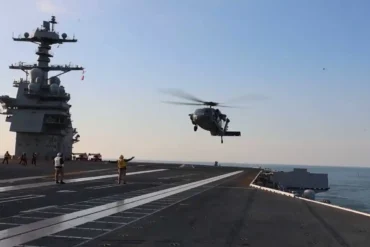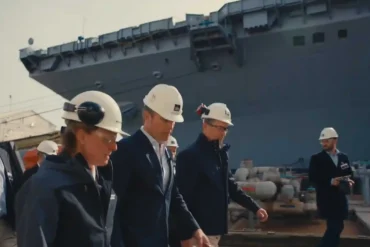
The departure of the USS John F. Kennedy (CVN-79) from Newport News in late January 2026 marked far more than a routine sailing. It signaled the transition of a long-delayed, intensely scrutinized warship from an industrial project into a living instrument of sea power. For the U.S. Navy and for Huntington Ingalls Industries, this moment represents validation, pressure, and renewed momentum rolled into a single wake stretching out into the Atlantic.
Built as the second Gerald R. Ford-class aircraft carrier, the Kennedy carries the expectations created by its groundbreaking predecessor while also bearing the burden of lessons learned the hard way. Sea trials are the first time those expectations collide with reality, where theory gives way to salt water, vibration, and unforgiving physics. This phase tests whether years of design refinements, manufacturing changes, and delayed decisions have finally aligned.
Unlike ceremonial milestones such as launch or christening, sea trials are brutally practical. Systems must function together, crews must respond instinctively, and the ship itself must behave as designed under real conditions. For a platform as complex as a nuclear-powered supercarrier, that first sustained encounter with the open ocean is a defining moment.
A Long-Awaited Departure from Newport News
The USS John F. Kennedy left the Newport News Shipbuilding facility on January 28, 2026, beginning a series of tests conducted before formal delivery to the U.S. Navy. These trials examine propulsion, navigation, electrical generation, radar performance, and ship handling, all while exposing the vessel to stresses impossible to simulate on land.
Todd Corillo of Huntington Ingalls Industries described the trials as the first opportunity to evaluate critical systems at sea, underscoring how much remains theoretical until this stage. For a ship originally expected to be delivered in 2022, the departure represents a psychological reset. The program has slipped through multiple revised schedules, with commissioning now projected for March 2027, and even that date remains vulnerable.
The Kennedy’s scale alone makes this milestone striking. At 1,092 feet long, displacing roughly 100,000 tons, and costing $13.2 billion, it joins the USS Gerald R. Ford as the most technologically advanced aircraft carriers ever built. Sea trials finally allow observers to judge whether that technological ambition translates into operational credibility.
Sea Trials as the Ultimate Reality Check
Sea trials exist for one reason: to reveal problems before the Navy takes ownership. Every vibration, software hiccup, or mechanical anomaly discovered now prevents exponentially higher costs later. For the Kennedy, this matters more than usual. The Ford class introduced revolutionary systems, including advanced arresting gear, electromagnetic aircraft launch systems, and redesigned internal layouts intended to reduce crew workload and lifetime operating costs.
These tests also evaluate how well design changes, made in response to issues aboard the USS Gerald R. Ford, have been implemented. The Navy and HII are keenly aware that early operational failures damaged confidence in the class. The Kennedy must demonstrate tangible improvement, not just incremental refinement, if the Ford program is to regain momentum.
Why the Kennedy’s Construction Took So Long
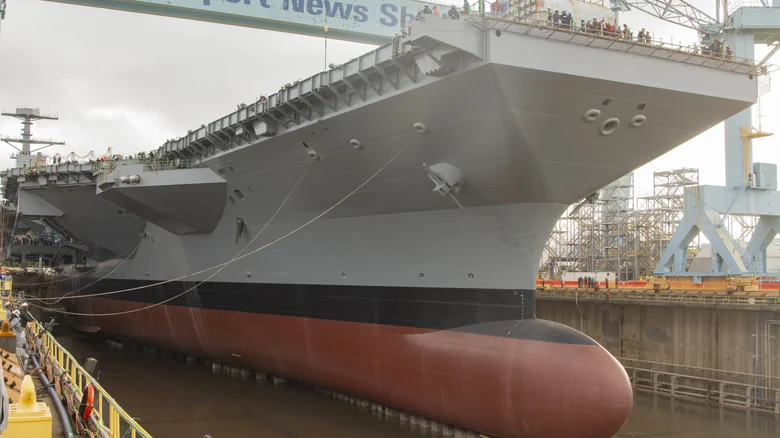
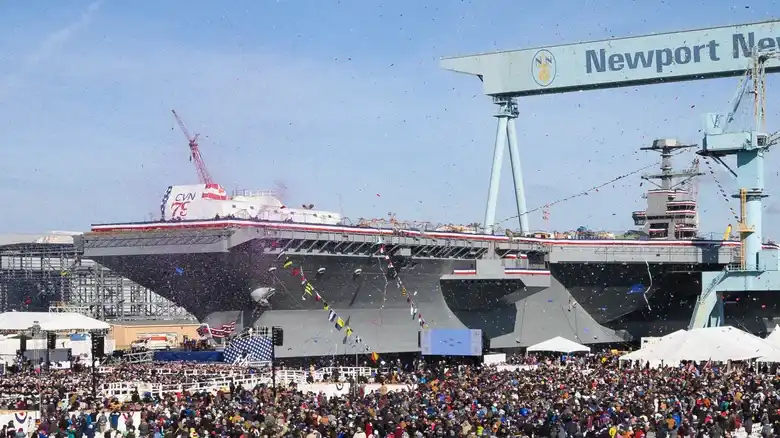
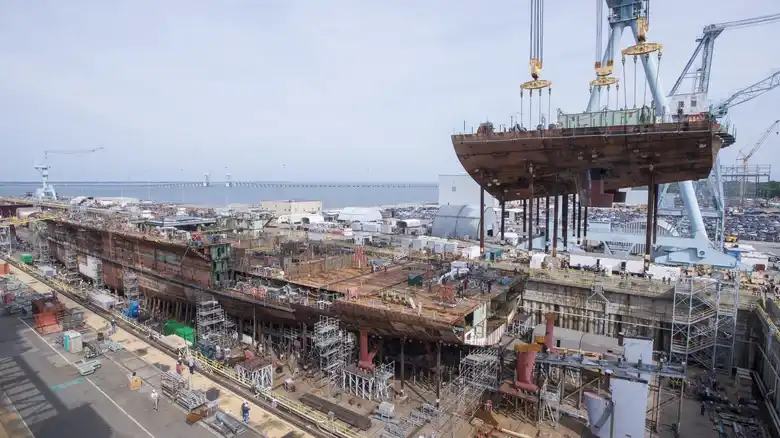
Although launched in October 2019 and christened two months later, the Kennedy spent years in an extended outfitting phase. The COVID-19 pandemic disrupted skilled labor availability, slowed supply chains, and forced workarounds that compounded inefficiencies. Yet the pandemic alone does not explain the scale of delay.
The deeper cause lies in complexity. The Ford class represents the first new aircraft carrier design since the Nimitz class, whose construction methods matured over three decades and ten hulls. In contrast, the Kennedy is effectively a refined prototype, incorporating changes while still wrestling with unresolved legacy issues.
Weapons elevators proved especially problematic, mirroring challenges that plagued the Ford. Manufacturing tolerances, installation sequencing, and late design improvements all contributed to delays. Some fixes arrived too late to be fully incorporated, forcing compromises that only sea trials can now validate.
Strategic Implications for the U.S. Navy
Delays ripple outward. Carrier availability is a finely balanced equation involving deployments, midlife refueling, and planned decommissionings. Each postponed commissioning compresses that schedule. Even if the Kennedy enters service in 2027, it will likely not be fully deployable until 2028, extending pressure on an already stretched carrier force.
For the Navy, the concern is not prestige but presence. Aircraft carriers remain central to U.S. power projection, deterrence, and alliance reassurance. Any gap in availability limits operational flexibility at a time when maritime competition is intensifying globally.
The Scale and Ambition of the Ford Class
The Ford class is designed to redefine what a carrier can do. Increased electrical generation supports future weapons and sensors, while automation reduces crew requirements. Over a projected fifty-year service life, these changes promise billions in savings, but only if they work as intended.
Understanding the Kennedy’s journey requires appreciating that ambition. The Nimitz class benefited from incremental evolution. The Ford class demands a leap. That leap inevitably carries risk, and the Kennedy’s sea trials are where that risk is finally measured against reality.
As the USS John F. Kennedy moves through successive trial phases, each successful test narrows the gap between promise and performance. The ship’s wake now carries more than water; it carries the credibility of an entire class and the future rhythm of U.S. carrier aviation.