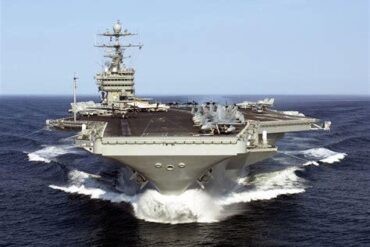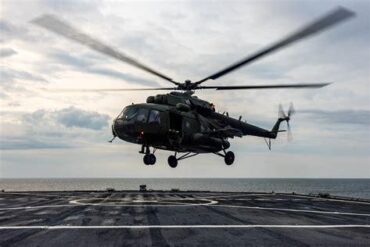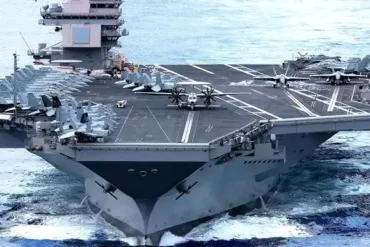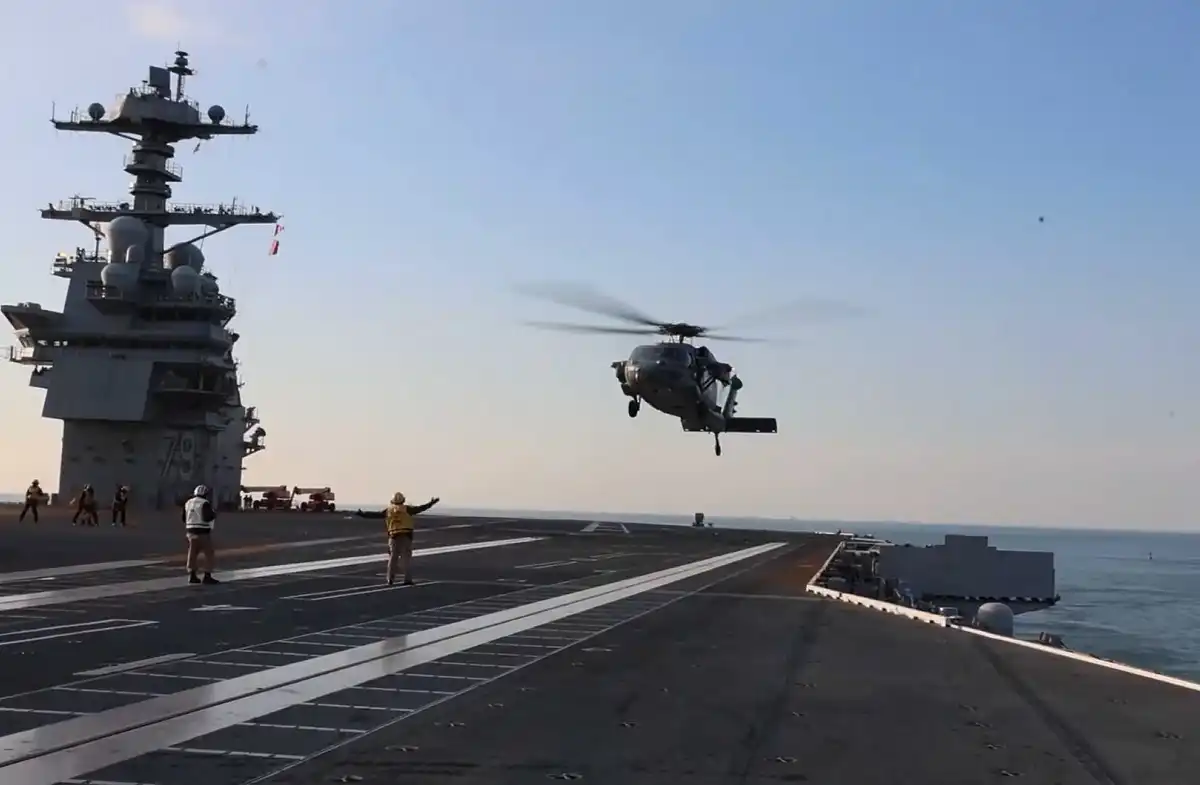
The future USS John F. Kennedy (CVN 79) has crossed a decisive threshold in its journey toward fleet service, achieving its first aircraft landing at sea during Builder’s Trials off the U.S. East Coast. On January 28, 2026, an MH-60S Knighthawk helicopter assigned to Helicopter Sea Combat Squadron 7 (HSC-7), known across naval aviation as the “Dusty Dogs,” successfully touched down on the carrier’s flight deck. The evolution marked the first operational validation of the second Ford-class supercarrier’s aviation systems outside the confines of the shipyard, transforming a construction milestone into a tangible operational achievement.
The landing occurred as Pre-Commissioning Unit John F. Kennedy underwent Builder’s Trials under the supervision of Huntington Ingalls Industries in coordination with the U.S. Navy. Traditionally, this phase evaluates propulsion, steering, auxiliary systems, and overall seaworthiness. Introducing live aviation operations into this demanding environment signals that CVN 79 is advancing beyond mechanical validation and entering the realm of integrated warship capability. A flight deck is not merely a surface for landings; it is the beating heart of a supercarrier’s combat power.
For naval aviation professionals, the first landing on a new carrier carries weight that extends far beyond symbolism. It confirms that deck lighting arrays, precision approach systems, communications links, fueling stations, aircraft securing points, and digital flight control networks function together as a cohesive ecosystem under open-ocean conditions. Unlike controlled pierside testing, sea-based validation introduces wind over deck, ship motion, and real-world environmental variables that stress every procedural and technical element simultaneously.
First Flight Deck Validation at Sea for CVN 79
Although helicopters do not require catapult launches or arrested recoveries, their operations still demand rigorous coordination. The MH-60S approach profile, deck handling procedures, and tie-down protocols exercise essential components of the carrier’s aviation architecture. The successful touchdown confirms that CVN 79’s redesigned island structure, repositioned further aft than on Nimitz-class carriers, integrates effectively with flight deck operations. This new geometry is engineered to optimize sortie flow and reduce congestion, a central promise of the Ford-class design.
Every evolution on a new carrier serves as a systems integration test. Deck crews, air traffic controllers, and shipboard command teams must operate within a tightly synchronized choreography. The January landing demonstrated that these elements function cohesively under operational tempo. In practical terms, it validates that the ship can safely host aviation assets at sea—a foundational requirement before more complex fixed-wing trials commence.
The MH-60S Knighthawk and the “Dusty Dogs”
The aircraft chosen for this milestone was the Sikorsky MH-60S Knighthawk, a versatile workhorse of the modern carrier strike group. Powered by twin General Electric T700-GE-401C turboshaft engines generating approximately 1,900 shaft horsepower each, the MH-60S can reach speeds near 180 knots. Its operational flexibility makes it indispensable, whether conducting search and rescue, vertical replenishment, Naval Special Warfare support, or armed escort missions.
HSC-7, based at Naval Station Norfolk, routinely deploys with Carrier Air Wing 3 and has long supported operations aboard USS Dwight D. Eisenhower (CVN 69). Their participation in CVN 79’s Builder’s Trials reflects the Navy’s reliance on experienced rotary-wing squadrons to validate new platforms. Helicopter crews are often the first to test the rhythm of a carrier’s flight deck, acting as pathfinders before high-performance jets enter the picture.
Advancing the Ford-Class Evolution
USS John F. Kennedy embodies the second iteration of the Ford-class aircraft carrier program, incorporating refinements informed by USS Gerald R. Ford (CVN 78). Lessons learned from early reliability challenges—particularly with the Electromagnetic Aircraft Launch System (EMALS) and Advanced Arresting Gear (AAG)—have shaped improvements in CVN 79’s design and integration. While the helicopter landing does not directly test catapult or arresting systems, it marks the beginning of progressive aviation certification that will ultimately culminate in fixed-wing flight operations.
The Ford-class departs significantly from its Nimitz-class predecessors. Its reconfigured flight deck, enhanced weapons handling systems, and advanced aircraft elevators are designed to increase sortie generation rates. More sorties mean more sustained combat power, a critical factor in high-intensity maritime conflict scenarios. Each incremental test builds confidence that these theoretical gains translate into operational reality.
Nuclear Power and Expanded Electrical Capacity
Beneath the flight deck, two Bechtel A1B nuclear reactors provide the immense power required for next-generation naval warfare. Compared to the A4W reactors of the Nimitz class, the A1B plants deliver substantially greater electrical output. This expanded capacity supports EMALS, advanced radar arrays, and future technologies such as directed-energy weapons. In a naval environment increasingly shaped by electronic warfare and precision strike systems, electrical power is strategic currency.
The Ford-class also integrates a higher degree of automation, enabling a reduced crew complement relative to previous carriers. Over a projected 50-year service life, this design choice is expected to generate significant lifecycle cost savings. Efficiency, in this context, is not merely economic—it enhances operational sustainability and manpower flexibility across the fleet.
Strategic Implications in a Contested Maritime Era
The timing of CVN 79’s milestone is notable. Global naval modernization efforts are accelerating, with peer competitors expanding submarine fleets, deploying advanced anti-ship missiles, and fielding new-generation aircraft. In this environment, aircraft carriers remain central to U.S. power projection strategy. The ability to deploy a fully operational Ford-class supercarrier reinforces deterrence and sustains the Navy’s global presence.
The first landing aboard John F. Kennedy may appear routine to casual observers, yet within naval circles it represents a declaration: the ship is transitioning from industrial project to operational instrument. As additional sea periods test propulsion systems, radar suites, and aircraft elevators, the integration of air operations will intensify. Fixed-wing trials with platforms such as the F-35C Lightning II and F/A-18E/F Super Hornet will eventually evaluate EMALS and AAG under combat-representative conditions.
For now, the image of the MH-60S Knighthawk settling onto Kennedy’s non-skid flight deck captures a moment of convergence between engineering ambition and operational reality. It is the instant when steel, circuitry, and nuclear propulsion coalesce into a functioning warship capable of launching and recovering aircraft in the open ocean.
USS John F. Kennedy moves steadily toward commissioning, and with each validated system, the promise of the Ford-class vision becomes more concrete. The January 28 landing did not simply mark the arrival of a helicopter; it signaled the emergence of America’s newest supercarrier as a credible and advancing component of twenty-first-century naval power.