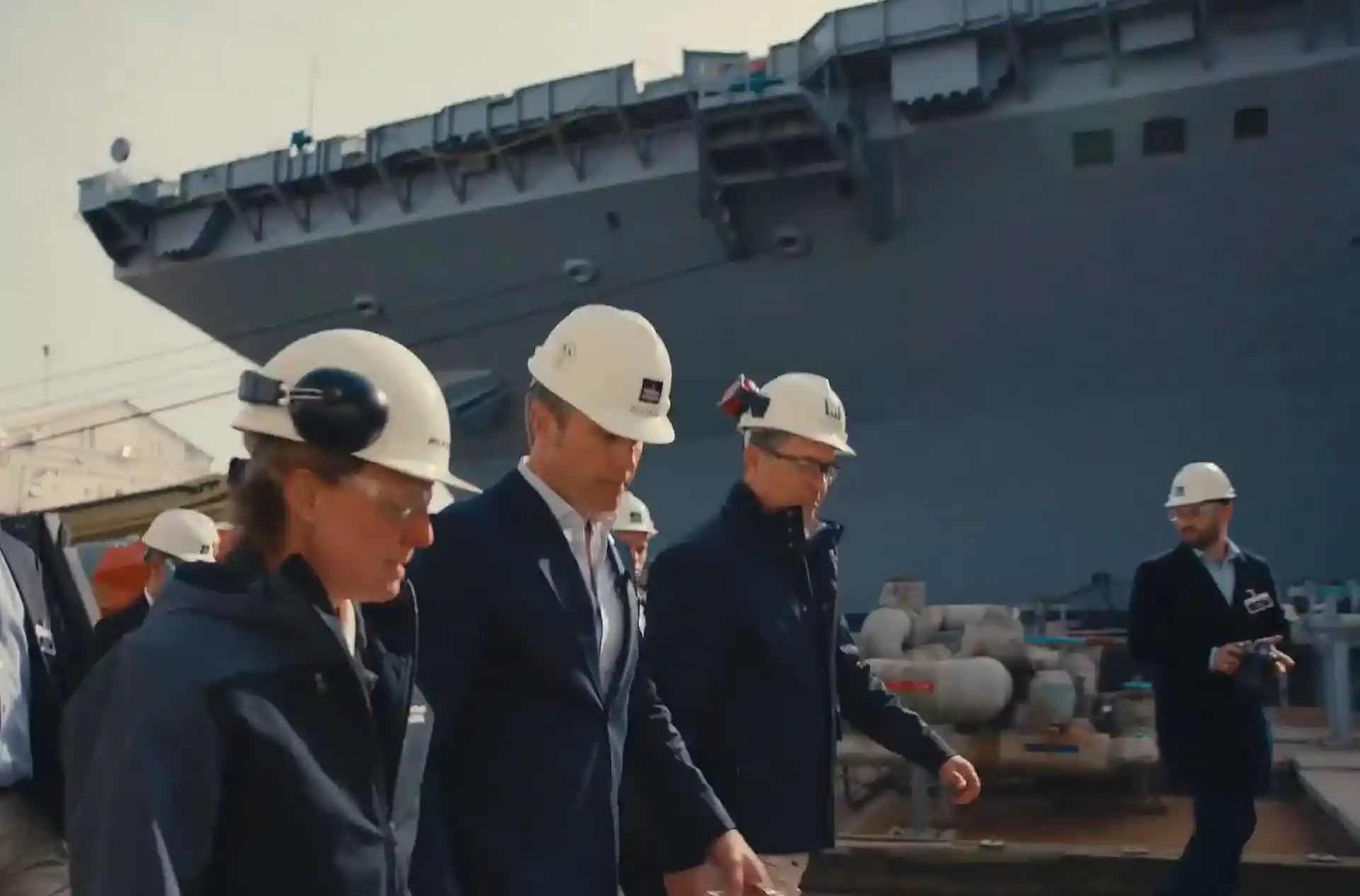
The United States Navy has officially accelerated the construction timeline of the USS John F. Kennedy (CVN-79), the second Ford-class aircraft carrier, as the lead ship of the class, USS Gerald R. Ford (CVN-78), enters real-world combat operations for the first time. The announcement, made during a high-profile visit by U.S. Secretary of War Pete Hegseth to Huntington Ingalls Industries on January 6, 2026, signals a major leap forward in carrier modernization and global force readiness.
Ford-Class Redefines Global Carrier Dominance
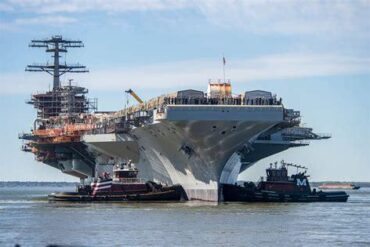
The Ford-class aircraft carrier program represents the most significant transformation in U.S. naval aviation since the 1970s. Designed as a generational leap from the Nimitz-class, the Ford-class incorporates advanced technologies to increase sortie rates, reduce maintenance requirements, and ensure adaptability to future threats.
Though similar in size to its predecessor — displacing around 100,000 tons and measuring 333 meters in length — the Ford-class features an entirely new internal architecture. Its Electromagnetic Aircraft Launch System (EMALS) and Advanced Arresting Gear (AAG) replace outdated steam catapults and hydraulic arrestors. These innovations enable smoother launches, quicker resets, and are fully compatible with both traditional and unmanned aircraft.
With the Ford-class, the U.S. Navy is no longer building ships to merely match past performance — it is building for the future battlespace, integrating next-gen platforms such as the F-35C, MQ-25 Stingray, and CMV-22B Osprey directly into its operating DNA.
USS Ford’s Combat Debut Signals Operational Maturity
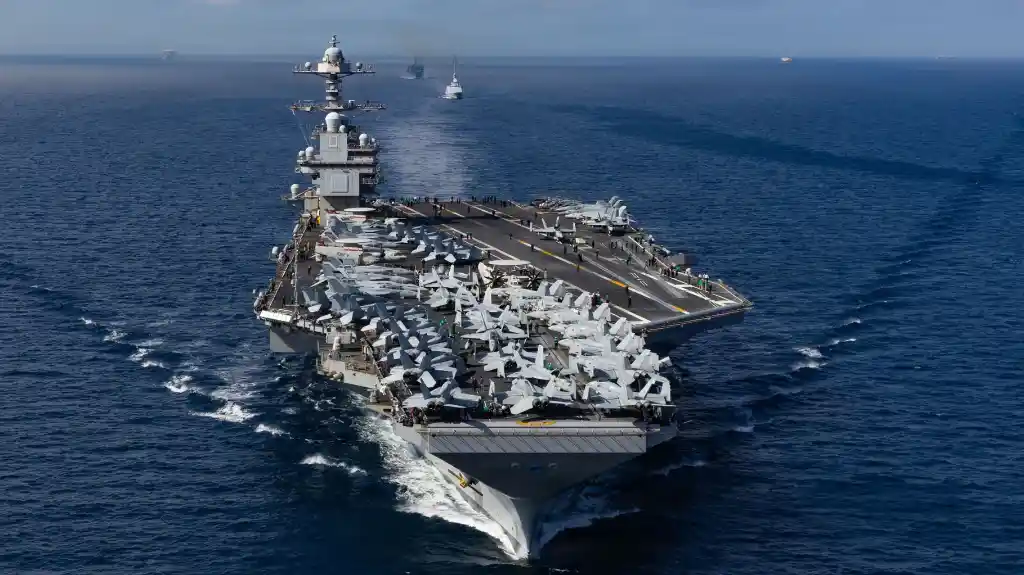
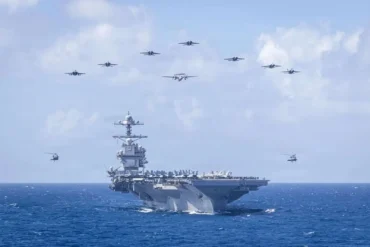
The urgency behind USS Kennedy’s accelerated schedule follows the historic combat deployment of USS Gerald R. Ford off the coast of Venezuela. Confirmed on January 3, 2026, the deployment marked the first operational use of a Ford-class carrier in a live conflict scenario. The carrier provided real-time Intelligence, Surveillance, and Reconnaissance (ISR), electronic warfare coordination, and strike readiness support to a U.S. Special Forces mission targeting hostile assets linked to Russian interests.
The Ford’s ability to integrate into joint operations while sustaining high-tempo flight operations validates years of design evolution and justifies the Pentagon’s increased confidence in the class. It also prompted a critical decision: fast-track the completion and commissioning of USS John F. Kennedy, now scheduled for March 2027.
Cutting-Edge Capabilities: Kennedy Builds on Ford’s Success
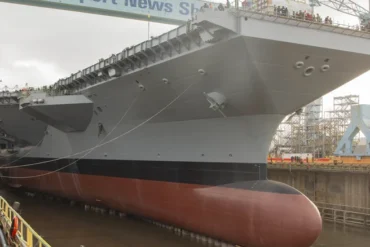
CVN-79, currently in the final outfitting phase at Newport News Shipbuilding, benefits from lessons learned during the Ford’s construction and early operations. This includes improvements in software integration, reliability of weapons elevators, and enhancements in crew workflow systems.
Key advancements include:
- Three advanced weapons elevators that operate with electromagnetic motors for faster, safer ordnance delivery.
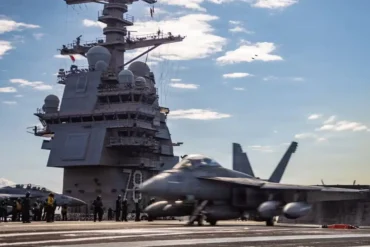
- Repositioned island structure to improve flight deck efficiency and aircraft movement.
- Modernized power plant using twin A1B nuclear reactors producing over 100 megawatts of electricity — over triple that of Nimitz-class ships.
- EMALS and AAG, which improve aircraft lifespan and reduce maintenance burdens.
These changes ensure the Kennedy will deploy with an air wing structured for tomorrow’s threat environment, supporting both manned and unmanned missions across contested maritime zones.
Air Wing Evolution: From Super Hornets to Autonomy
Unlike Nimitz-class carriers, which had to retrofit systems for unmanned operations, the Ford-class was designed from the keel up to accommodate next-generation aerial platforms. The USS John F. Kennedy will deploy with an upgraded composition, including:
- 44 F/A-18E/F Super Hornets (to be phased out for F-35C and NGAD platforms)
- 5 EA-18G Growlers for electronic warfare
- 4 E-2D Advanced Hawkeyes for airborne early warning
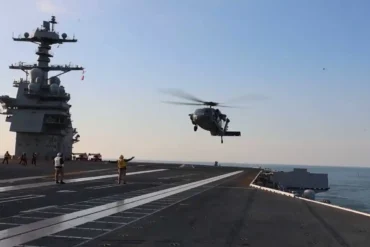
- 6 MH-60R/S Seahawks for ASW and logistics
- 4 MQ-25 Stingrays — game-changing unmanned refueling aircraft
- CMV-22B Osprey, replacing the aging C-2A Greyhound for carrier logistics
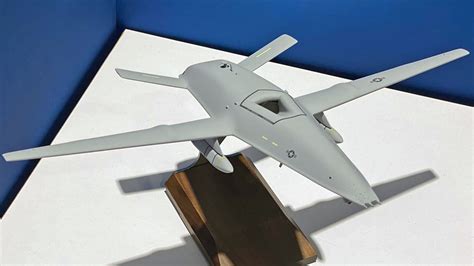
These enhancements extend the carrier’s reach, allowing the strike group to project power far beyond the range of manned fighters alone, with mid-air refueling dramatically increasing loiter and penetration times.
Global Context: Rivals Struggle to Match U.S. Capability
Globally, no other navy possesses a supercarrier on par with the Ford-class. China’s Type 003 Fujian, launched in 2022, represents Beijing’s closest effort to date. It features electromagnetic catapults but lacks nuclear propulsion and remains untested in operational settings.
Russia’s only carrier, the Admiral Kuznetsov, remains out of service and technologically dated. France’s Charles de Gaulle, while nuclear-powered and NATO-integrated, carries less than half the air wing and lacks the sortie generation capacity of a Ford-class vessel.
The Ford-class’s unmatched combination of power projection, survivability, nuclear endurance, and advanced aviation support ensures American carrier strike groups remain unchallenged in any theater.
Strategic Imperative: Forward-Deploying for Future Conflict
The Pentagon’s decision to accelerate Kennedy’s completion is not just logistical — it is strategic. In an era of rising maritime competition, especially in the Indo-Pacific, the ability to rapidly deploy advanced platforms is critical to deterrence and alliance assurance.
The Ford-class carriers are built to enable distributed maritime operations, empowering the U.S. Navy to operate across a wider battlespace, complicating enemy targeting and reinforcing the resilience of strike operations. Their modular systems and massive electrical output make them uniquely suited for future upgrades, including directed energy weapons, electromagnetic warfare systems, and next-gen radar arrays.
As CVN-80 (Enterprise) and CVN-81 (Doris Miller) progress through phased construction, and planning begins for CVN-82 and CVN-83, the Ford-class will increasingly form the backbone of American naval dominance well into the mid-21st century.
Conclusion: Kennedy’s Acceleration is a Signal to the World
The rapid advancement of the USS John F. Kennedy program sends a clear signal — the U.S. Navy is not resting on its legacy. The deployment of USS Ford into active combat marks a turning point for the Ford-class, transforming it from a futuristic promise into a battlefield asset.
By moving decisively to commission Kennedy, the Department of Defense ensures that America’s carrier strike groups remain at the cutting edge of air-sea combat, global presence, and deterrent capability. As adversaries scramble to expand their blue-water fleets, the U.S. has made its position clear: the future of naval warfare still belongs to those who can launch, recover, and sustain airpower — anytime, anywhere, with overwhelming superiority.