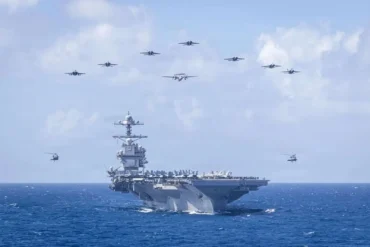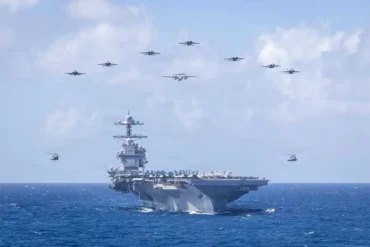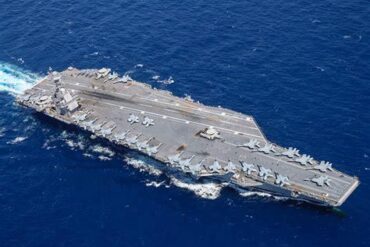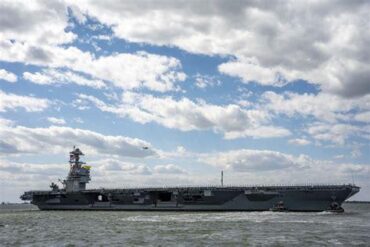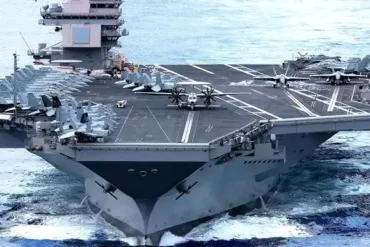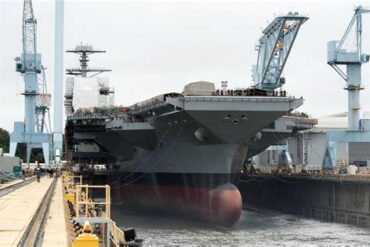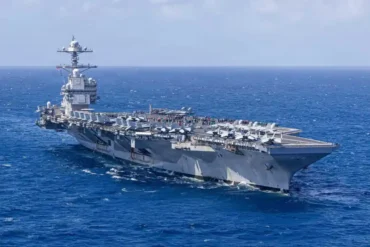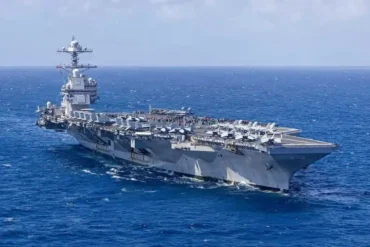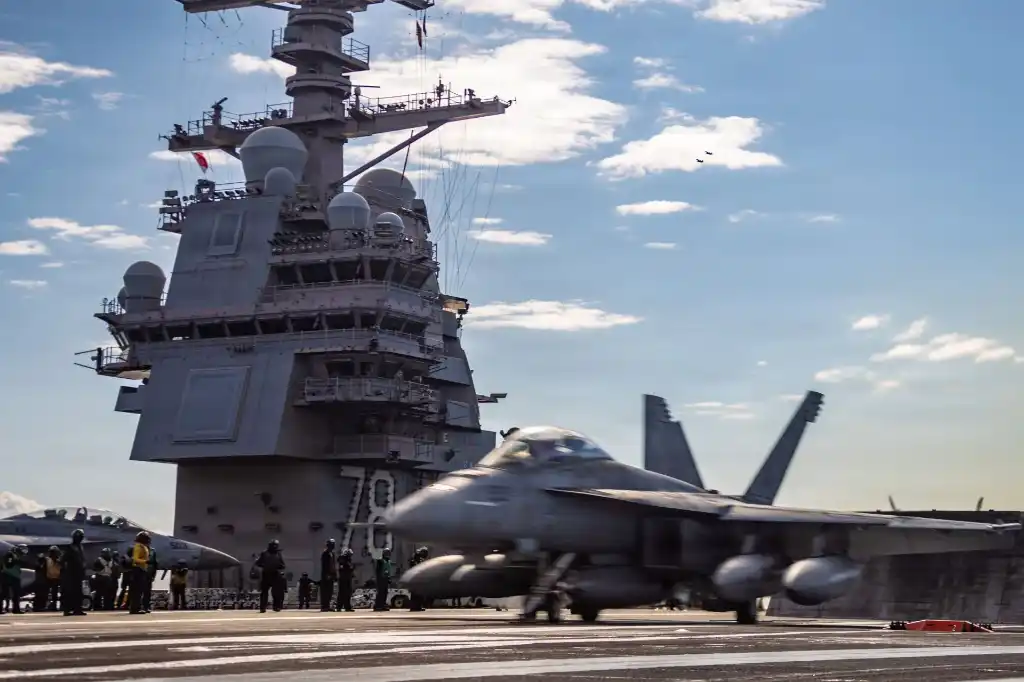
The United States has moved its most advanced aircraft carrier, USS Gerald R. Ford (CVN 78), into active combat operations in the Eastern Mediterranean, marking a significant escalation in military operations targeting Iranian infrastructure. Confirmed by U.S. Central Command (CENTCOM), the deployment places the Navy’s flagship Ford-class aircraft carrier at the center of Operation Epic Fury, a campaign designed to degrade Iranian missile, drone, and command-and-control capabilities across critical operational theaters.
Operating in international waters, the 100,000-ton nuclear-powered supercarrier has begun launching sustained strike missions, electronic warfare sorties, and airborne early warning patrols. This move significantly expands U.S. maritime airpower in the region while reducing reliance on fixed land bases that could be vulnerable to retaliation. The decision to commit the Navy’s most technologically advanced carrier signals Washington’s intent to maintain both strategic flexibility and overwhelming force projection amid intensifying U.S.–Iran tensions.
Unlike previous limited-response operations, the activation of USS Gerald R. Ford into live combat represents a high-tempo, integrated campaign combining naval aviation, cyber operations, long-range precision fires, and missile defense systems. The carrier’s presence introduces sustained sortie generation capacity capable of maintaining pressure on adversary networks over extended periods.
USS Gerald R. Ford (CVN 78), the world’s largest aircraft carrier, is in the fight with U.S. forces supporting Operation Epic Fury – launching aircraft from the Eastern Mediterranean Sea. pic.twitter.com/olehL4htW4
— U.S. Central Command (@CENTCOM) March 2, 2026
Operation Epic Fury and the Expansion of Maritime Strike Power
Operation Epic Fury integrates multi-domain warfare assets to disrupt and dismantle Iranian military infrastructure. According to defense officials, initial strike waves targeted air defense systems, missile launch facilities, and command nodes associated with coordinated drone and ballistic missile attacks. CENTCOM further reported that U.S. and allied forces successfully defended against hundreds of retaliatory Iranian projectiles, suffering no casualties and only minimal infrastructure damage.
The Eastern Mediterranean launch position offers operational depth. From this vantage point, carrier-based aircraft can project power across the Levant and adjacent maritime corridors while remaining mobile. Unlike land-based installations, which are fixed and targetable, a carrier strike group constantly shifts position, complicating adversary targeting calculations.
USS Gerald R. Ford’s combat role extends beyond simple strike delivery. Its embarked air wing conducts suppression of enemy air defenses, electronic attack operations, and persistent surveillance. These missions degrade Iranian radar coverage, disrupt missile guidance networks, and create corridors for follow-on precision strikes. The campaign demonstrates a layered operational strategy designed not merely to respond but to systematically erode Tehran’s strike architecture.
Technological Edge: Why the Ford-Class Carrier Matters
As the lead ship of its class, CVN 78 represents a generational leap over legacy Nimitz-class carriers. At its core is the Electromagnetic Aircraft Launch System (EMALS), replacing traditional steam catapults. EMALS allows smoother, more energy-efficient aircraft launches, reduces structural stress on airframes, and enables a higher sortie rate. In a high-intensity campaign involving repeated strike waves and defensive patrols, increased launch efficiency directly translates into greater operational tempo.
Complementing EMALS is the Advanced Arresting Gear (AAG), designed to recover aircraft with improved reliability and reduced maintenance demands. Together with a redesigned weapons handling system and enhanced flight deck layout, the Ford-class carrier can generate more sorties per day with fewer personnel.
Its advanced radar suite, including the Dual Band Radar system, enhances tracking and targeting capabilities in dense threat environments. In scenarios involving large-scale drone swarms and ballistic missile salvos, sensor fusion and rapid threat discrimination become decisive advantages. The carrier does not operate alone; it functions as the nucleus of a carrier strike group, supported by Aegis-equipped destroyers capable of ballistic missile defense and long-range strike missions.
Carrier Air Wing Capabilities in Active Combat
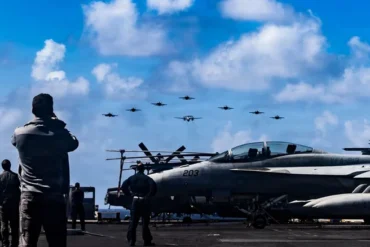
The embarked air wing provides a diversified combat toolkit. F/A-18E/F Super Hornets conduct precision strikes against fixed and mobile targets using guided munitions capable of penetrating hardened infrastructure. EA-18G Growlers perform electronic attack missions, jamming radar systems and suppressing enemy air defenses to ensure strike survivability.
Airborne early warning is provided by the E-2D Advanced Hawkeye, whose radar extends situational awareness hundreds of miles beyond the carrier’s horizon. This capability is essential in a conflict environment characterized by mass drone launches and missile retaliation. In configurations that include the F-35C Lightning II, stealth penetration missions add a further layer of survivability against heavily defended targets.
The result is a layered operational architecture. Strike fighters neutralize infrastructure, electronic warfare aircraft blind defenses, early warning platforms manage the air battle, and destroyers provide missile defense coverage. This integration reflects a modern doctrine emphasizing distributed yet synchronized combat effects.
Defensive Success Against Missile and Drone Retaliation
CENTCOM’s confirmation that U.S. forces successfully intercepted large volumes of Iranian missile and drone attacks underscores the scale of the confrontation. Ballistic missile defense systems aboard escorting destroyers, combined with carrier-based combat air patrols and land-based interceptors, formed a multilayered defensive umbrella.
The reported introduction of low-cost one-way attack drones by Task Force Scorpion Strike signals another evolution. Attritable systems—designed to be expendable—allow commanders to impose pressure without risking high-value platforms. This approach reflects a broader transformation in U.S. military doctrine toward distributed and scalable strike architectures.
The Gerald R. Ford’s presence amplifies this doctrine. Nuclear propulsion grants virtually unlimited operational endurance, freeing the strike group from refueling constraints and enabling sustained combat operations. Mobility and endurance together create strategic unpredictability, a key deterrent factor in maritime warfare.
Strategic Implications for U.S.–Iran Tensions
Deploying the Ford-class carrier into active combat carries strategic weight beyond tactical objectives. It demonstrates the United States’ capacity to escalate rapidly while maintaining maritime flexibility. By reducing reliance on regional bases potentially vulnerable to ballistic missile strikes, Washington reinforces a posture of resilience and adaptability.
Operation Epic Fury appears designed not only to respond to immediate provocations but to degrade Iran’s broader strike ecosystem. Targeting command structures and air defense networks reduces Tehran’s ability to coordinate mass attacks. The message conveyed is one of sustained deterrence backed by credible force.
For the U.S. Navy, the campaign serves as a real-world validation of decades of investment in next-generation carrier design. Debates over the future of large-deck carriers versus distributed unmanned systems continue within defense policy circles. The performance of USS Gerald R. Ford in high-intensity operations will inform those discussions for years to come.
A New Chapter in Maritime Power Projection
The entry of USS Gerald R. Ford into active combat operations marks a defining moment in contemporary naval warfare. It underscores that despite rapid advances in missile technology and unmanned systems, the nuclear-powered supercarrier remains a central instrument of American power projection.
Operation Epic Fury reflects an integrated, multi-domain campaign where maritime aviation, cyber capabilities, missile defense networks, and drone warfare converge. At the center of this architecture stands CVN 78, projecting sustained airpower from the sea with mobility, endurance, and technological sophistication unmatched by most global naval assets.
As tensions persist, the Eastern Mediterranean deployment highlights a core strategic reality: control of the seas continues to shape control of the skies and influence on land. In committing its most advanced carrier to active combat, the United States has signaled both resolve and capability, reinforcing the enduring relevance of carrier strike groups in modern high-intensity conflict.